Facts
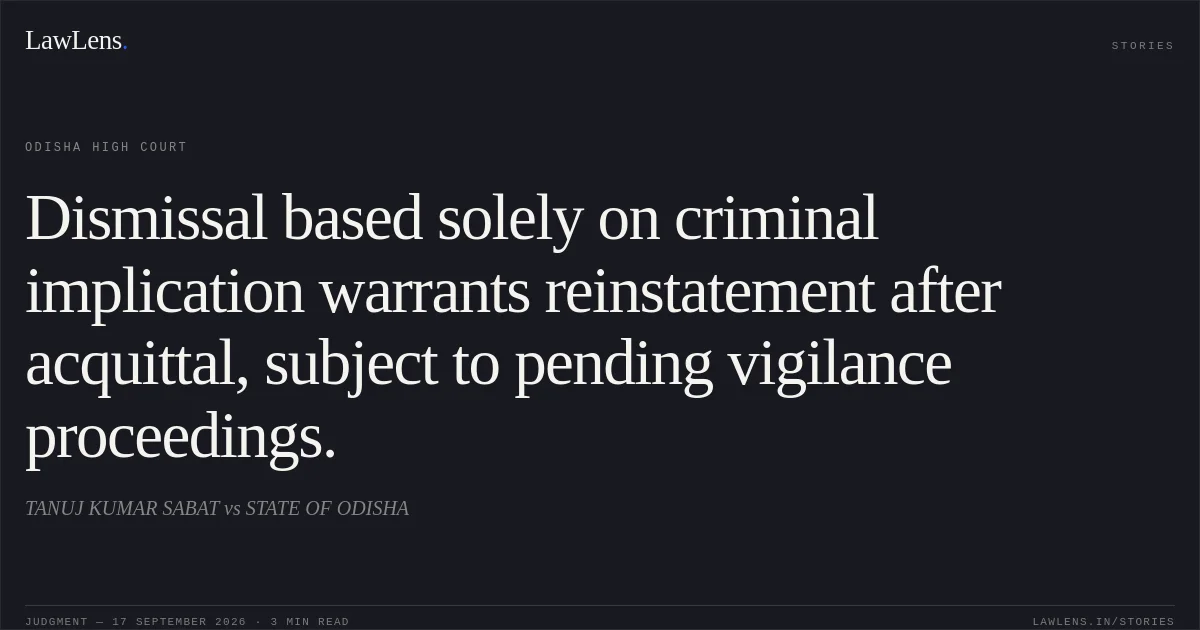
The petitioner was appointed as a Constable on 15 May 2004. After being implicated in Parlakhemundi P.S. Case No. 25 dated 25 January 2024 for offences under Sections 120-B and 394 of the IPC, he was suspended on 27 January 2024.
Source reference: p.2; para. 4He was thereafter dismissed on 9 February 2024 by invoking Article 311(2)(b) of the Constitution and Rule 18 of the Odisha Civil Services (Classification, Control and Appeal) Rules, 1962.
Source reference: pp.2–3; paras. 4.1, 7The petitioner was acquitted in the criminal case by the learned JMFC, Parlakhemundi, on 20 January 2026. The State did not challenge the acquittal.
Source reference: p.8; para. 7.1The petitioner consequently appealed against the dismissal and sought reinstatement, but the appeal was rejected on 19 June 2026, principally on the ground that his involvement was supported by CCTV footage.
Source reference: p.9; para. 7.1The State opposed reinstatement, contending that the petitioner had also been charge-sheeted in a Vigilance P.S. Case No. 57 dated 30 December 2018 under the Prevention of Corruption Act and that the departmental action was justified notwithstanding his acquittal in the subsequent criminal case.
Source reference: pp.6–7; paras. 5.2–5.4Issues
1. Whether the petitioner’s dismissal under Article 311(2)(b) of the Constitution read with Rule 18 of the OCS (CCA) Rules could be sustained after his acquittal in the criminal case which formed the basis of the dismissal?
Source reference: pp.8–9; paras. 7.1–7.22. Whether the petitioner was entitled to reinstatement and notional regularisation of the intervening period, notwithstanding the pending Vigilance proceeding?
Source reference: pp.4–6, 9–10; paras. 4.3–4.6, 7.2–7.33. Whether the existence of a separate pending Vigilance case justified denial of reinstatement?
Source reference: pp.6–10; paras. 5.2–5.3, 7.2–7.3Law Applied
The Court applied Article 311(2)(b) of the Constitution and Rule 18 of the Odisha Civil Services (Classification, Control and Appeal) Rules, 1962, governing dismissal without a regular departmental inquiry in circumstances where such inquiry is considered impracticable.
Source reference: pp.2–3; paras. 4.1, 7It relied on Ram Lal v. State of Rajasthan & Others, Civil Appeal No. 7935 of 2023, for the principle that an acquittal does not automatically invalidate disciplinary action, but where the criminal and departmental charges, evidence, witnesses and circumstances are identical or substantially similar, sustaining the disciplinary finding may become unjust, unfair and oppressive.
Source reference: p.4; para. 4.4The Court further relied on Maharana Pratap Singh v. State of Bihar, Civil Appeal No. 5497 of 2025, which reaffirmed that the substance of the acquittal must be examined rather than merely the expressions “benefit of doubt” or “honourably acquitted”.
Source reference: pp.4–5; para. 4.5It also followed Bansidhar Bariki, W.A. No. 589 of 2025, where departmental action based on the same evidence rejected by the criminal court was treated as founded on no evidence.
Source reference: pp.5–6; para. 4.6Accordingly, acquittal is not an automatic ground for reinstatement, but reinstatement may be ordered where the disciplinary action is substantially founded on the criminal accusation and its evidentiary basis has failed.
Source reference: no citationReasoning
The Court found that the petitioner’s dismissal was directly connected with his implication in Parlakhemundi P.S. Case No. 25 of 2024 and that no separate effective action had been taken against him after the earlier Vigilance charge-sheet.
Source reference: p.9; para. 7.2The criminal case ended in the petitioner’s acquittal, and the State did not appeal against that decision.
Source reference: p.8; para. 7.1Although the appellate authority relied on CCTV footage to maintain the dismissal, the Court held that the dismissal could not continue merely on the basis of the criminal implication once the criminal proceeding had culminated in acquittal.
Source reference: no citationApplying Ram Lal, Maharana Pratap Singh and Bansidhar Bariki, the Court treated the continued operation of the dismissal as unjust and unsustainable in the circumstances.
Source reference: pp.4–6, 9; paras. 4.4–4.6, 7.1–7.2However, because the petitioner remained involved in a separate Vigilance proceeding, the Court made reinstatement conditional upon its final outcome and upon the petitioner not becoming involved in any further criminal proceeding.
Source reference: pp.9–10; para. 7.3Holding
The High Court allowed the writ petition by quashing the dismissal order dated 9 February 2024 and the appellate order dated 19 June 2026.
It directed the competent authority to reinstate the petitioner in service and to regularise the intervening break period on a notional basis.
Source reference: pp.9–10; para. 7.3The reinstatement was expressly made subject to the final outcome of the pending Vigilance proceeding, and the order stipulated that involvement in any further criminal proceeding would entail cancellation of the reinstatement benefit.
Source reference: p.10; para. 7.3The writ petition was accordingly disposed of.
Source reference: p.10; para. 8Acts & Sections Cited
1 provisions across 1 statute referred to in this judgment. Each provision opens on LawLens.
Indian Penal Code, 18601
Original Court PDF
TANUJ KUMAR SABATvsSTATE OF ODISHA
Click to open original judgment
Original judgment, available to read, download and summarize on LawLens.in