Facts
The petitioner, a Warder posted at Central Jail, Buxar and functioning as Dafa In-charge of the North Cycle, was on duty when five prisoners escaped from Ward No. 29 during the intervening night of 30–31 December 2016.
Source reference: p.2, para. 3He was alleged to have failed to notice the breaking of the window/wall and thereby facilitated the escape through negligence and dereliction of duty.
Source reference: p.2, para. 3He was suspended on 31 December 2016, and departmental and administrative reports were prepared concerning the incident.
Source reference: p.2–3, para. 4A charge memorandum was issued, followed by appointment of an Enquiry Officer and Presenting Officer; the Enquiry Officer submitted his report, after which a second show-cause notice was issued.
Source reference: p.3–4, paras. 5–6The Inspector General, Prison and Correctional Services, Bihar dismissed the petitioner from service by Memo No. 468 dated 19 January 2018, and his appeal was rejected by Memo No. 3992 dated 14 June 2018.
Source reference: p.4, para. 7Issues
Whether the departmental enquiry and findings were sustainable when the material charges were not proved through admissible evidence and relevant witnesses were not examined?
Source reference: p.7, para. 13(i)Whether the Enquiry Officer acted within the limits of his jurisdiction and in accordance with the prescribed procedure under Rule 17 of the Bihar Government Servants (CCA) Rules, 2005?
Source reference: p.7, para. 13(ii)Whether the disciplinary and appellate authorities properly considered the petitioner’s defence and recorded adequate reasons?
Source reference: p.7, para. 13(iii)Whether the punishment of dismissal from service could be sustained on the facts and material available on record?
Source reference: p.7, para. 13(iv)Law Applied
Rule 17(4) of the Bihar Government Servants (Classification, Control & Appeal) Rules, 2005 requires the charge memorandum to be accompanied by a definite statement of imputations, a list of documents and a list of witnesses by whom each charge is proposed to be proved.
Source reference: p.12–13, paras. 18–19Rule 17(14) requires the department to produce its oral and documentary evidence during the enquiry, with witnesses being examined and made available for cross-examination.
Source reference: p.13–14, para. 19In Ranjan Kumar v. State of Bihar, the Court stressed that charges must be proved through the evidence prescribed under Rule 17 and that a finding cannot rest merely on presumptions or unproved documents.
Source reference: p.8–11, paras. 15–16Roop Singh Negi v. Punjab National Bank, (2009) 2 SCC 570, establishes that a departmental enquiry is quasi-judicial, that documents and reports must be proved through legally sustainable material, and that suspicion or ipse dixit cannot substitute for evidence.
Source reference: p.14–16, paras. 21–22State of U.P. v. Saroj Kumar Sinha, (2010) 2 SCC 772, requires the Enquiry Officer to act as an independent adjudicator and examine whether the departmental evidence proves the charge.
Source reference: p.17–18, para. 22The applicable standard is preponderance of probabilities, but that standard must still be based on relevant and admissible material.
Source reference: p.22–23, para. 34Reasoning
The Court found that the department had not demonstrated that material witnesses, including officers connected with the investigation and the relied-upon reports, were examined and subjected to cross-examination.
Source reference: p.19–20, paras. 25–27The charge concerned the petitioner’s specific failure to discharge his warder duties and the alleged causal connection between that failure and the prisoners’ escape; the mere fact that an escape occurred did not establish individual misconduct.
Source reference: p.19–20, paras. 25–27The reports relied upon by the department themselves disclosed broader deficiencies in lighting and security arrangements, weakening the inference that the petitioner’s individual negligence caused or facilitated the escape.
Source reference: p.20, para. 27The Enquiry Officer’s reliance on Rule 870(ii) was also not adequately connected to the petitioner’s duties, while the disciplinary authority referred to Rule 830(ii); the respondents failed to establish how the relevant rule was applicable or how its ingredients were proved against the petitioner.
Source reference: p.20–21, paras. 28–30The Court held that the enquiry effectively relied on unproved reports, assumptions and the petitioner’s failure to establish his innocence, contrary to the principle that the burden of proving misconduct remains on the department.
Source reference: p.21–22, para. 31The punishment order did not meaningfully address the petitioner’s defence regarding jail conditions, lighting, shortage of guards and his performance of rounds, and the appellate authority merely affirmed the punishment without adequately dealing with the grounds raised in appeal.
Source reference: p.22, para. 32–33Holding
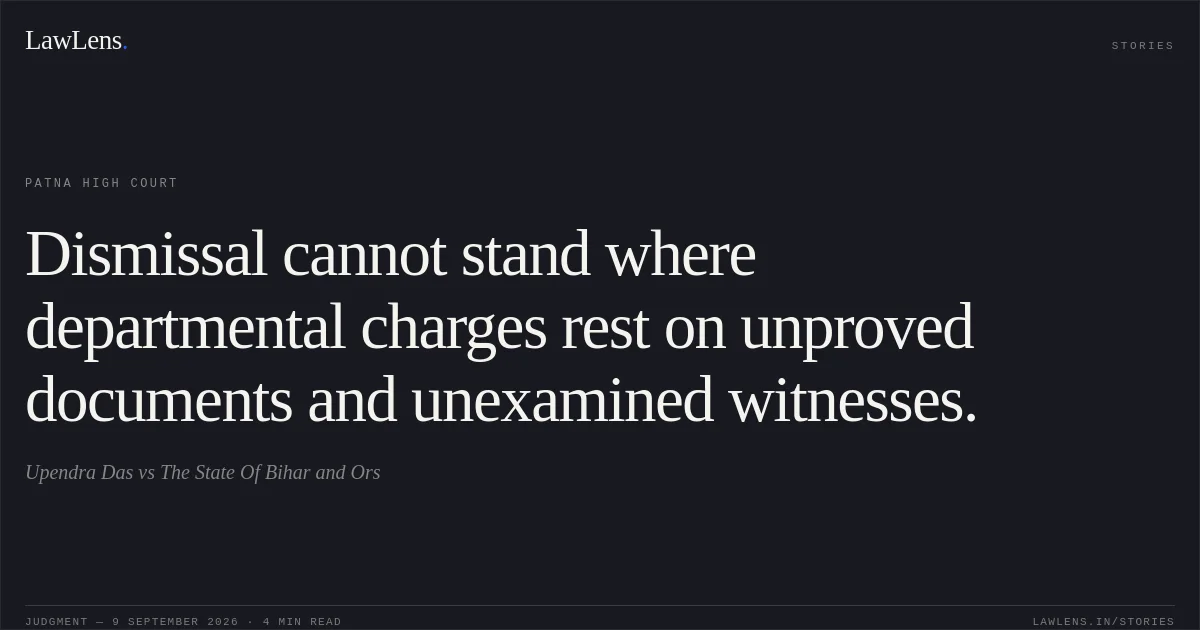
The Court held that the finding of guilt was legally unsustainable because the department failed to produce and examine material evidence establishing the petitioner’s specific dereliction, relied substantially on unproved reports and inferences, and failed to consider his defence through reasoned orders.
The dismissal order dated 19 January 2018 and appellate order dated 14 June 2018 were quashed and set aside.
Source reference: p.23, para. 36The departmental proceeding and enquiry report, insofar as they culminated in the impugned punishment on the identified procedural and evidentiary defects, were also set aside.
Source reference: p.23, para. 36The respondents were directed to take consequential steps, including reinstatement and consideration of the intervening period in accordance with the applicable service rules, within three months of receipt or production of the judgment.
Source reference: p.24, para. 37The writ petition was allowed without any order as to costs.
Source reference: p.24, paras. 38–39Original Court PDF
Upendra DasvsThe State Of Bihar and Ors
Click to open original judgment
Original judgment, available to read, download and summarize on LawLens.in