Facts
The petitioner’s complaint led to registration of an FIR in 2019.
Source reference: para. 2–3After the police filed a referred charge-sheet report, the petitioner’s protest petition resulted in a direction for further investigation; a further RCS report was then filed.
Source reference: para. 2–3The petitioner challenged that report by filing Crl.M.P. No. 2480 of 2025.
Source reference: para. 2–3The Magistrate treated the protest petition as a private complaint and directed proceedings under Section 223 of the BNSS, including examination of the complainant on oath.
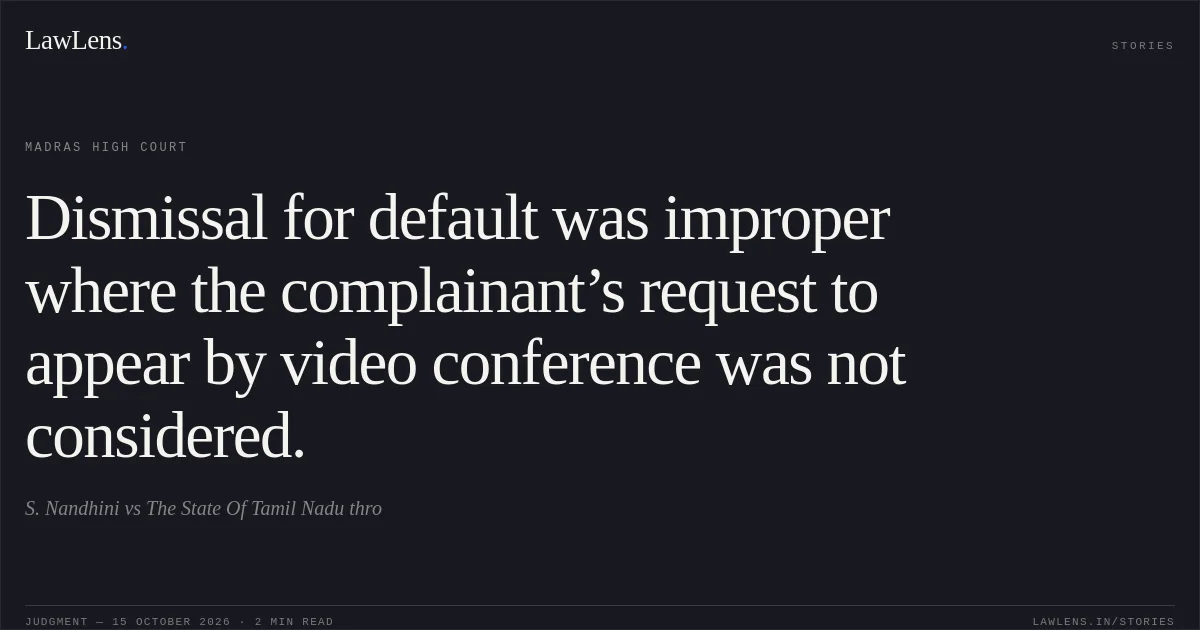
Source reference: para. 2–3After the petitioner did not appear on the scheduled dates, and her request to appear by video conference was returned, the Magistrate dismissed the complaint for default on 31 December 2025.
Source reference: para. 3–4The petitioner challenged that order under Section 528 of the BNSS, citing safety concerns and the advocates’ boycott of court proceedings during the relevant period.
Source reference: para. 1, 5–6Issues
1. Whether the Magistrate’s dismissal of the private complaint for the petitioner’s non-appearance should be set aside in the circumstances presented.
Source reference: para. 4–5, 8–92. Whether the petitioner should be given a further opportunity to have her sworn statement recorded and the complaint proceed in accordance with law.
Source reference: para. 9Law Applied
The petitioner invoked Section 528 of the BNSS to seek relief from the High Court, and the Magistrate had directed the private-complaint proceedings to continue under Section 223 of the BNSS, including examination of the complainant on oath.
Source reference: para. 1, 3The Court applied the principle that dismissing a complaint for non-appearance may cause serious prejudice where the complainant’s absence is explained by the circumstances and she was not afforded the requested means of appearing; it cited no precedent.
Source reference: para. 8–9Reasoning
The Court took judicial notice that advocates had abstained from appearing during December in protest against e-filing procedures.
Source reference: para. 8It considered that circumstance alongside the petitioner’s stated safety concerns and her attempt to seek permission to appear online.
Source reference: para. 5, 8In the Court’s view, dismissing the complaint for non-appearance, when the online-appearance request had not resulted in permission being granted, risked serious prejudice to the petitioner.
Source reference: para. 8It therefore concluded that the complaint should not have been dismissed without an opportunity to record her sworn statement.
Source reference: para. 9Holding
The High Court allowed the petition and set aside the Magistrate’s order dated 31 December 2025.
It directed the trial Court to record the petitioner’s sworn statement and proceed in accordance with law.
Source reference: para. 9–10Acts & Sections Cited
3 provisions across 2 statutes referred to in this judgment. Each provision opens on LawLens.
Bharatiya Nagarik Suraksha Sanhita, 20232
Indian Penal Code, 18601
Original Court PDF
S. NandhinivsThe State Of Tamil Nadu thro
Click to open original judgment
Original judgment, available to read, download and summarize on LawLens.in