Facts
The petitioner, appointed as a police constable on 03.05.2012, was alleged to have remained unauthorisedly absent from duty on multiple occasions: for 106 days between 27.02.2017 and 12.06.2017, for approximately 164–165 days between 09.07.2017 and 20.12.2017, and for 305 days from 09.03.2018 to 07.01.2019.
Source reference: pp. 3–5, 20–21, 26; paras. 3, 12–13, 20Several notices were served upon him, but he neither furnished satisfactory explanations nor produced supporting medical documents.
Source reference: no citationA charge-sheet containing four charges was issued on 09.10.2018.
Source reference: pp. 2–5, 21; paras. 2–3, 13As the petitioner did not submit a reply or participate in the departmental enquiry despite repeated notices, the enquiry proceeded ex parte, and all charges were found proved.
Source reference: pp. 2–5, 21; paras. 2–3, 13The petitioner claimed illness and inability to participate due to the death of his cousin, and relied upon Rule 178(ii) of the Police Regulations concerning leave.
Source reference: pp. 2–3, 26; paras. 2, 20The Disciplinary Authority dismissed/removed him from service by order dated 30.09.2019. His departmental appeal dated 04.05.2020 and mercy petition dated 21.09.2020 were rejected.
Source reference: pp. 1–3, 18–19; paras. 1–3, 11He therefore invoked Article 226 seeking quashing of the orders and reinstatement with consequential benefits.
Source reference: p. 1; para. 1Issues
1. Whether the departmental enquiry and the consequential orders of dismissal/removal were vitiated by violation of natural justice because the petitioner was proceeded against ex parte despite his alleged illness and the death of his cousin.
Source reference: pp. 2–5, 21–23; paras. 2–3, 13–162. Whether the findings of misconduct recorded by the Disciplinary Authority and affirmed by the Appellate Authority were based on no evidence or were otherwise amenable to interference under Article 226 of the Constitution.
Source reference: pp. 6–16, 22–23; paras. 5–163. Whether Rule 178(ii) of the Police Regulations protected the petitioner’s absence by permitting leave on average pay for up to four months.
Source reference: pp. 2–3, 26; paras. 2, 204. Whether the punishment of dismissal/removal from service for repeated unauthorised absence was shockingly disproportionate.
Source reference: pp. 2–3, 24–26; paras. 2, 16–20Law Applied
The Court applied the limited scope of judicial review under Article 226: a writ court does not act as an appellate authority or reappreciate evidence, but examines the competence of the authority, procedural compliance, observance of natural justice, existence of some evidence, perversity, arbitrariness, mala fides, and patent illegality.
Source reference: pp. 6–16, 22–24; paras. 5–16Relying on State of Karnataka v. N. Gangraj, State of A.P. v. S. Sree Rama Rao, B.C. Chaturvedi v. Union of India, High Court of Bombay v. Shashikant S. Patil, State Bank of Bikaner & Jaipur v. Nemi Chand Nalwaya, Union of India v. P. Gunasekaran and State Bank of India v. Ramesh Dinkar Punde, the Court reiterated that findings supported by some legal evidence cannot ordinarily be disturbed, and punishment cannot be interfered with unless it is mala fide or shocks the conscience.
Source reference: pp. 6–16; paras. 6–8Under State of Punjab v. P.L. Singla, unauthorised absence constitutes indiscipline and may attract punishment ranging from a minor penalty to dismissal, depending on the nature and duration of absence and the explanation offered.
Source reference: pp. 24–25; para. 17The Court also relied on Government of India v. George Philip and Tushar D. Bhatt v. State of Gujarat for the principle that prolonged or repeated absence without proper intimation is serious misconduct, particularly in a disciplined force.
Source reference: pp. 25–26; paras. 18–19Rule 178(ii) was held inapplicable where the absence exceeded four months.
Source reference: p. 26; para. 20Reasoning
The Court found that the petitioner had repeatedly remained absent without prior permission, failed to respond to several notices, and did not produce medical proof either during the enquiry or before the Disciplinary and Appellate Authorities.
Source reference: pp. 19–23; paras. 12–16Consequently, the ex parte enquiry was not treated as a denial of natural justice, since the petitioner had been given repeated opportunities to participate but intentionally failed to do so.
Source reference: pp. 21–23; para. 13The enquiry record contained witness statements and other material supporting the charges, so the findings were not findings based on “no evidence” or perverse conclusions.
Source reference: pp. 17–23; paras. 10–16The Court further held that Rule 178(ii) could not assist the petitioner because his separate periods of unauthorised absence substantially exceeded four months in aggregate.
Source reference: p. 26; para. 20Given the petitioner’s repeated absenteeism and the disciplinary character of the police force, the punishment was not considered shockingly disproportionate; substituting a lesser penalty would improperly amount to appellate interference.
Source reference: pp. 24–26; paras. 16–20Holding
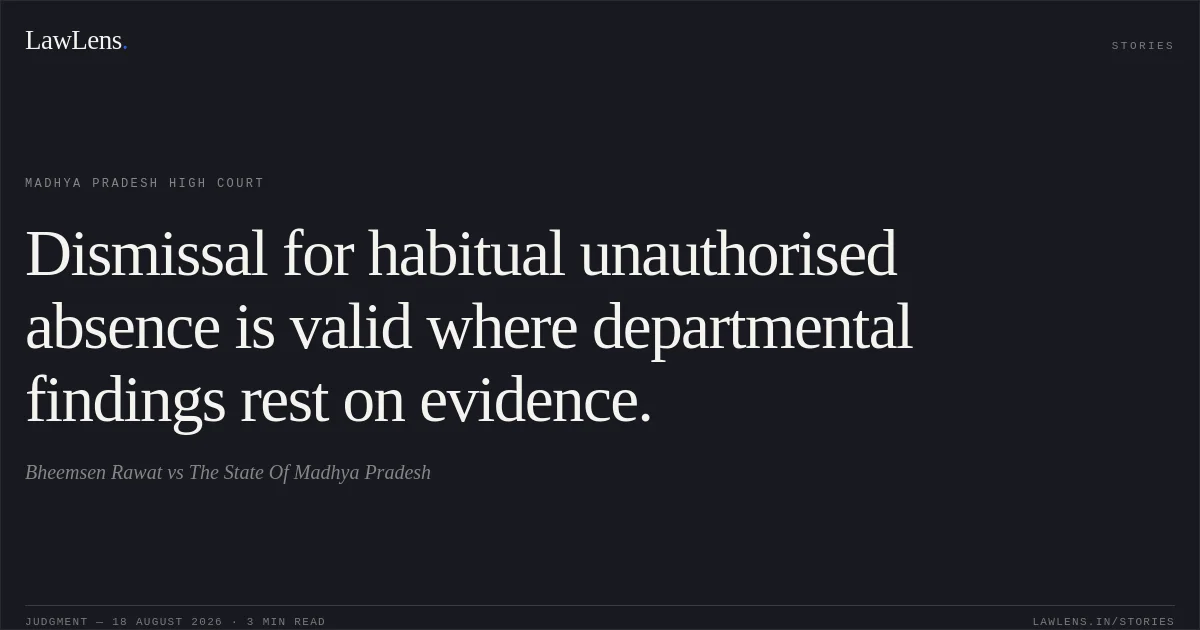
The Court answered all issues against the petitioner. It held that the departmental enquiry was procedurally valid, the findings of misconduct were supported by evidence, Rule 178(ii) was inapplicable, and the punishment of dismissal/removal was not shockingly disproportionate.
The orders dated 30.09.2019, 04.05.2020 and 21.09.2020 were therefore not interfered with, and the writ petition seeking quashing of the orders and reinstatement was dismissed as being without merit.
Source reference: p. 26; para. 22Original Court PDF
Bheemsen RawatvsThe State Of Madhya Pradesh
Click to open original judgment
Original judgment, available to read, download and summarize on LawLens.in