Facts
The Petitioner, appointed as a Constable (GD) in the Indo-Tibetan Border Police (ITBP) in 2012, was diagnosed with a psychiatric illness in 2015 and placed in a low medical category.
Source reference: p. 2, para 2.1He went on unauthorized absence from his battalion in Ranchi starting November 27, 2021.
Source reference: p. 3, para 6Despite repeated communications, a Daily Diary Report (DDR) with local police, and offers of medical treatment at specialized institutions like CIP/RIMS, Ranchi, the Petitioner failed to report for duty.
Source reference: p. 4, para 6A Court of Inquiry (COI) declared him a 'deserter' on February 15, 2022.
Source reference: no citationFollowing a show-cause notice published in national newspapers, the Respondent dismissed him from service effective November 26, 2021, under Rule 17 of the ITBP Rules.
Source reference: p. 4, para 6A subsequent statutory appeal was rejected on November 15, 2023, noting the Petitioner’s history of habitual absenteeism.
Source reference: p. 5, para 7The Petitioner challenged these orders via a writ of certiorari.
Source reference: p. 3, para 4Issues
Whether the dismissal orders were passed in violation of the principles of natural justice and without jurisdiction by failing to conduct a trial by a Force Court under Section 21 of the ITBP Act.
Source reference: p. 2–3, para 3Whether the Petitioner's absence, attributed to a diagnosed psychiatric illness, constitutes "misconduct" or "desertion" justifying dismissal.
Source reference: p. 2, para 3Whether the High Court can interfere with the findings of fact or the proportionality of punishment in a writ of certiorari.
Source reference: p. 3, para 5Law Applied
The Court applied the principles governing the writ of certiorari as established in Syed Yakoob v. K.S. Radhakrishnan, which limits judicial intervention to jurisdictional errors, patent errors of law, or violations of natural justice, rather than re-appreciating evidence.
Source reference: p. 3, para 5Statutorily, the Court relied on Section 11 of the ITBP Act, 1992, and Rules 17, 20, and 21 of the ITBP Rules, 1994, which empower the authorities to dismiss personnel for misconduct or desertion after following the prescribed summary procedure.
Source reference: p. 4, para 6Reasoning
The Court observed that the Respondents followed due process by granting the Petitioner multiple opportunities to resume duty and join medical treatment at Force facilities, which the Petitioner and his family acknowledged but ignored.
Source reference: p. 5, para 8The argument regarding the violation of natural justice was rejected because a show-cause notice was issued both personally and through newspaper publications.
Source reference: p. 5, para 8The Court found that the Petitioner’s psychiatric illness did not exempt him from the requirement to report, especially since the Battalion offered to facilitate his clinical treatment.
Source reference: p. 4, para 6Applying the Syed Yakoob standard, the Court held that it could not act as an appellate authority to disturb findings of fact regarding "habitual absenteeism" or "desertion" when the procedure followed was legally sound.
Source reference: p. 3, para 5; p. 5, para 9Holding
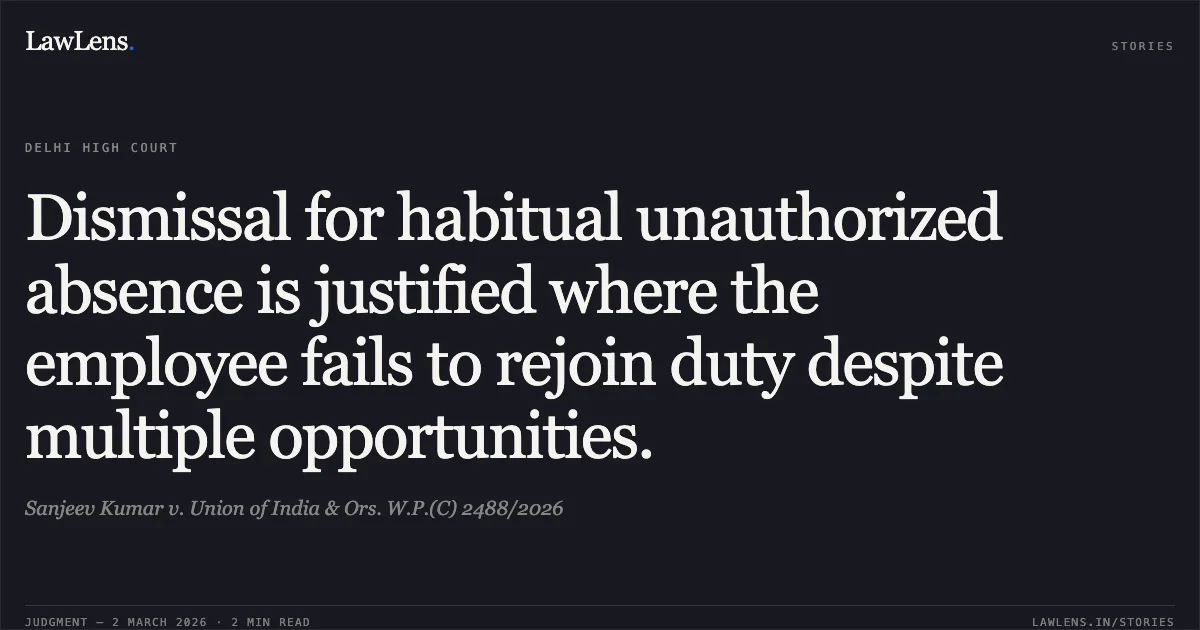
The Court dismissed the writ petition, holding that the dismissal was justified and the procedure was not for want of jurisdiction or natural justice.
The Court affirmed that the Petitioner's conduct evidenced an unwillingness to serve, making his retention not in the interest of the Force.
Source reference: p. 5-6, para 9The prayers for quashing the dismissal order dated July 23, 2022, and the appellate order dated November 15, 2023, were denied.
Source reference: p. 6, para 10Acts & Sections Cited
3 provisions across 1 statute referred to in this judgment. Each provision opens on LawLens.
Indo-Tibetan Border Police Force Act, 19923
Original Court PDF
Sanjeev Kumar v. Union of India & Ors. W.P.(C) 2488/2026
Click to open original judgment
Original judgment, available to read, download and summarize on LawLens.in