Facts
The original petitioner joined the respondent bank as a Clerk in 1952 and rose to the rank of General Manager.
Source reference: no citationIn July 1993, two months prior to his retirement, he was served a charge-sheet alleging procedural lapses committed between 1986 and 1990 while serving as Chief Manager.
Source reference: p. 2-3The charges involved failure to verify inflated stocks and lack of control over export packing credit (EPC) accounts.
Source reference: p. 13-16While the inquiry officer found the petitioner guilty, there were no findings of misappropriation or actual financial loss to the bank.
Source reference: p. 3, 13Despite his retirement on 31.10.1993, he was continued in service for the proceedings and was dismissed on 06.05.1994.
Source reference: p. 4After a series of litigations and a withdrawn writ petition to seek a sympathetic review, the Chairman and Managing Director (CMD) rejected his representation on 24.07.2003, citing the "financial impact" of the misconduct.
Source reference: p. 5, 30The petitioner’s legal heirs (LHs) continued the challenge after his death, seeking to set aside the "stigmatic" dismissal while waiving any monetary benefits.
Source reference: p. 8, 36Issues
1. Whether the penalty of dismissal was grossly disproportionate to the proved charges, considering they were procedural in nature and resulted in no financial loss.
Source reference: p. 19, 35-362. Whether the CMD's order rejecting the representation was sustainable given it was based on an alleged "financial impact" not supported by the inquiry report or disciplinary order.
Source reference: p. 30-32Law Applied
Regulation 4 of the Central Bank of India Officer Employees (Discipline and Appeal) Regulations, 1976, which categorizes minor and major penalties, including reduction in pay [Reg 4(f)] and dismissal [Reg 4(j)].
Source reference: p. 33-34The principle of proportionality in judicial review, which allows interference if a punishment is "shockingly disproportionate" or based on an erroneous factual premise.
Source reference: p. 21, 35-36Reasoning
The court found that the CMD had "flagrantly violated" the High Court’s previous direction to consider the petitioner's representation sympathetically.
Source reference: p. 31The CMD’s conclusion regarding "financial impact" was deemed an "astonishing" lack of application of mind because the inquiry officer and disciplinary authority had explicitly noted that no financial loss was caused to the bank.
Source reference: p. 31-32While acknowledging that bank officers must maintain high integrity, the court observed that the petitioner had 41 years of unblemished service.
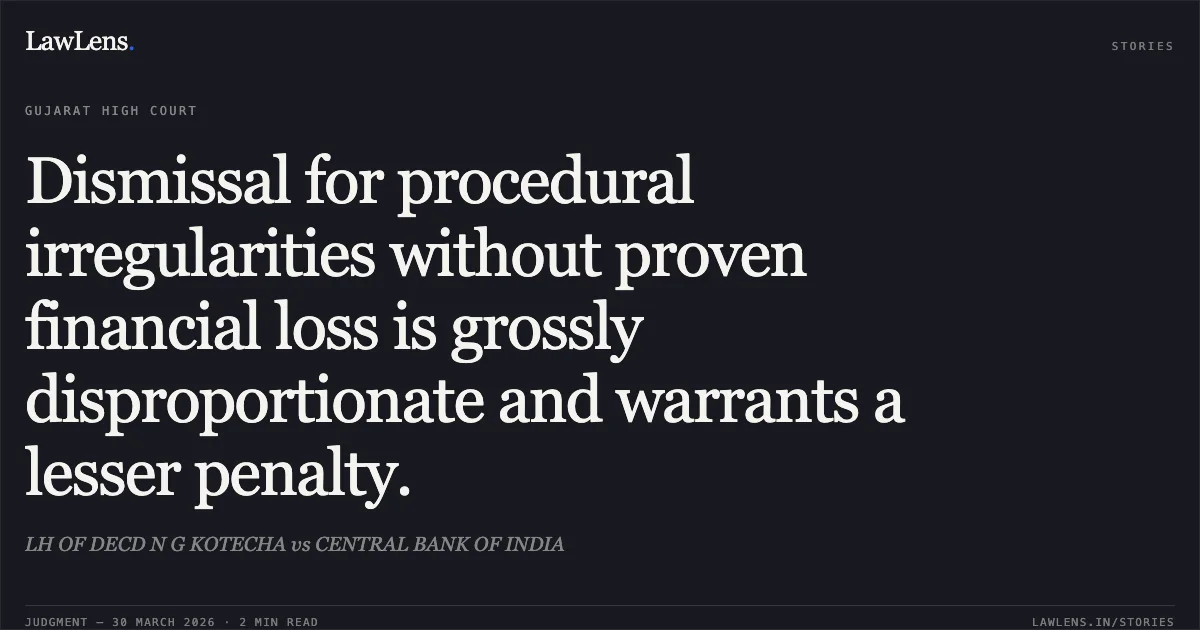
Source reference: p. 8, 35Since the proven charges related only to procedural irregularities and the appellants had voluntarily forgone monetary claims, the court determined that the "economic and social death" of dismissal was disproportionate.
Source reference: p. 35-36The court held that a non-stigmatic major penalty under Regulation 4(f) was more appropriate to the facts of the case.
Source reference: p. 36Holding
The High Court allowed the appeal in part, quashing the order of dismissal and substituting the penalty with "reduction of basic pay by six stages in time scale."
The court directed the respondent bank to pass consequential orders reflecting this substitution, but held that the bank is not liable to pay any monetary benefits or arrears resulting from this reduction in punishment based on the appellants' undertaking.
Source reference: p. 37Original Court PDF
LH OF DECD N G KOTECHAvsCENTRAL BANK OF INDIA
Click to open original judgment
Original judgment, available to read, download and summarize on LawLens.in