01Facts
The prosecutrix alleged that the applicant developed a relationship with her, repeatedly had sexual intercourse with her on the promise of marriage, provided her accommodation, and thereafter refused to marry her and left without informing her.
¶ 2Crime No. 101/2025 was registered at Police Station Manpur, Indore, under Sections 69 and 351(3) of the Bharatiya Nyaya Sanhita, 2023 (“BNS”).
¶ 2The applicant’s applications for anticipatory bail before the Sessions Court and the High Court were rejected, the High Court noting the allegations, his criminal antecedents, alleged non-availability during investigation, and the possibility of influencing witnesses.
¶ 3The Supreme Court subsequently granted interim protection from arrest during the pendency of the applicant’s Special Leave Petition (“SLP”).
¶ 4After filing of the charge-sheet, the JMFC ordered the applicant’s release on bail.
¶ 5The SLP was dismissed on 28 October 2025.
¶ 9Thereafter, the Sessions Court issued a warrant of arrest, holding that the protection granted by the Supreme Court had ceased and that the JMFC’s order merely implemented that interim protection.
¶ 6–7, 10–12The applicant challenged the order dated 2 April 2026 under Section 528 of the Bharatiya Nagarik Suraksha Sanhita, 2023 (“BNSS”).
¶ 6–7, 10–1202Issues
i.Whether, after dismissal of the applicant’s SLP, he could continue to claim protection under the Supreme Court’s interim order granting bail in the event of arrest.
¶ 15–16ii.Whether the JMFC’s order dated 25 September 2025 constituted an independent order granting regular bail, or merely gave effect to the Supreme Court’s interim protection, and consequently whether the Sessions Court was justified in issuing a warrant of arrest.
¶ 15, 1703Law Applied
The Court applied Section 528 of the BNSS, which preserves the High Court’s inherent jurisdiction to prevent abuse of process and secure the ends of justice.
¶ 1–3, 6–7Sections 482 and 72(2) of the BNSS in the procedural history concerning anticipatory bail and cancellation/recall of the warrant; and Sections 69 and 351(3) of the BNS, under which the criminal case was registered.
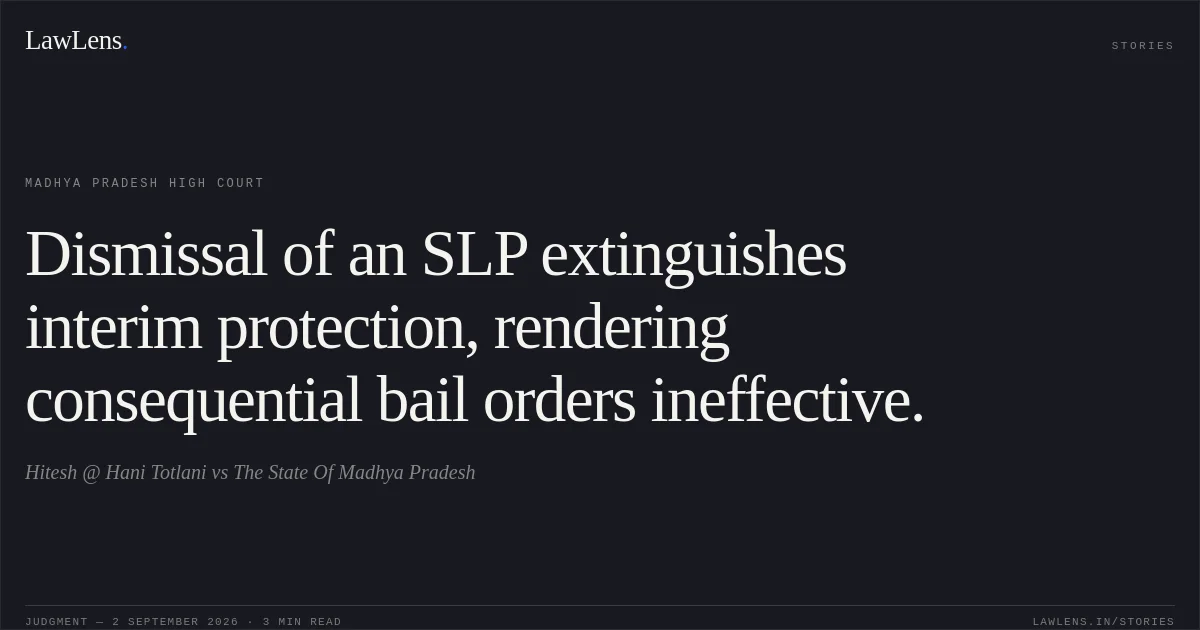
¶ 1–3, 6–7The Court held that an interim protection order granted by the Supreme Court during the pendency of an SLP cannot be claimed after dismissal of the SLP, unless the order expressly provides otherwise.
¶ 16–17It further held that an order passed by the Magistrate merely to implement such interim protection does not survive once the underlying protection expires.
¶ 16–17The earlier High Court order had also relied on *Pradeep Sharma v. State of M.P.*, (2014) 2 SCC 171, concerning the exceptional nature of anticipatory bail in the circumstances of that case.
¶ 3Provisions in the judgment · 7 · Linked ones open on LawLens
Bharatiya Nagarik Suraksha Sanhita, 2023 Section 72Section 180Section 183Section 482Section 528
Bharatiya Nyaya Sanhita, 2023 Section 69Section 351
04Reasoning
The Supreme Court’s order dated 18 July 2025 protected the applicant only “in the event of arrest” while the SLP was pending.
¶ 4Once the SLP challenging the rejection of anticipatory bail was dismissed on 28 October 2025, the interim protection came to an end and could no longer furnish a basis for the applicant’s continued liberty.
¶ 9, 16The High Court examined the JMFC’s order passed after filing of the charge-sheet and concluded that it was not an independent adjudication granting regular bail; rather, it merely gave effect to the Supreme Court’s interim order.
¶ 17Therefore, expiry of the Supreme Court’s protection necessarily terminated the operative effect of the JMFC’s order.
¶ 17The Sessions Court was consequently justified in issuing the warrant of arrest, and the applicant could not obtain through the present petition the same protection that had already been denied in the earlier proceedings and whose challenge had failed before the Supreme Court.
¶ 17–1805Holding
The Court answered both issues against the applicant.
¶ 16–19It held that the applicant could not claim the benefit of the Supreme Court’s interim protection after dismissal of the SLP, and that the JMFC’s order did not constitute an independent, continuing order of regular bail.
¶ 16–19The warrant of arrest issued by the Sessions Court was therefore held justified.
¶ 16–19The application under Section 528 of the BNSS was dismissed, and no relief was granted to the applicant.
¶ 16–19Original Court PDF
Hitesh @ Hani TotlanivsThe State Of Madhya Pradesh
Click to open original judgment
Original judgment, available to read, download and summarize on LawLens.in