Facts
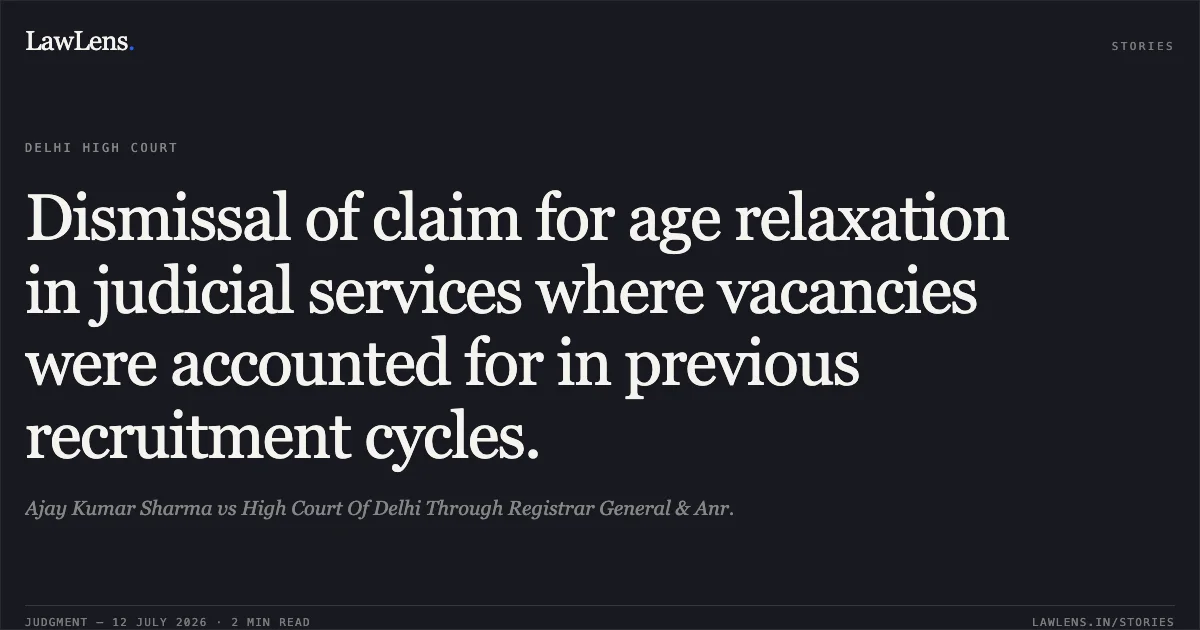
The Petitioner, a candidate for the Delhi Higher Judicial Service (DHJS), challenged the Advertisement dated 01.07.2026 for the DHJS Examination 2026
Source reference: p. 1-2The advertisement set an upper age limit of 45 years as of 15.07.2026
Source reference: p. 3The Petitioner, born on 03.10.1980, became over-age in September 2025
Source reference: p. 5He contended that because no examination was conducted in 2025, he lost his last opportunity to compete. He further challenged the validity of Rule 9(5) of the DHJS Rules, amended on 19.02.2026, which shifted the age determination date to the last date of application
Source reference: p. 3-4He sought a one-time age relaxation and a direction to bifurcate vacancies to account for those arising in 2025
Source reference: p. 2Issues
1. Whether Rule 9(5) of the DHJS Rules is arbitrary and violative of Articles 14 and 16 of the Constitution for failing to provide a transitional provision for candidates who turned over-age in a non-recruitment year
Source reference: p. 2 / para. 1(b)2. Whether the Petitioner is entitled to a one-time age relaxation for the DHJS Exam 2026 due to the non-conduct of an examination in 2025
Source reference: p. 2 / para. 1(c)3. Whether the High Court was required to conduct an independent examination in 2025 despite including anticipated vacancies up to 01.12.2025 in the 2024 notification
Source reference: p. 3-4 / para. 6 & 9Law Applied
Rule 9 of the Delhi Higher Judicial Service Rules, 1970 (as amended in 2024 and 2026), which governs age eligibility and recruitment cycles
Source reference: p. 3-4Principles regarding the timely conduct of judicial exams from Malik Mazhar Sultan v. U.P. Public Service Commission and High Court of Delhi v. Devina Sharma, which address age relaxations in judicial services
Source reference: p. 4The Supreme Court’s directions in Rejanish K.V. v. K. Deepa & Others (09.10.2025) regarding rule amendments, and evaluated the "old rule" principle from Y.V. Rangaiah v. J. Sreenivasa Rao
Source reference: p. 4Reasoning
The Court rejected the Petitioner's arguments, finding that the DHJS Exam 2024 notification (issued 27.12.2024) had already accounted for all anticipated vacancies up to 01.12.2025
Source reference: p. 4-5Since the 2025 vacancies were already included in the previous cycle in which the Petitioner participated but failed, there was no requirement to hold a separate exam in 2025
Source reference: p. 5The Court noted that the delay in issuing the 2026 notification was justified as the High Court had to amend its Rules on 19.02.2026 to comply with the Supreme Court’s directions in Rejanish K.V.
Source reference: p. 5-6The Court reasoned that since the Rules were followed and the recruitment objective (filling vacancies) was met via the 2024 exam, the Petitioner had no vested right to a relaxation simply because he turned over-age before the next cycle
Source reference: p. 6Holding
The Court dismissed the petition, holding that the Petitioner was ineligible due to being over-age and was not entitled to relaxation
The Court concluded that the non-conduct of a 2025 examination was neither discriminatory nor illegal because the vacancies for that period were covered by the 2024 advertisement [p. 5]. There were no "compelling circumstances" to grant a one-time relaxation, as the Petitioner’s rights were not adversely affected by the administration’s actions [p. 6]. All pending applications were also dismissed
Source reference: p. 6Original Court PDF
Ajay Kumar SharmavsHigh Court Of Delhi Through Registrar General & Anr.
Click to open original judgment
Original judgment, available to read, download and summarize on LawLens.in