Facts
The petitioners (wife and two minor daughters) filed an application for maintenance under Section 125 of the Cr.P.C. against the respondent. Interim maintenance of ₹10,000 each was awarded to the daughters.
Source reference: p. 2After the petitioners closed their evidence on 10.02.2024, the case was fixed for the respondent’s evidence. On 11.03.2024, the respondent’s chief examination commenced, but the petitioners’ junior counsel sought a one-week adjournment due to the main counsel’s illness. The Family Court granted only one day.
Source reference: p. 4On 12.03.2024, when the petitioners failed to appear at 12:10 p.m., the Family Court dismissed the maintenance application for "want of prosecution".
Source reference: p. 4A restoration application filed the same afternoon was rejected on the grounds that counsels have no right to appear in Family Court under Section 13 of the Family Courts Act and the main case was already dismissed.
Source reference: p. 4Issues
1. Whether the Family Court was justified in dismissing a maintenance application for want of prosecution after the petitioners had already concluded their evidence.
Source reference: p. 5 / para. 112. Whether the refusal to grant a reasonable adjournment due to a counsel’s illness violated the principles of natural justice and Order XVII Rule 1 of the C.P.C.
Source reference: p. 6 / para. 13-143. Whether Section 13 of the Family Courts Act justifies the summary dismissal of a case in the absence of a party when a counsel has already been permitted to represent them.
Source reference: p. 7 / para. 16Law Applied
The court applied Section 126 of the Cr.P.C. (and Section 146 of the BNSS), which prescribes the procedure for maintenance.
Source reference: p. 5Order XVII Rule 1(2)(b) of the C.P.C., which mandates that adjournments should not be granted unless circumstances (like illness) are beyond a party’s control.
Source reference: p. 6Under Section 13 of the Family Courts Act, 1984, while legal practitioners have no absolute right to appear, once permitted, they may represent parties.
Source reference: p. 7The court further applied the doctrine from G. Ratna Raj v. Sri Muthukumarasamy Permanent Fund Ltd. (2019) and B. Janakiramaiah Chetty v. A.K. Parthasarthi (2003), establishing that if a party has already led evidence, the court should decide the matter on merits rather than dismissing for default.
Source reference: p. 8Reasoning
The High Court observed that maintenance proceedings are quasi-civil and summary in nature. The Family Court committed a "glaring example of non-application of mind" by dismissing the case for want of prosecution after the petitioners’ evidence was already on record.
Source reference: p. 2, 5, 7The court reasoned that under the Explanation to Order XVII Rule 2 of the C.P.C., the Family Court should have treated the petitioners as present, recorded the respondent’s ex-parte evidence, and passed a final judgment on the merits.
Source reference: p. 7-8Highlighting Bashir Ahmed v. Mehmood Hussain Shah, the court held that a counsel's illness is a circumstance beyond a party's control, making the one-day adjournment insufficient and illegal.
Source reference: p. 6Furthermore, the Trial Court erred in using Section 13 of the Family Courts Act to disregard the junior counsel’s presence; if the court deemed the counsel unauthorized, it should have issued fresh notices to the petitioners before dismissing the suit.
Source reference: p. 7Holding
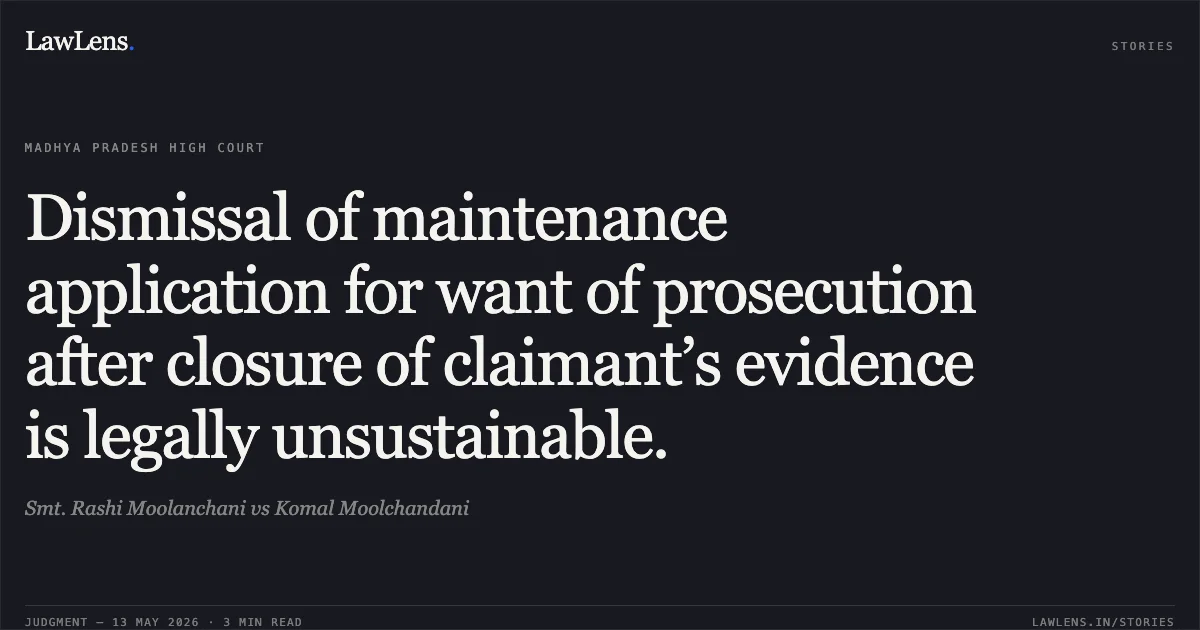
A maintenance application cannot be dismissed for want of prosecution after the applicant's evidence is closed.
The High Court allowed the criminal revision in part, set aside the order dated 12.03.2024, and remanded the matter to the Family Court, Katni, with directions to restore MJCR no. 33/2021 to its original number and decide it afresh on merits after providing both parties a fair hearing. The parties were directed to appear before the Family Court on 29.06.2026.
Source reference: p. 8Acts & Sections Cited
9 provisions across 3 statutes referred to in this judgment. Each provision opens on LawLens.
Code of Criminal Procedure, 19734
Bharatiya Nagarik Suraksha Sanhita, 20234
Family Courts Act, 19841
Original Court PDF
Smt. Rashi MoolanchanivsKomal Moolchandani
Click to open original judgment
Original judgment, available to read, download and summarize on LawLens.in