Facts
Respondent No. 1, a driver for the Petitioner-Corporation, was involved in a bus accident on December 5, 1987.
Source reference: p. 2-3A departmental inquiry held him responsible for rash and negligent driving, leading to an order dated March 14, 1989, imposing a penalty of stoppage of three increments with future effect.
Source reference: p. 2-3The Respondent challenged this before the Industrial Tribunal, Rajkot, in Reference (IT) No. 95/1994. The Tribunal quashed the penalty.
Source reference: p. 3-4The Petitioner moved the High Court under Articles 226 and 227, asserting the accident was admitted, the damage was significant (Rs. 20,000), and the Reference was filed after a five-year delay.
Source reference: p. 3-4Issues
1. Whether the Industrial Tribunal was justified in quashing the penalty of stoppage of increments based on the evidentiary inconsistencies in the disciplinary proceedings.
Source reference: p. 4-52. Whether the Reference filed by the workman was maintainable despite a delay of five years.
Source reference: p. 4Law Applied
The Court applied the principles of administrative law regarding disciplinary inquiries, specifically that findings of a Disciplinary Authority must be supported by evidence and be well-reasoned rather than cryptic.
Source reference: p. 5It relied on the Principle of Proportionality, which dictates that the quantum of punishment must not be shockingly disproportionate to the proved misconduct.
Source reference: p. 6Under Articles 226/227, the High Court’s jurisdiction is supervisory, aimed at correcting perversity or errors in the interpretation of evidence rather than re-appreciating facts.
Source reference: p. 6Reasoning
The Court observed that while the accident was admitted, the Petitioner failed to prove the extent of negligence or the financial loss. The Petro-Corporation initially claimed damages of Rs. 20,000, but the Enquiry Officer’s report (Exhibit-21) assessed the damage at only Rs. 3,941.40, with no repair receipts produced.
Source reference: p. 6The Disciplinary Authority’s order was deemed "cryptic" as it ignored the spot survey report and failed to record statements from the injured passengers or the reporter.
Source reference: p. 5Crucially, the Court noted that the driver was denied the opportunity to cross-examine key witnesses, such as the spot survey reporter, whose independent report was withheld during proceedings.
Source reference: p. 5Regarding the delay, the Court found no reason to interfere with the Tribunal’s decision to entertain the Reference. Consequently, the High Court found no perversity in the Labour Court’s conclusion that the penalty was disproportionate and illegal.
Source reference: p. 6Holding
The High Court dismissed the Special Civil Application and upheld the Industrial Tribunal’s award.
It held that the imposition of the penalty was disproportionate and lacked a sound evidentiary basis because the Petitioner failed to establish the quantum of damage or provide a well-reasoned disciplinary order.
Source reference: p. 6The Rule was discharged, and no costs were awarded.
Source reference: p. 6Original Court PDF
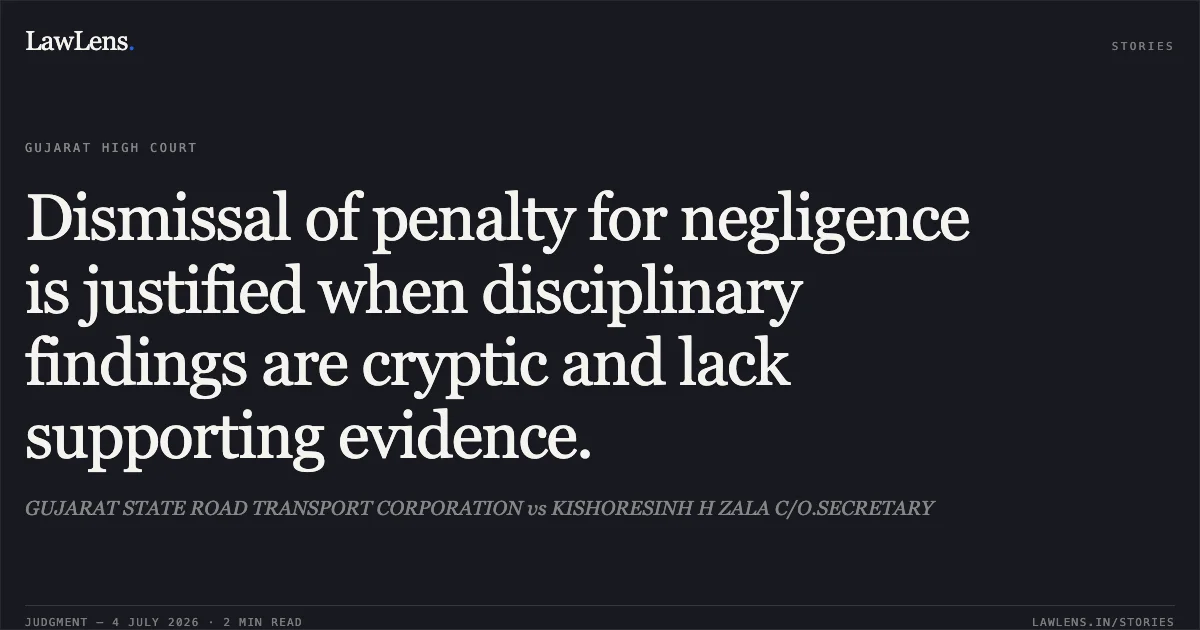
GUJARAT STATE ROAD TRANSPORT CORPORATIONvsKISHORESINH H ZALA C/O.SECRETARY
Click to open original judgment
Original judgment, available to read, download and summarize on LawLens.in