Facts
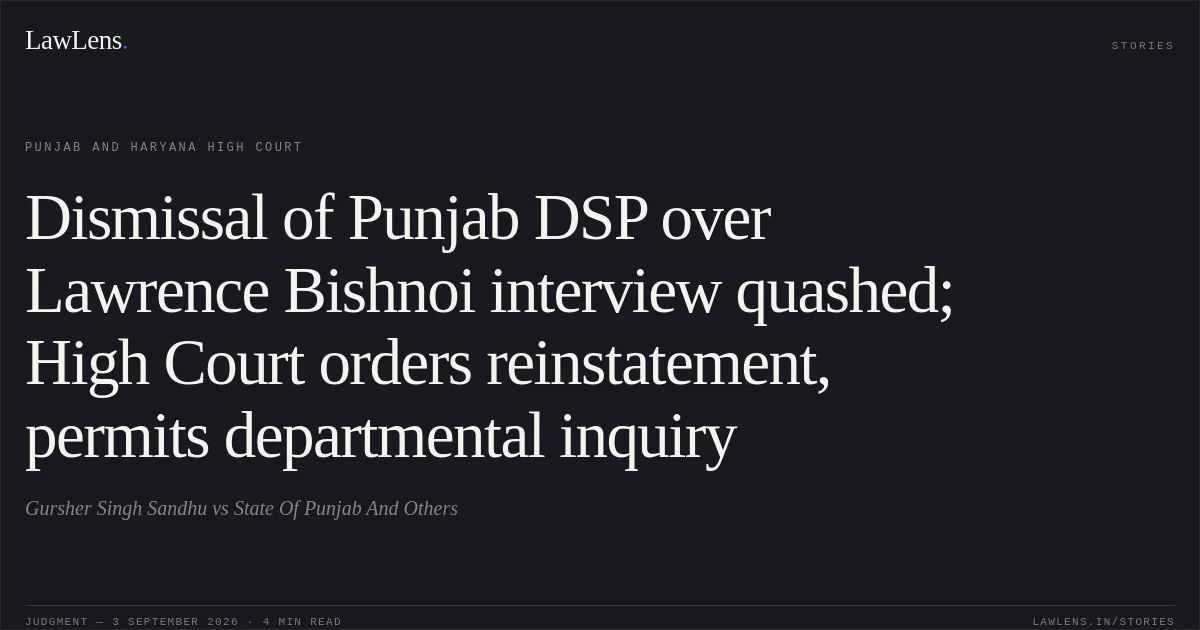
The petitioner, a Deputy Superintendent of Police in the Punjab Police, was posted as DSP (Detective), SAS Nagar, when an interview of Lawrence Bishnoi was recorded while he was in police custody at CIA Staff, Kharar, during the night intervening 03/04.09.2022.
Source reference: paras. 4–17; pp. 3–11Following the investigation conducted pursuant to directions in CWP-PIL-93-2023, the petitioner was issued show-cause notices dated 19.09.2024 and 14.10.2024, suspended on 25.10.2024, and served with a charge-sheet concerning alleged negligence, dereliction of duty and facilitation of the interview.
Source reference: paras. 4–17; pp. 3–11Although departmental proceedings were initiated against the petitioner and other police officials, the State Government dismissed him on 02.01.2025 by invoking Article 311(2)(b) of the Constitution and dispensing with the departmental enquiry on the ground that he was non-cooperative and had evaded service of the charge-sheet.
Source reference: paras. 20, 26–27; pp. 13, 16–18During the pendency of the writ petition, however, a joint departmental enquiry was conducted against the other officials and the petitioner was also called upon to participate. He sought the charge-sheet and relevant documents, appeared before the Enquiry Officer through virtual mode, submitted his reply, and participated in subsequent proceedings.
Source reference: paras. 21–23, 50–52; pp. 14–16, 52–54Issues
1. Whether the respondents validly invoked Article 311(2)(b) of the Constitution to dispense with the regular departmental enquiry and dismiss the petitioner.
Source reference: paras. 33–36, 44–61; pp. 22–25, 49–622. Whether the petitioner’s alleged non-cooperation and failure to receive the charge-sheet constituted circumstances rendering the departmental enquiry “not reasonably practicable”.
Source reference: paras. 44–47, 60; pp. 49–51, 60–613. Whether the respondents’ continuation of the same departmental enquiry against the co-delinquent officials, and the petitioner’s subsequent participation in it, undermined the justification for dispensing with the enquiry in his case.
Source reference: paras. 50–52; pp. 52–54Law Applied
Article 311(2) of the Constitution ordinarily mandates an enquiry, notice of charges and a reasonable opportunity of being heard before dismissal, removal or reduction in rank. Under the second proviso, clause (b), the disciplinary authority may dispense with an enquiry only where it is satisfied, for reasons recorded in writing, that holding the enquiry is not reasonably practicable.
Source reference: paras. 34–43, 54–58; pp. 22–49, 55–58The power is exceptional and cannot be exercised mechanically, arbitrarily, merely because the allegations are serious, or solely on the basis of the authority’s ipse dixit.
Source reference: paras. 34–43, 54–58; pp. 22–49, 55–58The Court relied principally on Union of India v. Tulsiram Patel, (1985) 3 SCC 398, and Jaswant Singh v. State of Punjab, (1991) 1 SCC 362, which require objective circumstances and written reasons.
Source reference: paras. 34–43; pp. 22–49Ex. Constable Chhote Lal v. Union of India, (2000) 10 SCC 196, and Tarsem Singh v. State of Punjab, (2006) 13 SCC 581, hold that the power cannot be used merely to avoid an enquiry.
Source reference: paras. 34–43; pp. 22–49The Court also considered Rule 8 and Rule 13(ii) of the Punjab Civil Services (Punishment and Appeal) Rules, 1970, Rule 16.24 of the Punjab Police Rules, 1934, and the Punjab Police guidelines dated 02.09.2022 on Article 311(2)(b).
Source reference: paras. 54–58; pp. 55–58Reasoning
The Court held that the respondents failed to establish any objective circumstance making a fair departmental enquiry genuinely impracticable. There was no allegation or material showing that the petitioner had threatened or intimidated witnesses, tampered with evidence, interfered with the Enquiry Officer, or created an atmosphere of violence or coercion.
Source reference: paras. 47, 58; pp. 51, 58His conduct at the relevant stage was inconsistent with deliberate obstruction: he had replied to the first show-cause notice, submitted an interim reply to the second, sought relevant documents, and later participated in the enquiry after being supplied with the charge-sheet.
Source reference: paras. 46, 51–52; pp. 50, 53–54Even assuming that service of the charge-sheet had initially failed, the department could proceed ex parte under the applicable rules; non-cooperation or absence alone could not satisfy Article 311(2)(b).
Source reference: paras. 44–45; pp. 49–50Further, the charge-sheet was sent to the petitioner’s former Chandigarh address despite the respondents’ knowledge of his permanent Jalandhar address, making the allegation of deliberate evasion doubtful.
Source reference: para. 60; pp. 60–61The same occurrence formed the basis of a joint enquiry against eight other officials, which continued before the same Enquiry Officer. The respondents neither explained why the enquiry was practicable for the other officials nor identified any circumstance peculiar to the petitioner that made it impracticable in his case.
Source reference: para. 50; pp. 52–53The SIT report could justify initiation of disciplinary proceedings but could not substitute a regular enquiry or independently establish the requirements of Article 311(2)(b).
Source reference: para. 49; pp. 51–52The Court also noted that the State’s prior decision to recommend dismissal, followed by the later invocation of Article 311(2)(b), raised concerns regarding a pre-determined outcome and procedural fairness.
Source reference: paras. 59–60; pp. 59–61Holding
The Court answered the issues in favour of the petitioner and held that the satisfaction recorded under Article 311(2)(b) did not meet the constitutional standard.
The dismissal order dated 02.01.2025 was quashed, and the respondents were directed to reinstate the petitioner with all consequential benefits.
Source reference: para. 62; p. 62The reinstatement was made without prejudice to the respondents’ right to proceed in accordance with law by continuing the departmental enquiry pending against the petitioner and the other officials before Justice Rajiv Narain Raina, former Judge of the High Court.
Source reference: para. 63; p. 63Pending applications, if any, were disposed of.
Source reference: para. 64; p. 63Acts & Sections Cited
19 provisions across 5 statutes referred to in this judgment. Each provision opens on LawLens.
Information Technology Act, 20002
Indian Penal Code, 1860
Code of Criminal Procedure, 19731
Prevention of Corruption Act, 19883
Marine Products Export Development Authority Act, 19721
Original Court PDF
Gursher Singh SandhuvsState Of Punjab And Others
Click to open original judgment
Original judgment, available to read, download and summarize on LawLens.in