Facts
The complainant (respondent), an advocate, filed a complaint under Section 138 of the Negotiable Instruments Act against the petitioner, alleging a debt of Rs. 4,00,000/- advanced for domestic needs.
Source reference: para 2The petitioner allegedly issued a cheque dated 16.02.2018, which was returned with the endorsement "Funds Insufficient".
Source reference: para 2During cross-examination, the complainant claimed the advanced amount was reflected in his Income Tax Returns (ITR).
Source reference: para 2Consequently, the petitioner moved an application under Section 91 of the Cr.P.C. seeking the production of the complainant’s ITRs up to March 2022 to verify the transaction.
Source reference: para 2-3The Trial Court (JMFC Satna) and the Revisional Court (6th ASJ Satna) both rejected the application.
Source reference: para 1-3The petitioner challenged these orders before the High Court under Section 528 of the BNSS, 2023.
Source reference: para 1Issues
1. Whether the Trial Court committed an illegality or jurisdictional error in dismissing the petitioner’s application under Section 91 of the Cr.P.C. for the production of the complainant's Income Tax Returns.
Source reference: para 62. Whether the High Court should exercise its inherent powers to interfere with the discretionary interlocutory/revisional orders passed by the courts below.
Source reference: para 6Law Applied
The court considered Section 528 of the Bharatiya Nagarik Suraksha Sanhita (BNSS), 2023 (equivalent to Section 482 of the Cr.P.C.), which saves the inherent powers of the High Court to prevent abuse of the process of any court or to secure the ends of justice.
Source reference: para 1, 6It also examined Section 91 of the Cr.P.C., which grants courts the discretionary power to summon documents necessary or desirable for the purpose of any investigation, inquiry, or trial.
Source reference: para 2, 6Reasoning
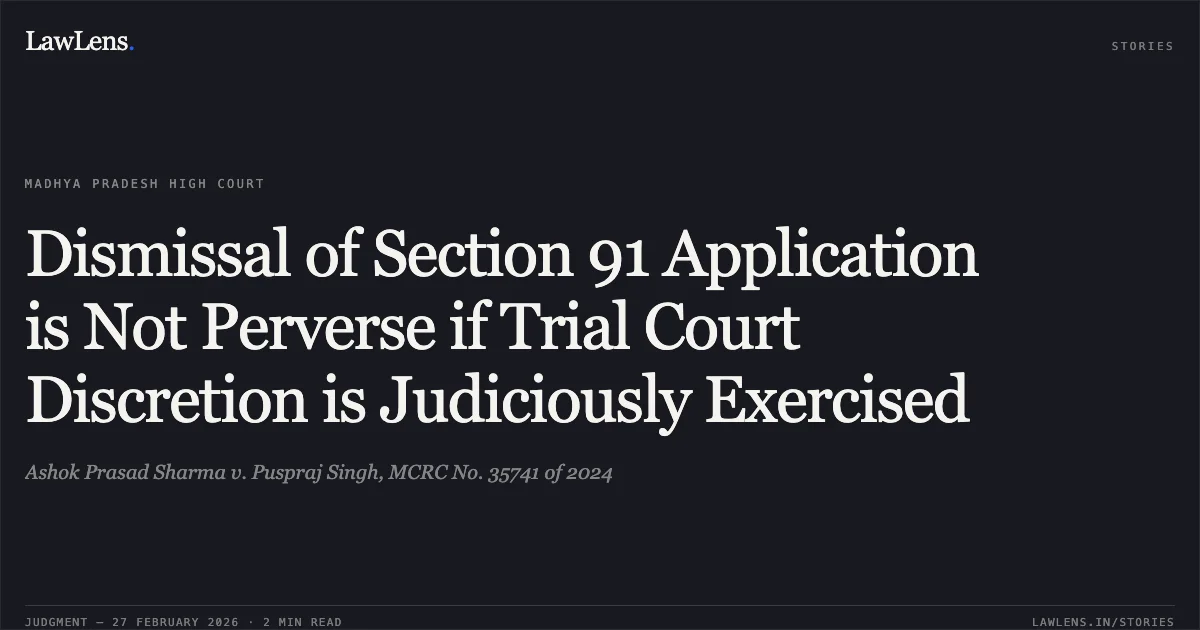
The High Court perused the record and observed that the Trial Court had exercised its discretion "judiciously" in rejecting the application.
Source reference: para 6The court noted that while the petitioner argued the ITR was material to prove the non-existence of a legally enforceable debt, the Trial Court’s decision was primarily based on the specific averments regarding the loan for domestic needs and the stage of the trial.
Source reference: para 3, 6The High Court emphasized that its jurisdiction under Section 482 Cr.P.C. (now Section 528 BNSS) is limited and should not be used to substitute its own view for that of the Trial Court, especially when there is no patent illegality, perversity, or failure of justice evident in the lower court's exercise of discretion.
Source reference: para 6Holding
The High Court held that the impugned orders do not suffer from any patent illegality or jurisdictional error warranting interference.
The petition was dismissed, and the court declined to interfere with the Trial Court's discretion regarding the production of documents.
Source reference: para 7No order as to costs was made.
Source reference: para 7Acts & Sections Cited
4 provisions across 3 statutes referred to in this judgment. Each provision opens on LawLens.
Bharatiya Nyaya Sanhita, 20231
Negotiable Instruments Act, 18811
Code of Criminal Procedure, 19732
Original Court PDF
Ashok Prasad Sharma v. Puspraj Singh, MCRC No. 35741 of 2024
Click to open original judgment
Original judgment, available to read, download and summarize on LawLens.in