Facts
The petitioner was appointed as a Constable (Jal Vahak) in the CRPF in 1988. He had married Urmila Devi in 1976, with whom he had children.
Source reference: paras. 3–4He stated that she left the matrimonial home in 1989 and could not thereafter be traced. In 1992, while the first marriage was subsisting, he married Pratima Devi without obtaining prior permission from the department or informing it of the second marriage.
Source reference: paras. 3–4He subsequently recorded Pratima Devi as his wife and nominee in his service records, without disclosing that she was his second wife.
Source reference: para. 19Disciplinary proceedings were initiated in 2011 for violating Rule 15 of the CRPF Rules, 1955. The petitioner admitted the previous and subsequent marriages and the absence of departmental permission. The Inquiry Officer found the charge proved, following which the disciplinary authority removed him from service under Section 11(1) of the CRPF Act, 1949. His departmental appeal and revision were dismissed on 4 June 2013 and 13 December 2013, respectively.
Source reference: paras. 3–4Issues
Whether contracting a second marriage during the subsistence of the first marriage, without prior departmental permission, amounted to misconduct under Rule 15 of the CRPF Rules, 1955 and Rule 21 of the CCS (Conduct) Rules, 1964?
Source reference: paras. 8–11Whether dismissal or removal from service could lawfully be imposed under Section 11(1) of the CRPF Act, 1949, despite that provision being titled “Minor punishments”?
Source reference: paras. 5–7, 12–14Whether the punishment of removal from service was disproportionate or excessive in the circumstances of the case?
Source reference: paras. 20–21Law Applied
The Court applied Rule 15 of the CRPF Rules, 1955, which prohibits a member of the Force having a living wife from contracting another marriage without prior Government permission, even where the subsequent marriage is permissible under personal law.
Source reference: para. 9It also relied on Rule 21 of the CCS (Conduct) Rules, 1964, which restricts a Government servant from contracting a marriage during the subsistence of an existing marriage, subject to limited governmental permission.
Source reference: para. 10Section 11(1) of the CRPF Act, 1949 authorises suspension or dismissal, either in addition to or in lieu of the punishments specified in clauses (a)–(e), for disobedience, neglect of duty, remissness or other misconduct.
Source reference: para. 12In Union of India v. Ghulam Mohd. Bhat, (2005) 13 SCC 228, the Supreme Court held that dismissal may be imposed under Section 11(1), notwithstanding its description as a provision concerning minor punishments.
Source reference: para. 14The Court further relied on M.M. Malhotra v. Union of India, (2005) 8 SCC 351, for the principle that misconduct includes conduct inconsistent with the discipline, dignity and standards expected of a public servant.
Source reference: para. 15It also referred to Union of India v. Rama Shankar, 2012 SCC OnLine Gau 943, and Veer Pal Singh v. Senior Superintendent of Police, Agra, 2006 (5) ALJ 307, to hold that dismissal for proven bigamy in a disciplined force is not inherently disproportionate.
Source reference: paras. 16–17Judicial review of punishment is ordinarily limited to cases where the penalty is impermissible or shocks the conscience of the Court as being shockingly disproportionate.
Source reference: para. 20Reasoning
The petitioner’s first marriage was admittedly subsisting when he contracted the second marriage, and he had neither obtained prior departmental permission nor secured a divorce decree.
Source reference: paras. 8, 11, 19Since both marriages were governed by Hindu law, the second marriage was prohibited and void during the subsistence of the first marriage; independently, it violated the specific service restrictions under Rule 15 of the CRPF Rules and Rule 21 of the CCS Conduct Rules.
Source reference: para. 11The petitioner’s subsequent failure to disclose that Pratima Devi was his second wife, while recording her as his wife and nominee, further indicated deliberate concealment.
Source reference: para. 19Applying Ghulam Mohd. Bhat, the Court held that Section 11(1) expressly permits dismissal in departmental proceedings and that the use of the expression “minor punishments” did not exclude dismissal.
Source reference: paras. 13–14, 18Given the need for discipline and moral standards in a force such as the CRPF, the punishment could not be considered shockingly disproportionate.
Source reference: paras. 16, 20–21Holding
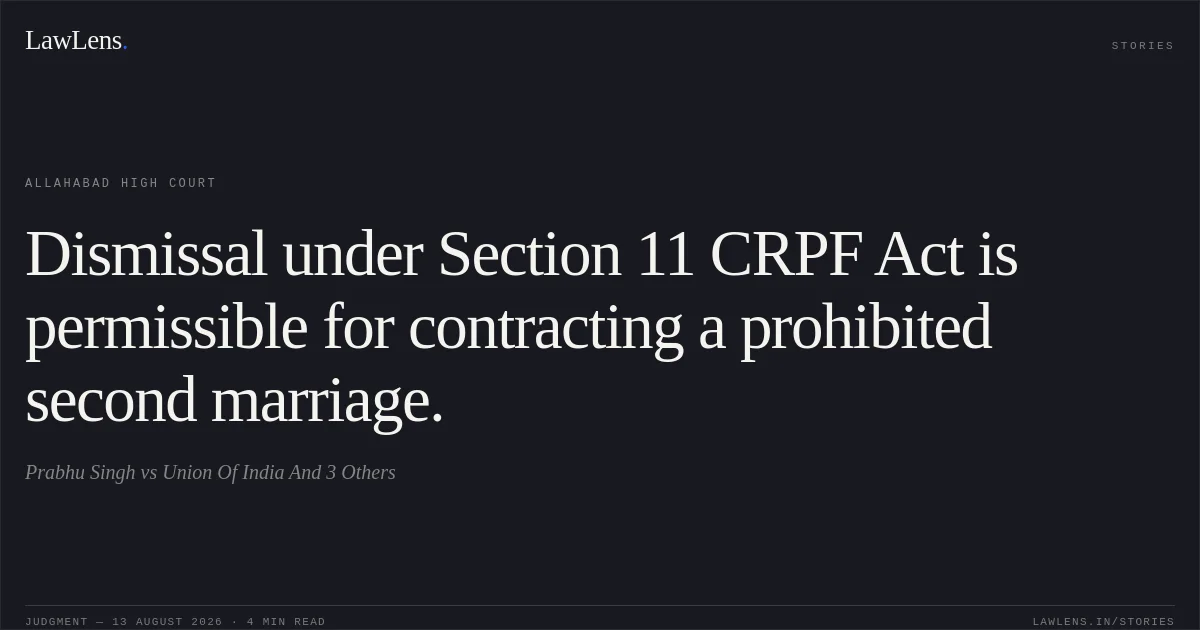
The Court held that the petitioner’s second marriage during the subsistence of his first marriage, without prior permission, constituted misconduct in violation of Rule 15 of the CRPF Rules, 1955 and Rule 21 of the CCS (Conduct) Rules, 1964.
It further held that dismissal or removal from service was legally permissible under Section 11(1) of the CRPF Act, 1949 and was not disproportionate in the facts of the case.
Source reference: paras. 18, 20–21The writ petition was accordingly dismissed, and the punishment order dated 8 July 2011 and the appellate and revisional orders dated 4 June 2013 and 13 December 2013 were upheld.
Source reference: para. 22Acts & Sections Cited
3 provisions across 1 statute referred to in this judgment. Each provision opens on LawLens.
Central Reserve Police Force Act, 19493
Original Court PDF
Prabhu SinghvsUnion Of India And 3 Others
Click to open original judgment
Original judgment, available to read, download and summarize on LawLens.in