Facts
The petitioner, a dismissed employee of the Tamil Nadu State Transport Corporation and a trade union member, filed a writ petition seeking a Mandamus against respondents 1 to 4
Source reference: p. 3He alleged a scam involving the creation of fake records where multiple sets of tickets were issued for a single bus (Bus No. TN-57-N-2084) to misappropriate funds and expenses by pretending three buses were being operated simultaneously
Source reference: p. 3-4The respondent Corporation admitted the irregularities in its counter-affidavit, noting that audit reports confirmed the issuance of three different ticket slips on one bus
Source reference: p. 4-5Although the Corporation initiated disciplinary proceedings against a Branch Manager and a Junior Assistant—imposing minor punishments—the petitioner contended that higher officials, including the Managing Director, were involved and that the Vigilance Department failed to conduct a proper enquiry
Source reference: p. 5, 8-10Issues
1. Whether a third party or a dismissed employee has the locus standi to maintain a writ petition regarding disciplinary action and internal administration of a public corporation
Source reference: para. 9, 142. Whether the Court can compel the Vigilance Department to investigate an alleged institutional fraud that the administration appears to have summarily closed with minor disciplinary actions
Source reference: para. 11, 13Law Applied
The Court applied the doctrine of locus standi as interpreted in Joshbhai Motibhai Desai v. Roshan Kumar Haji Bashir Ahamed, which distinguishes between a "person aggrieved," a "stranger," and a "busybody"
Source reference: para. 9, 14It further referenced Ranjit Prasad v. Union of India, which generally holds that departmental proceedings are a private matter between employer and employee where strangers cannot interfere
Source reference: para. 15The Court also relied on the principle that the term "person aggrieved" is of wide import (citing Attorney General of the Gambia v. Peirra Sarr N'Jie) and that a writ of Mandamus may be issued to compel the performance of a public duty when governed by considerations of public interest and the prevention of fraud
Source reference: para. 13, 18Reasoning
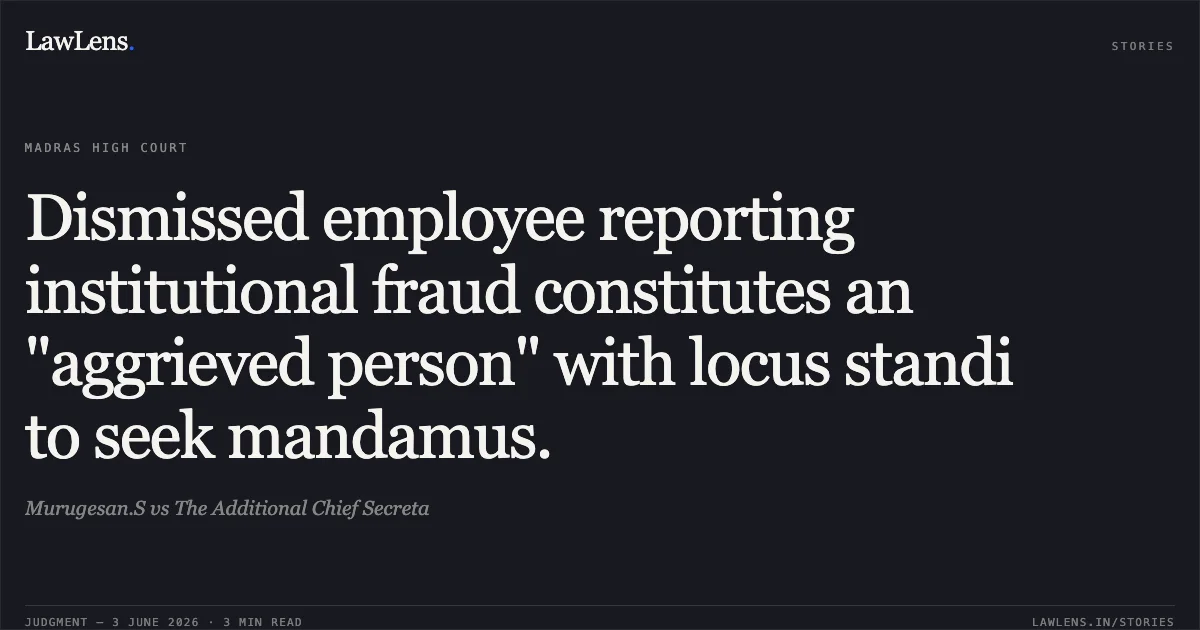
The Court acknowledged the general rule that third parties cannot maintain writ petitions for service matters. However, it distinguished the present case on the grounds that the petitioner alleged serious institutional fraud and misappropriation of public funds, which the Corporation admitted to in part
Source reference: para. 10, 11The Court reasoned that as a former employee and trade union member, the petitioner has an interest in the reputation of the institution, elevating him from a "stranger" to an "aggrieved person"
Source reference: para. 19The Court scrutinized the Vigilance Department’s inaction, noting it had merely forwarded the complaint back to the Corporation rather than investigating the potential involvement of higher-level management
Source reference: para. 11-12The Court found that when public officials fail to perform statutory duties in the face of admitted financial irregularities, judicial intervention is necessary to serve the public good
Source reference: para. 13Holding
The Court held that despite the petitioner’s status as a dismissed employee, the serious nature of the admitted fraud warranted a formal investigation. The Court answered that the petitioner cannot be treated as a mere meddlesome interloper when raising issues of public financial loss
The Court disposed of the writ petition by directing the fourth respondent (Director of Vigilance and Anti-Corruption) to investigate the petitioner’s complaint and take appropriate action. The Vigilance Department was further ordered to file a status report by 03.09.2026
Source reference: para. 23Original Court PDF
Murugesan.SvsThe Additional Chief Secreta
Click to open original judgment
Original judgment, available to read, download and summarize on LawLens.in