Facts
A money decree for Rs. 50,70,000, jointly and severally against the petitioners and other judgment debtors, was passed by the Civil Court, Pune, on 7 August 2019 and transferred for execution to Palanpur.
Source reference: para. 6On 5 October 2023, the Executing Court directed the judgment debtors to file affidavits disclosing their assets under Order XXI Rule 41(2) CPC; the petitioners did not comply.
Source reference: paras. 6.2–6.3The decree holder then applied under Order XXI Rule 41(3) CPC, and the Executing Court ordered the petitioners’ detention in civil prison for up to three months.
Source reference: paras. 6.2, 6.4The petitioners challenged that order under Article 227, arguing, among other things, that the order wrongly relied on Section 58 CPC and that the application did not state grounds for arrest as required by Order XXI Rule 11A.
Source reference: paras. 2–3.2Issues
1. Whether the Executing Court’s order directing detention could be sustained where its operative part referred to Section 58 CPC, although the application and non-compliance concerned Order XXI Rule 41(3) CPC.
Source reference: paras. 3, 7–82. Whether the decree holder’s application sufficiently stated grounds for arrest and detention to satisfy Order XXI Rule 11A CPC.
Source reference: paras. 3.2, 9–9.13. Whether the order warranted interference under Article 227 of the Constitution.
Source reference: paras. 12–13Law Applied
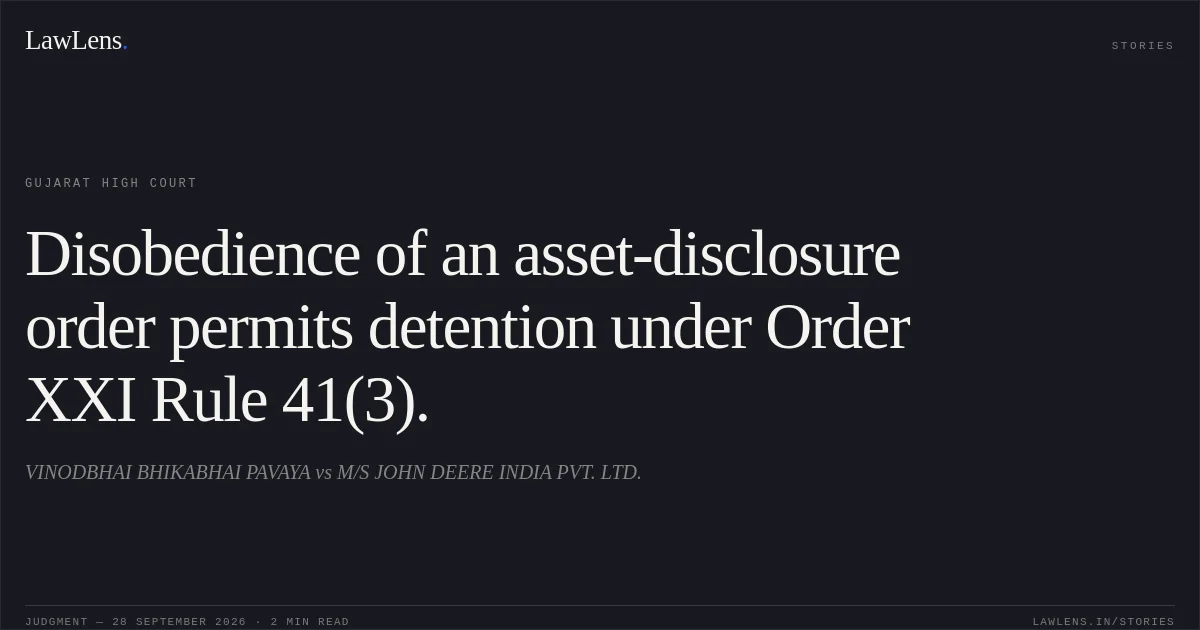
Order XXI Rule 41(2) CPC empowers the executing court to require a judgment debtor to disclose assets by affidavit, and Rule 41(3) permits detention in civil prison for up to three months for disobedience of an order under sub-rule (2).
Source reference: paras. 6.2, 7.2Order XXI Rule 11A requires an application seeking arrest and detention to state the grounds for that relief.
Source reference: paras. 3.2, 9.1Section 58 CPC concerns detention in execution of a money decree; the Court treated the reference to that provision as not invalidating an order otherwise within the Executing Court’s power.
Source reference: paras. 7–8Relying on State of Karnataka v. Muniyalla, (1985) 1 SCC 196, the Court applied the principle that citation of a wrong statutory provision does not invalidate an order if it could validly have been made under another provision.
Source reference: para. 7.1It also applied the restricted scope of Article 227 review, relying on Sameer Suresh Gupta v. Rahul Kumar Agarwal, (2013) 9 SCC 374, and Garment Craft v. Prakash Chand Goel, (2022) 4 SCC 181.
Source reference: paras. 12–13Reasoning
The Court found that the petitioners had not complied with the order to disclose their assets, and that the decree holder’s application sought detention specifically because of that disobedience.
Source reference: paras. 6.2–6.3, 9Accordingly, the Executing Court had authority to act under Order XXI Rule 41(3), and the reference to Section 58 in the operative order did not invalidate it; the Court also noted that the reference allowed detention to end earlier if the decretal amount was paid.
Source reference: paras. 7–8The application adequately identified non-compliance with the asset-disclosure order as the ground for detention, satisfying the purpose of Rule 11A.
Source reference: para. 9.1The Court found no perversity, gross illegality, or other basis for supervisory intervention.
Source reference: paras. 10, 12–13Holding
The High Court held that the impugned detention order disclosed no ground for interference under Article 227.
The Court dismissed the petition, making no order as to costs.
Source reference: para. 14Acts & Sections Cited
2 provisions across 2 statutes referred to in this judgment. Each provision opens on LawLens.
Code of Civil Procedure, 19081
Code of Criminal Procedure, 19731
Original Court PDF
VINODBHAI BHIKABHAI PAVAYAvsM/S JOHN DEERE INDIA PVT. LTD.
Click to open original judgment
Original judgment, available to read, download and summarize on LawLens.in