Facts
Jagdish Lal Arora retired from the Bank of India on 31 October 2018 after more than 36 years of service.
Source reference: paras. 1, 4–5; pp. 1–3Before his superannuation, the Bank issued a major-penalty charge-sheet dated 27 September 2018 concerning foreign-exchange transactions in the account of M/s Mine-O-Gold.
Source reference: paras. 1, 4–5; pp. 1–3The enquiry was conducted in October 2018, with the Petitioner represented by a Defence Assistant, permitted to cross-examine the management witness, produce documents, and file a written brief.
Source reference: paras. 6–7; pp. 3–4Invoking Regulation 20(3)(iii) of the Bank of India (Officers’) Service Regulations, 1979, the Bank continued the disciplinary proceeding after the Petitioner’s superannuation.
Source reference: para. 8; p. 3The Disciplinary Authority disagreed with the Inquiry Officer on three partly proved charges, furnished a tentative disagreement note, and thereafter imposed the penalty of removal from service on 13 May 2019.
Source reference: paras. 9–10; pp. 4–5Removal resulted in forfeiture of past service and denial of regular pension.
Source reference: para. 11; p. 4Issues
Whether the Bank had jurisdiction under Regulation 20(3)(iii) to continue disciplinary proceedings and impose a penalty after the Petitioner’s superannuation, where the charge-sheet had been issued before retirement?
Source reference: paras. 14–18; pp. 6–7Whether the disciplinary enquiry and the Disciplinary Authority’s disagreement with the Inquiry Officer violated principles of natural justice or denied the Petitioner a reasonable opportunity of defence?
Source reference: paras. 19–23; pp. 7–8Whether the findings of misconduct, particularly the finding relating to excess utilisation of the sanctioned Foreign Bills Purchased limit, were supported by evidence?
Source reference: paras. 24–37; pp. 8–13Whether the penalty of removal from service was disproportionate in light of the surviving misconduct, the Petitioner’s service record, absence of dishonesty or personal gain, and the penalties imposed on other employees?
Source reference: paras. 38–51; pp. 13–17What pensionary and retiral benefits followed from substitution of removal with compulsory retirement?
Source reference: paras. 52–60; pp. 17–22Law Applied
Regulation 20(3)(iii) of the Bank of India (Officers’) Service Regulations, 1979 permits disciplinary proceedings initiated before superannuation to continue thereafter as if the officer remained in service until final conclusion.
Source reference: paras. 14–18; pp. 6–7The Court relied on UCO Bank v. Rajinder Lal Capoor, (2007) 6 SCC 694, distinguishing cases where the charge-sheet was issued only after retirement; Ramesh Chandra Sharma v. Punjab National Bank, (2007) 9 SCC 15; Mahanadi Coalfields Ltd. v. Rabindranath Choubey, (2020) 18 SCC 71; and Virinder Pal Singh v. Punjab & Sind Bank, 2026 INSC 266, which recognise continuation of validly instituted disciplinary proceedings after superannuation where the governing regulations so provide.
Source reference: paras. 16–17; pp. 6–7Under Punjab National Bank v. Kunj Behari Misra, (1998) 7 SCC 84, a Disciplinary Authority disagreeing with a favourable finding of the Inquiry Officer must give tentative reasons and an opportunity to represent before recording its final finding.
Source reference: para. 23; p. 8Judicial review under Article 226 does not ordinarily permit reappreciation of evidence or substitution of the disciplinary authority’s reasonable view; however, under B.C. Chaturvedi v. Union of India, (1995) 6 SCC 749, and Punjab & Sind Bank v. Raj Kumar, 2026 INSC 313, the Court may interfere with a punishment that is strikingly or exceptionally disproportionate, and in rare cases substitute an appropriate penalty.
Source reference: paras. 42–43; pp. 14–15Regulation 4(h) of the Discipline & Appeal Regulations treats compulsory retirement as a major penalty, while Regulation 33 of the Bank of India (Employees’) Pension Regulations, 1995 prescribes pension between two-thirds and the full pension otherwise admissible on compulsory retirement as a penalty.
Source reference: paras. 54–56; pp. 18–19Under Vijay Kumar v. Central Bank of India, 2025 INSC 848, reduction below full pension requires prior hearing and consultation with the Board of Directors, and two-thirds is the statutory minimum.
Source reference: paras. 54–56; pp. 18–19Regulation 46(1) requires maximum provisional pension during the pendency of disciplinary proceedings after retirement, and Regulation 38 entitles an officer compulsorily retired, including as a penalty, to cash equivalent of accumulated privilege leave up to 240 days.
Source reference: paras. 57–58; pp. 19–20Reasoning
The Court held that the proceeding was validly continued because the charge-sheet was issued before superannuation and Regulation 20(3)(iii) expressly authorised continuation until a final order.
Source reference: paras. 15–18; pp. 6–7The enquiry was not unfair merely because it was conducted expeditiously: the Petitioner had representation, document access, cross-examination, and an opportunity to submit a written defence.
Source reference: paras. 19–22; pp. 7–8His contemporaneous statement that he had received a fair and impartial opportunity substantially undermined his later natural-justice objection, particularly since he identified no withheld document or specific prejudice.
Source reference: paras. 19–22; pp. 7–8The disagreement procedure also complied with Kunj Behari Misra because tentative reasons were supplied and the Petitioner’s response was considered.
Source reference: para. 23; p. 8On the merits, the Court declined to reappraise the disciplinary evidence and upheld the findings concerning lack of LC exposure and approvals, excess of delegated authority, failure to scrutinise onerous LC clauses, unauthorised extensions, and the remaining procedural lapses in bill negotiation.
Source reference: paras. 24–31, 37; pp. 8–12However, Charge I(vii) was set aside because the Bank’s own sanction document treated FBN as “over and above” the MPBF, and the LFAR recorded outstanding FBP of INR 384.46 lakh against the INR 4 crore limit.
Source reference: paras. 32–36; pp. 12–13The Inquiry Officer’s rejection of the audit record rested only on conjecture that the LFAR might be wrong, unsupported by evidence.
Source reference: paras. 32–36; pp. 12–13Although the surviving misconduct justified a major penalty, removal was disproportionate.
Source reference: paras. 39–47; pp. 13–16The Petitioner had no established misappropriation, personal benefit, collusion, or dishonesty; he had an otherwise unblemished service record of over 36 years; Charge I(vii), which had contributed to the penalty, was unsustainable; and every other employee proceeded against in relation to the account received censure, caution, or closure.
Source reference: paras. 39–47; pp. 13–16While strict parity was unavailable because the Petitioner had a broader and more direct role, the comparative penalties remained relevant to proportionality.
Source reference: paras. 39–47; pp. 13–16The Court therefore substituted removal with compulsory retirement rather than remitting the matter, considering the passage of nearly eight years and the complete material available for determining the appropriate penalty.
Source reference: paras. 48–51; pp. 16–17Holding
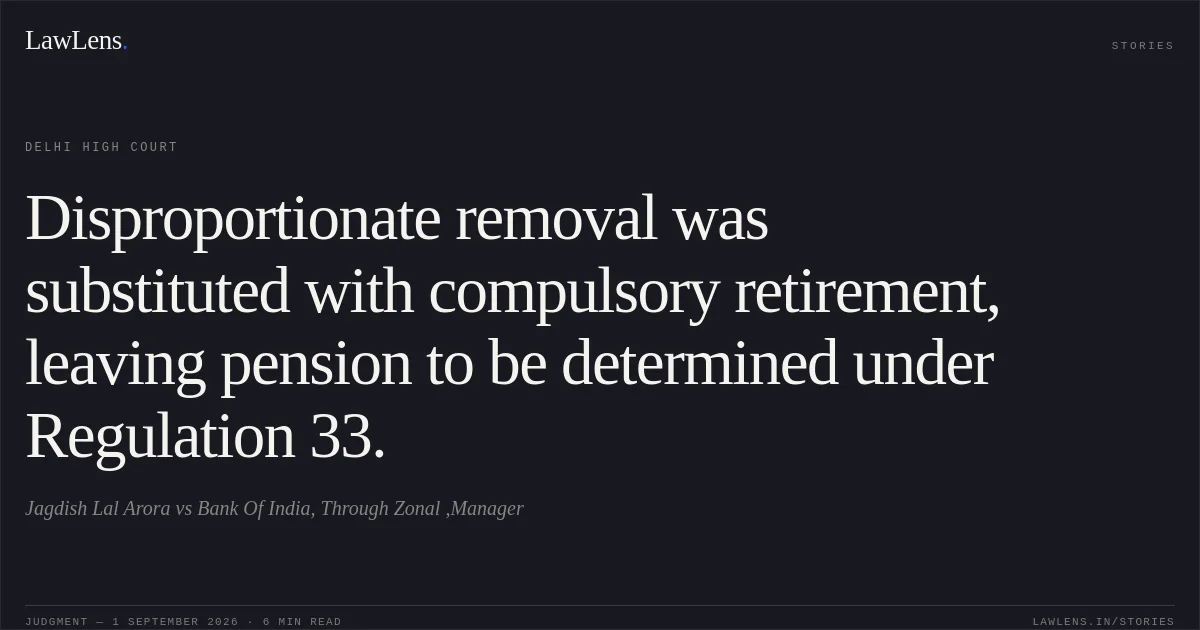
The petition was partly allowed.
The finding under Charge I(vii) was quashed, while the remaining findings were upheld.
Source reference: para. 60(i); pp. 20–21The penalty of removal imposed on 13 May 2019 was substituted with compulsory retirement under Regulation 4(h), reckoned for retiral and pensionary purposes from 31 October 2018, without disturbing salary or emoluments earned up to that date.
Source reference: para. 60(ii); pp. 20–21The Bank was directed to recalculate and pay any shortfall in maximum provisional pension for 1 November 2018 to 13 May 2019 within eight weeks, without future recovery of any difference merely because final pension was lower.
Source reference: para. 60(iii); pp. 21–22The competent authority was directed to determine final pension under Regulation 33 from 1 November 2018, not below two-thirds of the otherwise admissible pension; any reduction below full pension required hearing of the Petitioner and prior consultation with the Board of Directors.
Source reference: para. 60(iv); pp. 21–22In default of a valid decision within eight weeks, full pension would become payable, with arrears to follow within four weeks and interest at 6% per annum for subsequent delay.
Source reference: para. 60(v); pp. 21–22The Bank was also directed to pay the cash equivalent of privilege leave standing to the Petitioner’s credit, subject to the 240-day ceiling, with 6% interest for delay.
Source reference: para. 60(vi); p. 22The claim for interest on gratuity was rejected because gratuity had been lawfully withheld during the disciplinary proceeding and was released shortly after the penalty order.
Source reference: para. 60(vii); pp. 20–22Original Court PDF
Jagdish Lal AroravsBank Of India, Through Zonal ,Manager
Click to open original judgment
Original judgment, available to read, download and summarize on LawLens.in