01Facts
The marriage between the revisionist and respondent No. 1 was solemnized on 14 February 2020, and respondent No. 2 was born on 31 January 2021.
¶ 4Following matrimonial discord, respondent No. 1 resided separately at her maternal home and filed a maintenance proceeding on 23 March 2026.
¶ 7The Principal Judge, Family Court, Indore, passed an interim order dated 23 June 2026 in Case No. MJCR/393/2026, granting interim maintenance to respondent Nos. 1 and 2.
¶ 1–2In revision, the husband alleged that respondent No. 1 was living in adultery with a person named Somesh and relied upon alleged written admissions by respondent No. 1 and Somesh concerning their relationship.
¶ 5–6, 8–10He sought setting aside of the interim maintenance order.
02Issues
i.Whether the High Court, in exercise of its revisional jurisdiction under Section 19(4) of the Family Courts Act read with Sections 438 and 442 of the BNSS, should interfere with an order granting interim maintenance.
¶ 1, 3, 12ii.Whether the revisionist’s allegations of adultery, alleged written admissions, and voluntary withdrawal by respondent No. 1 from his company could be conclusively adjudicated in revision against an interim maintenance order.
¶ 13–1403Law Applied
The Court applied the limited and supervisory scope of revisional jurisdiction under Section 19(4) of the Family Courts Act read with Sections 438 and 442 of the BNSS, under which interference is confined to examining the correctness, legality, propriety, jurisdictional validity, perversity, or material irregularity of the impugned order.
¶ 1, 3, 12, 15–16A revisional court does not function as a regular appellate court and ordinarily cannot reappreciate evidence unless intervention is necessary to prevent a miscarriage of justice.
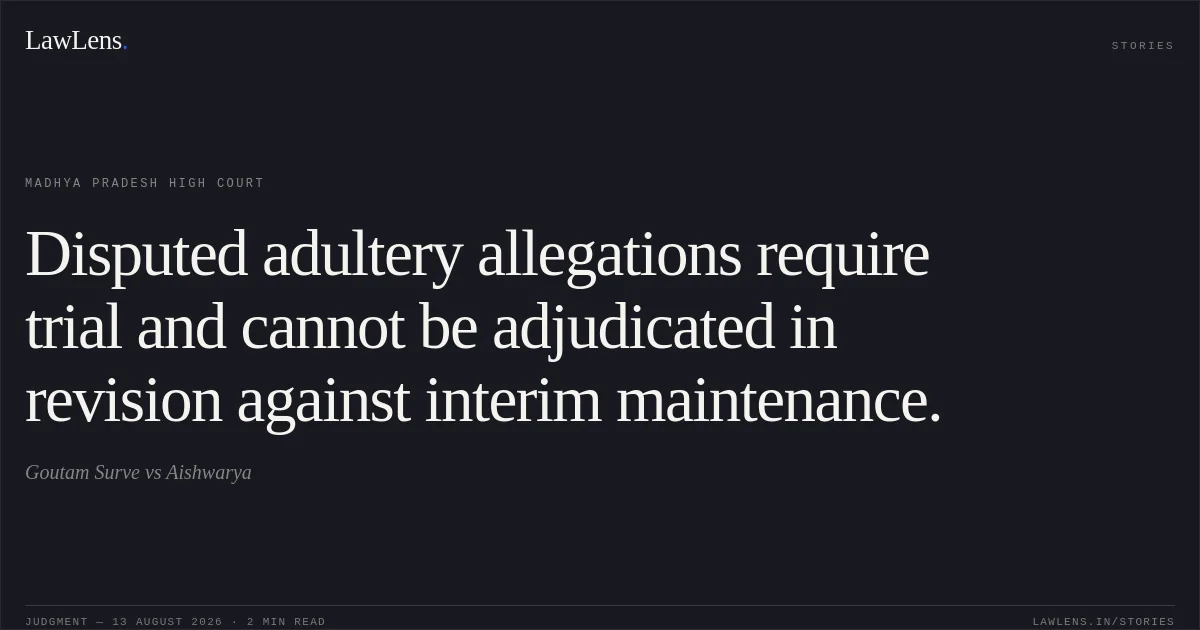
¶ 12The Court further held that interim maintenance is a temporary measure intended to secure sustenance pending final adjudication, and disputed factual allegations requiring evidence should ordinarily be determined at trial rather than in revision.
¶ 14–15Provisions in the judgment · 3 · Linked ones open on LawLens
Family Courts Act, 1984 Section 19
Bharatiya Nagarik Suraksha Sanhita, 2023 Section 438Section 442
04Reasoning
The Court found that the allegations regarding respondent No. 1’s alleged adulterous relationship, the authenticity and evidentiary value of the alleged written admissions, and her alleged withdrawal from the revisionist’s society were disputed questions of fact.
¶ 13Determining those questions would require a full-fledged trial and examination of evidence by both parties, which was impermissible in the present revision arising from an interim order.
¶ 14Since the Family Court had granted interim maintenance on the material available at that stage and had committed neither a jurisdictional error nor a patent illegality, the limited revisional standard was not satisfied.
¶ 15The impugned order also did not suffer from perversity or material irregularity warranting interference.
¶ 1605Holding
The High Court answered the issues against the revisionist.
It held that the allegations of adultery and the related documents could not be conclusively examined in revision against an interim maintenance order and that no jurisdictional error, patent illegality, perversity, or material irregularity had been demonstrated.
¶ 14–16Accordingly, Criminal Revision No. 3277 of 2026 was dismissed, and the Family Court’s order dated 23 June 2026 granting interim maintenance to respondent Nos. 1 and 2 was affirmed.
¶ 17Original Court PDF
Goutam SurvevsAishwarya
Click to open original judgment
Original judgment, available to read, download and summarize on LawLens.in



