Facts
The appellants challenged an order dated 12.01.2026 passed by a Single Judge in W.P. No. 15342/2025
Source reference: para. 1The appellants contended that in prior revenue proceedings, their signatures on deposition sheets were forged and that they were impersonated by third parties to provide false consent
Source reference: paras. 2, 5They sought to overturn the revenue orders on the grounds of this alleged fraud and lack of actual participation in the proceedings
Source reference: para. 5Issues
1. Whether a Writ Court, exercising powers under Article 226/227 of the Constitution or in a Writ Appeal, can decide highly disputed questions of fact regarding the forgery of signatures and impersonation in lower court proceedings
Source reference: paras. 4, 62. Whether the existence of an express bar under Section 257 of the MPLR Code precludes the Civil Court from entertaining a suit where the underlying revenue order is alleged to have been obtained by fraud
Source reference: paras. 7, 9Law Applied
The court applied the principle that court proceedings carry a presumption of truth unless proven false
Source reference: para. 3Section 257 of the Madhya Pradesh Land Revenue (MPLR) Code, which generally excludes Civil Court jurisdiction over revenue matters
Source reference: para. 7Dhulabhai v. State of Madhya Pradesh [AIR 1969 SC 78], which establishes that statutory bars do not exclude Civil Court jurisdiction where fundamental principles of judicial procedure are ignored
Source reference: para. 8Vishnu Vardhan v. State of U.P. [2025 SCC OnLine SC 1501] and A.V. Papayya Sastry v. Govt. of A.P. [(2007) 4 SCC 221], the court reaffirmed the doctrine that "fraud vitiates every solemn act," rendering any order obtained through fraud a nullity that can be challenged in collateral proceedings
Source reference: paras. 11, 12, 13Reasoning
The Court reasoned that the determination of whether signatures were forged or whether impersonation occurred constitutes a "highly disputed question of fact"
Source reference: paras. 4, 6Such factual inquiries are outside the scope of summary writ jurisdiction under Article 226/227 of the Constitution
Source reference: para. 4While Section 257 of the MPLR Code typically grants exclusive jurisdiction to revenue authorities, the Court emphasized that fraud is an extrinsic collateral act that "unravels everything"
Source reference: paras. 11-13Applying the Dhulabhai principles, the Court found that if an order is a nullity due to fraud, the aggrieved party has a right to seek a remedy in a Civil Court, as writ proceedings are not the appropriate forum for the detailed evidentiary trial required to prove deceit and forgery
Source reference: paras. 9, 14Holding
The Court dismissed the Writ Appeal, holding that it cannot adjudicate disputed facts regarding forgery
Final Order: Appeal dismissed with liberty [to approach the Civil Court to set aside the revenue orders on the grounds of fraud, noting that a judgment obtained by fraud is non-est in the eyes of the law]
Source reference: para. 12, 14Acts & Sections Cited
17 provisions across 2 statutes referred to in this judgment. Each provision opens on LawLens.
MP Land Revenue Code 1959
Code of Civil Procedure, 19081
Original Court PDF
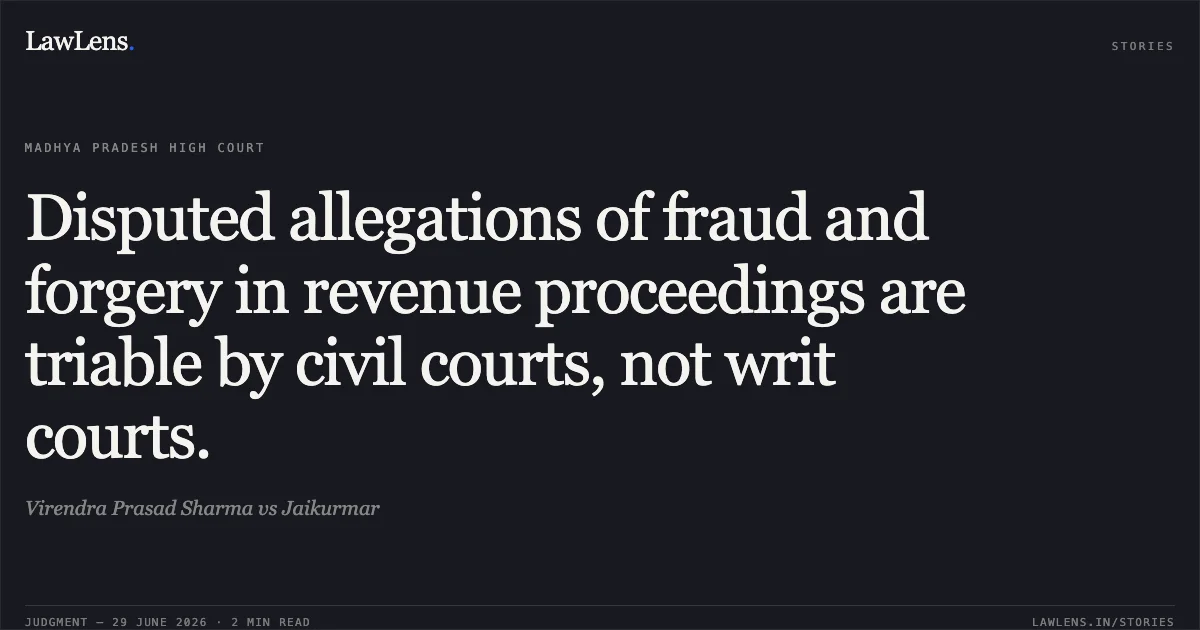
Virendra Prasad SharmavsJaikurmar
Click to open original judgment
Original judgment, available to read, download and summarize on LawLens.in