Facts
Petitioner No. 1, a real-estate company, and its directors negotiated with the opposite party for purchase of adjoining land at Ramnagar, Hooghly.
Source reference: para. 2The petitioners alleged that the opposite party failed to produce original title documents and complete revenue records and that, pending verification, a post-dated cheque for ₹1,58,45,971 was issued as a conditional part-payment, with an assurance that it would be returned if the transaction did not materialise.
Source reference: paras. 2–4After alleged due diligence revealed defects in title and lack of contiguity, the petitioners claimed to have cancelled the transaction and requested return of the cheque.
Source reference: paras. 3–4The opposite party nevertheless presented it, and it was dishonoured for insufficiency of funds.
Source reference: paras. 3–4The opposite party initiated a complaint under Sections 138 and 141 of the Negotiable Instruments Act, 1881 (“NI Act”).
Source reference: para. 5Cognizance was taken, the petitioners appeared and were released on bail, and their applications under Sections 305 and 205 Cr.P.C. were allowed.
Source reference: para. 5–6They were examined under Section 251 Cr.P.C. and pleaded not guilty.
Source reference: para. 5–6The Trial Court subsequently directed payment of 15% of the cheque amount, namely ₹23,77,000, as interim compensation under Section 143A of the NI Act.
Source reference: paras. 7, 22The petitioners invoked Sections 397/401 read with Section 482 Cr.P.C. seeking quashing of the complaint proceeding and setting aside of the impugned order, contending that no legally enforceable debt or liability existed because the proposed land transaction had been cancelled.
Source reference: paras. 1, 8–13Issues
Whether the complaint under Sections 138/141 of the NI Act disclosed the basic ingredients of an offence warranting continuation of the proceedings, despite the petitioners’ contention that the cheque was issued conditionally and that the underlying land transaction had been cancelled?
Source reference: paras. 19–21, 27Whether the statutory presumptions under Sections 118(a) and 139 of the NI Act could be rebutted, and the alleged absence of a legally enforceable debt determined, at the revisional or inherent-jurisdiction stage without a trial?
Source reference: paras. 23–26Whether the High Court should exercise jurisdiction under Sections 397/401 read with Section 482 Cr.P.C. to quash the complaint or interfere with the order directing interim compensation under Section 143A of the NI Act?
Source reference: paras. 22, 27–30Law Applied
Section 138 of the NI Act criminalises dishonour of a cheque issued towards discharge, in whole or in part, of a legally enforceable debt or liability, while Section 141 governs liability in the case of offences by companies.
Source reference: no citationUpon admission or proof of issuance and signature of the cheque, Sections 118(a) and 139 require presumptions that the instrument was made for consideration and received towards discharge of a debt or liability; these presumptions are rebuttable but ordinarily must be tested through evidence.
Source reference: para. 24In Rangappa v. Sri Mohan, (2010) 11 SCC 441, and as reiterated in Renuka v. State of Maharashtra, 2026 SCC OnLine SC 533, the Supreme Court held that the presumption under Section 139 includes the existence of a legally enforceable debt and cannot ordinarily be displaced summarily at the stage of issuance of process.
Source reference: para. 26Indu Airways (P) Ltd. v. Magnum Aviation (P) Ltd., (2014) 12 SCC 539, holds that a cheque issued merely as advance payment under a contract may not attract Section 138 where the transaction is cancelled and no liability subsists; however, that principle applies where the relevant contractual facts are established and undisputed.
Source reference: paras. 14, 23The powers under Sections 397/401 and 482 Cr.P.C. are to be exercised sparingly where the allegations do not disclose an offence, are inherently improbable, or the proceeding is demonstrably mala fide on undisputed facts.
Source reference: para. 27Section 143A of the NI Act empowers the Trial Court to direct interim compensation after commencement of proceedings, subject to the statutory conditions.
Source reference: paras. 7, 22Reasoning
The Court found that issuance of the cheque and the petitioners’ signatures were undisputed, and that the complaint alleged presentation, dishonour, service of statutory notice, and institution within the prescribed period.
Source reference: paras. 21, 24, 27These facts triggered the presumptions under Sections 118(a) and 139 of the NI Act.
Source reference: paras. 21, 24Although the petitioners asserted that the cheque was conditional, that the opposite party lacked valid title, and that the transaction had been cancelled, the parties’ competing accounts concerned disputed oral negotiations, the purpose of the cheque, the stage and terms of cancellation, and whether any liability had crystallised.
Source reference: paras. 19–20, 23The absence of a written agreement or sale deed did not, by itself, establish that no liability existed, particularly when an oral agreement could legally be proved by evidence.
Source reference: para. 20The Court distinguished Indu Airways because that case involved an undisputed concluded purchase order and advance-payment arrangement, whereas the present case involved no settled written contractual matrix and materially disputed facts.
Source reference: para. 23Consequently, the alleged cancellation and absence of legally enforceable liability constituted matters for rebuttal at trial, not grounds for quashing under Sections 397/401 or 482 Cr.P.C.
Source reference: paras. 25, 27–28The Court also held that the existence of related or cross-litigation did not, without more, establish mala fides warranting interference.
Source reference: para. 28Holding
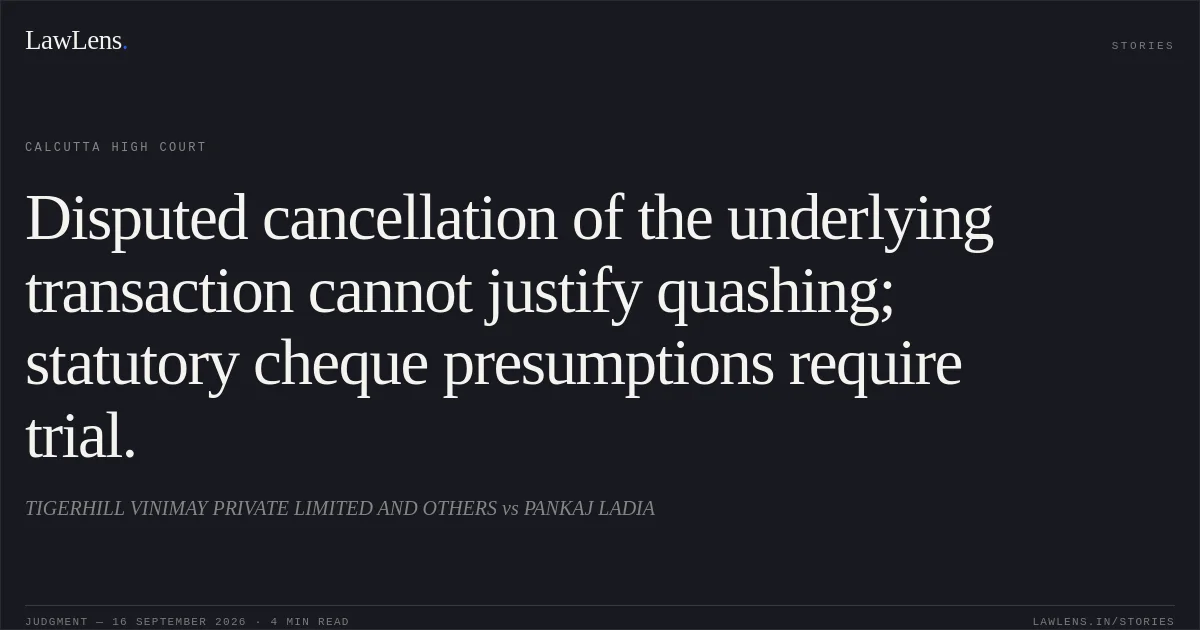
The Court held that the complaint prima facie satisfied the requirements of Section 138 of the NI Act and that the petitioners’ defence regarding cancellation of the proposed land transaction and absence of liability required adjudication at trial.
It declined to quash C.S. No. 107429 of 2018 or interfere with the order directing payment of interim compensation under Section 143A of the NI Act.
Source reference: paras. 29–32C.R.R. No. 3282 of 2022 was dismissed; connected applications, if any, were disposed of, and any interim order was vacated.
Source reference: paras. 29–32Acts & Sections Cited
14 provisions across 3 statutes referred to in this judgment. Each provision opens on LawLens.
Code of Criminal Procedure, 19737
Negotiable Instruments Act, 18815
Indian Penal Code, 18602
Original Court PDF
TIGERHILL VINIMAY PRIVATE LIMITED AND OTHERSvsPANKAJ LADIA
Click to open original judgment
Original judgment, available to read, download and summarize on LawLens.in