01Facts
On 30 April 2026, police intercepted co-accused Vivek Sahu and Vikas Bakshi near Laxmi Niwas Chowk, Dhamtari, and allegedly recovered 18 and 24 bottles of Budweiser beer from their possession.
¶ 2The petitioner was not present at the spot and no contraband was recovered from him.
¶ 2The co-accused allegedly stated in memoranda recorded under Section 23(2) of the Bharatiya Sakshya Adhiniyam, 2023, that the petitioner, proprietor of Bagga Bar, had financed their purchase of liquor.
¶ 2An FIR was registered on 1 May 2026 under Section 34(2) of the Chhattisgarh Excise Act.
¶ 2After investigation, including witness statements, spot maps and a Farari Panchnama, the police filed a charge-sheet on 27 June 2026.
¶ 2The Chief Judicial Magistrate, Dhamtari, took cognizance, treated the petitioner as absconding and issued a warrant of arrest against him.
¶ 3The petitioner invoked Section 528 of the Bharatiya Nagarik Suraksha Sanhita, 2023, seeking quashing of the Dehati Nalishi, FIR, charge-sheet, cognizance order, absconder declaration, warrant and consequential criminal proceedings.
¶ 2–302Issues
i.1. Whether the Dehati Nalishi, FIR, charge-sheet, order taking cognizance and criminal proceedings against the petitioner were liable to be quashed under Section 528 of the BNSS, 2023, on the grounds of inadmissibility of co-accused memoranda, procedural irregularities in seizure and arrest, and insufficiency of evidence.
¶ 4ii.2. Whether the High Court should interfere with the declaration of the petitioner as absconding and the consequential warrant of arrest, and whether the petitioner should be granted an opportunity to appear before the Trial Court and seek appropriate relief.
¶ 8–903Law Applied
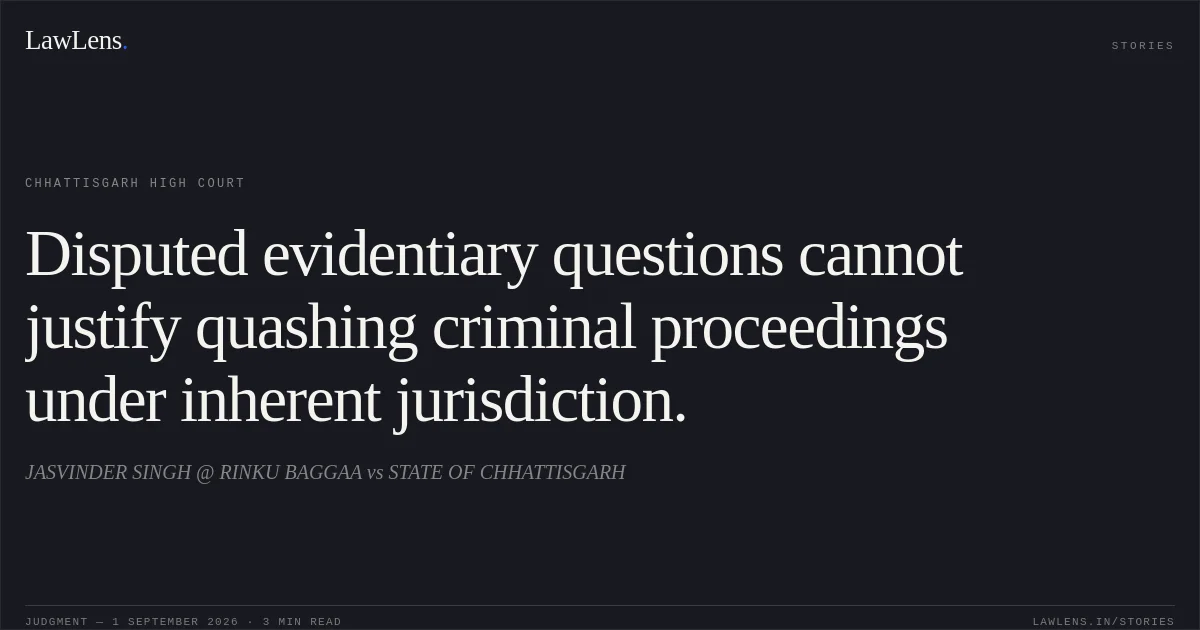
The Court applied Section 528 of the Bharatiya Nagarik Suraksha Sanhita, 2023, which preserves the High Court’s inherent jurisdiction to prevent abuse of the process of court and secure the ends of justice; however, disputed questions concerning the manner of investigation, evidentiary value or admissibility of material, and sufficiency of prosecution evidence ordinarily cannot be conclusively determined in quashing proceedings.
¶ 7The Court also applied the principle that the issuance of coercive process is intended to secure an accused’s presence before the court and is not punitive in character.
¶ 8The petitioner relied upon Inder Mohan Goswami v. State of Uttaranchal , Appeal (Cri.) No. 1392 of 2007, concerning the cautious exercise of power to issue non-bailable warrants, and Aman Preet Singh v. CBI through Director , 2021 SCC OnLine SC 941, concerning protection from unnecessary arrest where custodial interrogation is not required and the charge-sheet has been filed.
¶ 4Provisions in the judgment · 3 · Linked ones open on LawLens
Bharatiya Sakshya Adhiniyam, 2023 Section 23
Bharatiya Nagarik Suraksha Sanhita, 2023 Section 528
Code of Criminal Procedure, 1973 Section 482
04Reasoning
The Court held that the petitioner’s challenges to the FIR, charge-sheet and cognizance order depended upon disputed factual and evidentiary matters, including the legality of the seizure and arrest chronology, the admissibility and reliability of the co-accused memoranda, alleged non-compliance with arrest safeguards, and the absence of recovery or documentary proof directly connecting the petitioner with the liquor.
¶ 7These matters required assessment by the Trial Court on the basis of evidence and could not be meticulously examined in the High Court’s inherent jurisdiction under Section 528 BNSS.
¶ 7Nevertheless, since the petitioner had approached the High Court and expressed willingness to submit to the jurisdiction of the Trial Court, the Court considered it appropriate to modify the coercive process.
¶ 8It distinguished between adjudicating the merits of the prosecution and ensuring the petitioner’s appearance, holding that the warrant should not operate as a punitive measure.
¶ 805Holding
The Court rejected the prayer for quashing the Dehati Nalishi, FIR, charge-sheet, order taking cognizance and criminal proceedings against the petitioner.
¶ 7, 11The warrant of arrest issued pursuant to the order dated 27 June 2026 was quashed.
¶ 9The petitioner was directed to appear before the Chief Judicial Magistrate, Dhamtari, within two weeks and was granted liberty to pursue all remedies available in law, including an application for bail.
¶ 10The Trial Court was directed to proceed in accordance with law, uninfluenced by the High Court’s observations on the merits.
¶ 10Original Court PDF
JASVINDER SINGH @ RINKU BAGGAAvsSTATE OF CHHATTISGARH
Click to open original judgment
Original judgment, available to read, download and summarize on LawLens.in