Facts
The petitioners (the husband and father-in-law of the respondent) filed a petition under Section 528 of the Bharatiya Nagarik Suraksha Sanhita (BNSS), 2023, seeking to quash FIR No. 58/2025 registered at Mahila Thana, Bhind.
Source reference: p.1The FIR alleged offenses under Section 85 of the Bharatiya Nyaya Sanhita (BNS), 2023, and Sections 3 and 4 of the Dowry Prohibition Act.
Source reference: p.1The complainant alleged that after her marriage in April 2024, the petitioners harassed her for a motorcycle and Rs. 5,00,000, eventually assaulting and expelling her from the matrimonial home on September 25, 2024.
Source reference: p.2The petitioners argued that the allegations were vague and motivated by mala fide intent, noting that a previous FIR filed by the complainant regarding a domestic dispute on September 19, 2024, contained no mention of dowry demands.
Source reference: p.4They further raised a plea of alibi, asserting they were on active military duty in Assam and Arunachal Pradesh at the time of the alleged incident.
Source reference: p.4-5Issues
1. Whether the FIR and consequential proceedings should be quashed under Section 528 of the BNSS on the grounds that the allegations are inherently improbable or constitute an abuse of the process of law.
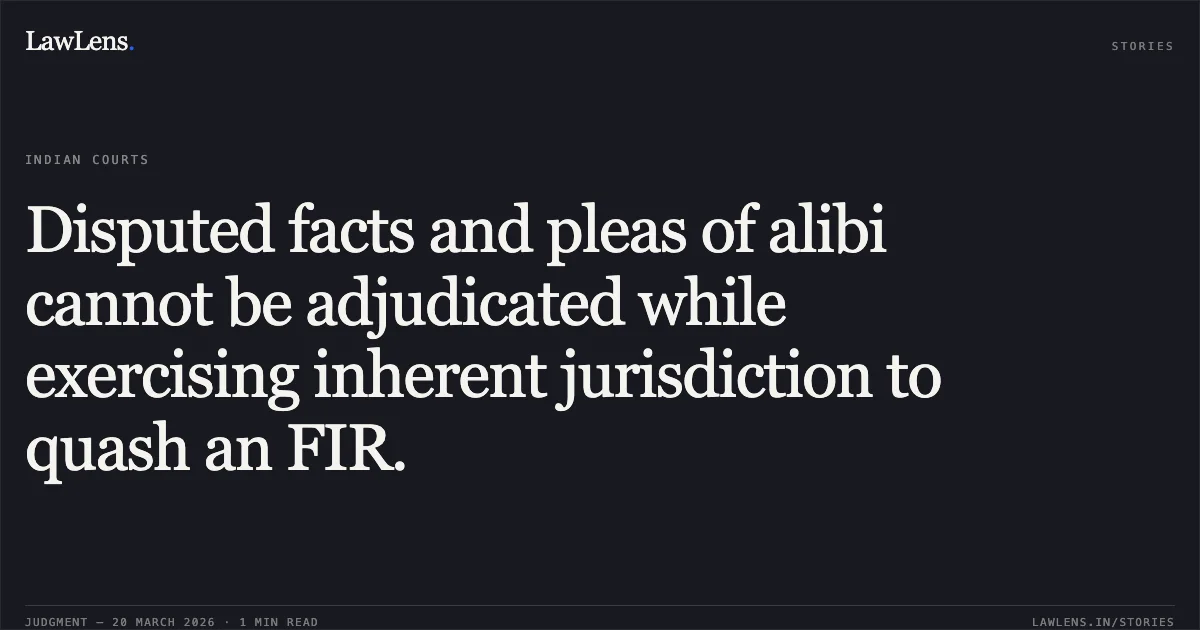
Source reference: p.72. Whether the High Court, in its inherent jurisdiction, can adjudicate upon disputed questions of fact such as a plea of alibi or the credibility of evidence at the threshold stage.
Source reference: p.8Law Applied
Section 528 of the BNSS, 2023 (corresponding to Section 482 of the CrPC), which grants the High Court inherent powers to quash proceedings to prevent the abuse of the process of any court or to secure the ends of justice.
Source reference: p.1, 7The court adhered to the established principle that such power must be used "sparingly" and only when the FIR, taken at face value, fails to disclose a cognizable offense.
Source reference: p.7Section 85 of the BNS regarding matrimonial cruelty.
Source reference: p.5The guidelines for preliminary inquiries in matrimonial disputes established in Rajesh Sharma v. State of U.P. (2017).
Source reference: p.8Reasoning
The Court reasoned that the FIR contained specific and categorical allegations of dowry harassment and physical ill-treatment that were not "so absurd or inherently improbable" as to be discarded without a trial.
Source reference: p.7The Court rejected the petitioners' arguments regarding the delay in filing the FIR and the omissions in previous statements, categorizing these as matters of defense that require the appreciation of evidence during trial rather than in a quashment proceeding.
Source reference: p.8Regarding the plea of alibi, the Court held that such a claim is a matter of evidence to be established during the trial and cannot be adjudicated at a preliminary stage under Section 528 of the BNSS.
Source reference: p.8The Court noted that matrimonial offenses usually occur within the privacy of a home, making the statements of the victim and relatives primary evidence that should not be prematurely scuttled.
Source reference: p.8The Court ruled that even if procedural guidelines from Rajesh Sharma were not strictly followed, it does not warrant quashing if the FIR prima facie discloses cognizable offenses.
Source reference: p.9Holding
The Court dismissed the petition, holding that a prima facie case was made out and the continuation of proceedings did not amount to an abuse of the process of law.
The Court directed the investigating agency to proceed strictly in accordance with the law and clarified that its observations were limited to the adjudication of the present petition and should not influence the merits of the trial.
Source reference: p.9Acts & Sections Cited
5 provisions across 4 statutes referred to in this judgment. Each provision opens on LawLens.
Bharatiya Nyaya Sanhita, 20231
Code of Criminal Procedure, 19731
Bharatiya Nagarik Suraksha Sanhita, 20231
Original Court PDF
Husain KhanvsThe State Of Madhya Pradesh
Click to open original judgment
Original judgment, available to read, download and summarize on LawLens.in


