Facts
The District Health Society, Madhubani approved the petitioner’s selection to supply a 40 KVA generator to the Sub-Divisional Hospital, Jhanjharpur, at the rate of ₹348 per hour, through Memo No. 460 dated 4 March 2014.
Source reference: p.2The petitioner continuously supplied generator services, with the hours of operation recorded in a logbook, and raised bills on that basis.
Source reference: p.2Although payments were made without deduction up to May 2016, the respondents subsequently deducted amounts on the ground that electricity had been supplied to the hospital during the relevant periods and, therefore, generator services were allegedly not required.
Source reference: p.2–3The petitioner sought payment of ₹16,77,764, comprising withheld amounts for June 2016–January 2017 and July 2017–February 2018.
Source reference: p.1The respondents defended the deductions on the ground that generator charges were not payable during periods when regular electricity was available.
Source reference: p.3–4Issues
1. Whether the petitioner was entitled to payment of the withheld generator-service charges on the basis of the logbook and bills raised under the approval dated 4 March 2014
Source reference: p.1–32. Whether the deductions made by the respondent authorities on account of electricity supply were legally justified under the applicable arrangement
Source reference: p.3–43. Whether the High Court could determine these disputed factual issues in exercise of its jurisdiction under Article 226 of the Constitution
Source reference: p.4–5Law Applied
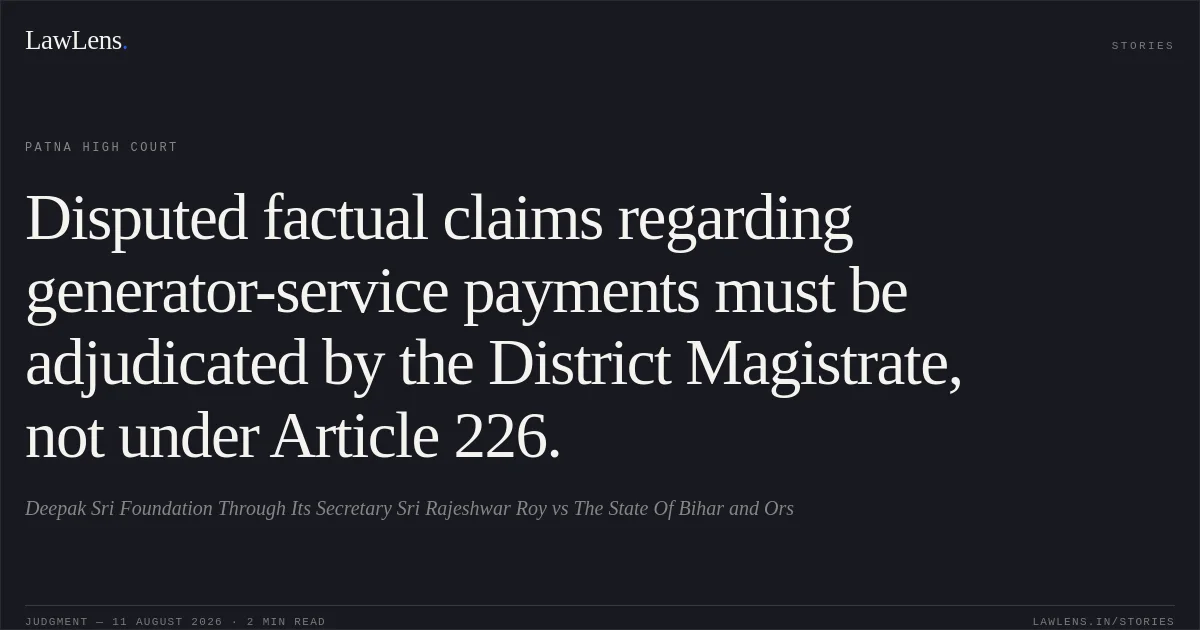
The Court applied the principle governing judicial review under Article 226 of the Constitution of India, namely that disputed and fact-intensive matters ordinarily should not be conclusively adjudicated in writ jurisdiction where an appropriate administrative authority can examine the evidence.
Source reference: p.4–5The Court further applied the principles of natural justice by directing that the petitioner and the respondent authorities be given an opportunity of hearing before a decision is taken.
Source reference: p.4–5No specific statutory provision or judicial precedent was cited in the judgment.
Source reference: no citationReasoning
The Court noted that the petitioner relied on a maintained logbook and had received payment on that basis up to May 2016, while the respondents disputed the petitioner’s entitlement by asserting that generator use was unnecessary whenever electricity was available.
Source reference: p.4Determining the actual hours of generator operation, the effect of electricity supply, and the correctness of the deductions required examination of factual records and evidence.
Source reference: p.4Since the High Court considered that it could not appropriately decide these factual matters under Article 226, it referred the dispute to the District Magistrate, who was considered the competent authority to examine the bills and related records on merits.
Source reference: p.4–5Holding
The Court did not adjudicate the petitioner’s entitlement to the claimed amount or the validity of the deductions on merits.
The Court directed the petitioner to submit a representation before the District Magistrate or concerned authority within one month from receipt of the judgment.
Source reference: p.5The District Magistrate was directed to hear both the petitioner and the respondent authorities and pass an appropriate order regarding payment of the petitioner’s bills within three months from the filing of the representation, in accordance with law.
Source reference: p.4–5The writ petition was accordingly disposed of, and any pending interlocutory applications were also disposed of.
Source reference: p.5Original Court PDF
Deepak Sri Foundation Through Its Secretary Sri Rajeshwar RoyvsThe State Of Bihar and Ors
Click to open original judgment
Original judgment, available to read, download and summarize on LawLens.in