Facts
The complainant executed a registered sale deed dated 14 June 2013 in favour of Newtech Residency Pvt. Ltd. for 9.389 decimals of land for a consideration of ₹48,00,000.
Source reference: pp. 2–3Five post-dated cheques of ₹9,60,000 each were allegedly issued towards payment of the sale consideration.
Source reference: pp. 2–3One cheque, bearing No. 000138 and dated 13 October 2013, was dishonoured on 31 December 2013.
Source reference: pp. 2–3The complainant thereafter issued a statutory legal notice dated 20 January 2014, which was delivered to the accused on 23 January 2014, but payment was not made within the prescribed period.
Source reference: pp. 2–3The complainant filed Complaint Case No. 25404(C)/2014 alleging offences under Sections 406 and 420 of the Indian Penal Code and Section 138 of the Negotiable Instruments Act, 1881.
Source reference: p. 2The Magistrate took cognizance of offences under Section 420 IPC and Section 138 of the NI Act by order dated 19 April 2016.
Source reference: p. 2The petitioners sought quashing of the cognizance order, contending that disputes concerning possession, pending proceedings under Section 144 CrPC, and an earlier title suit relating to the land relieved them from liability to honour the cheque.
Source reference: pp. 3–5Issues
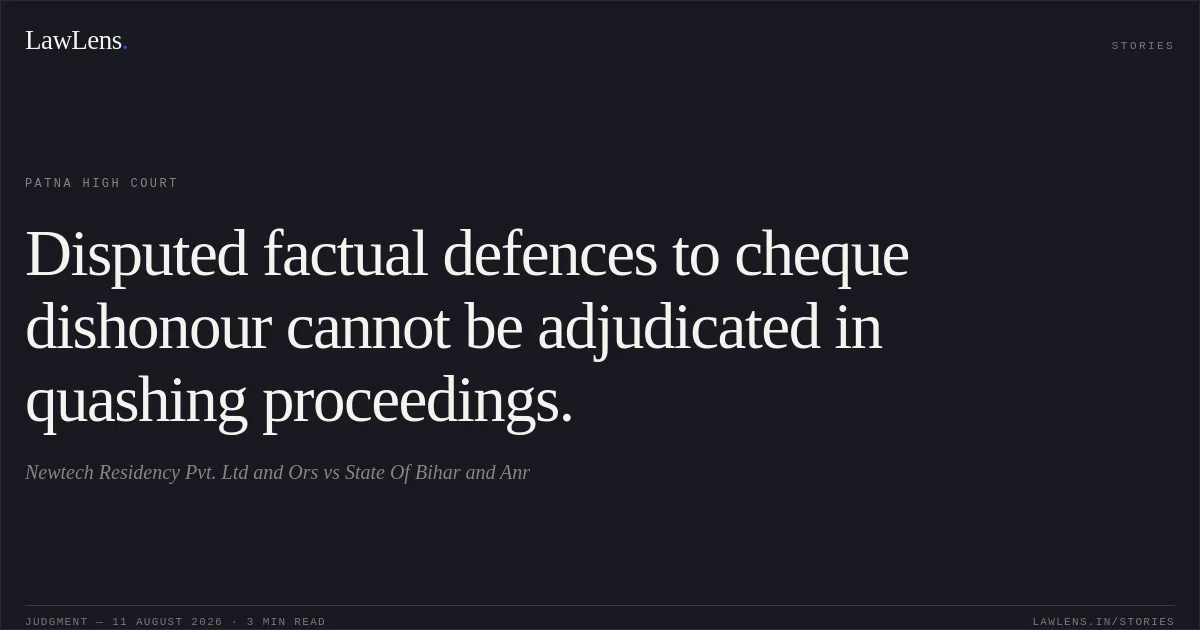
1. Whether the order dated 19 April 2016 taking cognizance under Section 420 IPC and Section 138 of the Negotiable Instruments Act, 1881 was liable to be quashed in the exercise of the High Court’s jurisdiction.
Source reference: p. 22. Whether the petitioners’ defence concerning pending land litigation, alleged non-disclosure of title disputes, and non-liability to pay the cheque amount could be adjudicated at the quashing stage or required determination at trial.
Source reference: pp. 4–63. Whether the statutory presumption under Section 139 of the Negotiable Instruments Act operated against the petitioners in relation to the dishonoured cheque.
Source reference: p. 6Law Applied
The Court applied Section 139 of the Negotiable Instruments Act, 1881, which raises a presumption in favour of the holder that a cheque was issued for the discharge of a debt or other legally enforceable liability, subject to rebuttal by the accused.
Source reference: p. 6The Court also applied the principle governing proceedings for quashing criminal complaints that disputed questions of fact and defences requiring evidence should ordinarily be examined by the trial court rather than determined in quashing proceedings.
Source reference: pp. 2, 6The Court considered the statutory consequences of dishonour of a cheque under Section 138 of the NI Act and the allegations constituting cheating under Section 420 IPC.
Source reference: pp. 2, 6Reasoning
The Court found that the cheques had been issued pursuant to the registered sale transaction and that the cheque in question had been dishonoured.
Source reference: pp. 4–6The petitioners’ reliance on the alleged pending title suit, proceedings under Section 144 CrPC, obstruction to possession, and the complainant’s alleged failure to disclose litigation raised factual disputes concerning the underlying transaction and the existence of liability.
Source reference: pp. 4–6These matters could not be conclusively determined at the quashing stage.
Source reference: pp. 4–6The Court further noted that the petitioners’ notice dated 16 July 2013 did not request the complainant not to present the post-dated cheques, which had been issued in furtherance of the sale deed.
Source reference: pp. 4–6In view of the presumption under Section 139 of the NI Act and the availability of the petitioners’ factual defences before the trial court, the Court found no sufficient ground to interfere with the cognizance order.
Source reference: p. 6Holding
The High Court held that the quashing petition lacked merit and dismissed it.
The cognizance order dated 19 April 2016 under Section 420 IPC and Section 138 of the NI Act was not interfered with.
Source reference: p. 6The petitioners were granted liberty to raise all their factual and legal defences before the trial court.
Source reference: p. 6A copy of the judgment was directed to be transmitted to the trial court along with the lower-court record, if any.
Source reference: p. 6Acts & Sections Cited
5 provisions across 3 statutes referred to in this judgment. Each provision opens on LawLens.
Indian Penal Code, 18602
Negotiable Instruments Act, 18812
Code of Criminal Procedure, 19731
Original Court PDF
Newtech Residency Pvt. Ltd and OrsvsState Of Bihar and Anr
Click to open original judgment
Original judgment, available to read, download and summarize on LawLens.in