Facts
The petitioner claimed lawful allotment and possession of 0.740 acres under Khatian No. 720.
Source reference: p. 2Of this, 0.498 acres was acquired for the NH-208 Project under Award No. 1248 dated 21 October 2025, leaving 0.242 acres allegedly unacquired.
Source reference: p. 2She apprehended that part of the remaining land had been occupied or utilised for the project without acquisition or compensation.
Source reference: p. 2She alleged that no proper GPS/geo-tracking survey, physical verification, demarcation, or fixation of boundary pillars had been undertaken despite notice to the authorities.
Source reference: pp. 2–3The State contended that joint verification and demarcation had been conducted, that the petitioner had signed a statement recording her satisfaction, and that she had communicated her acknowledgment by email dated 21 August 2026.
Source reference: p. 3The petitioner disputed the authenticity and evidentiary value of those documents, stating that she was illiterate, unfamiliar with English, and had no access to the internet.
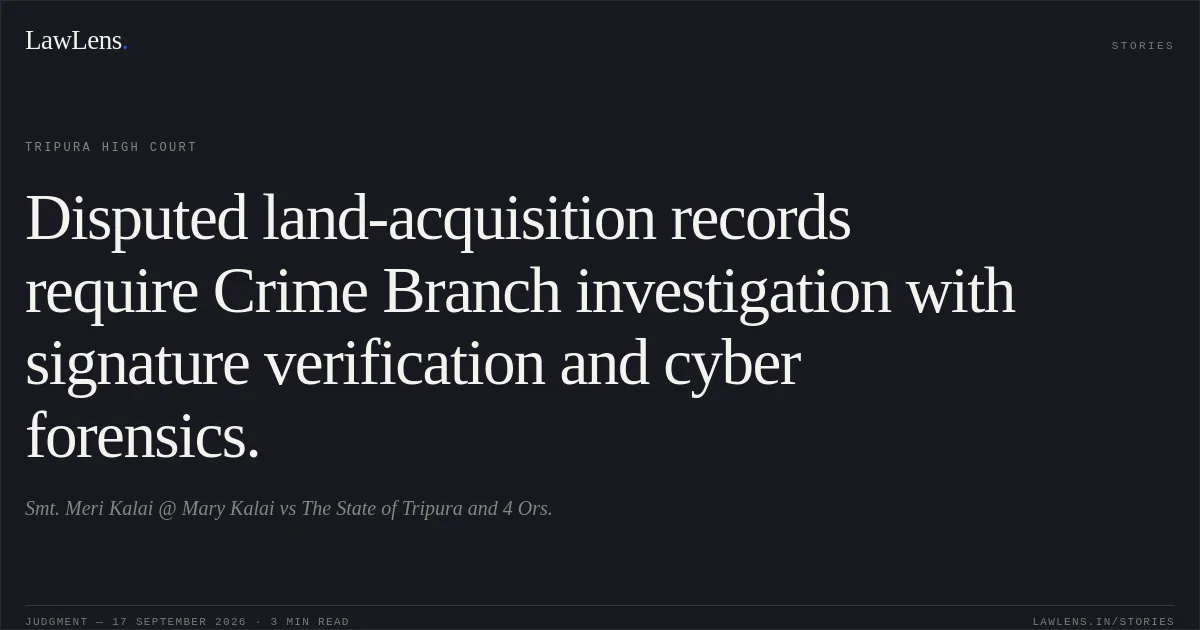
Source reference: p. 4In view of the disputed signatures and email, the High Court referred the matter to the Crime Branch for investigation.
Source reference: pp. 4–5Issues
Whether the petitioner was entitled to a GPS/geo-tracking survey, physical verification, demarcation, and fixation of boundary pillars to determine whether any part of her remaining 0.242 acres had been utilised for the NH-208 Project without acquisition.
Source reference: pp. 2–3Whether the disputed statement and email relied upon by the State required signature verification and cyber-forensic examination in light of the petitioner’s denial of their authenticity and her alleged inability to understand or access the relevant documents and electronic communication.
Source reference: p. 4Whether the disputed factual questions concerning land utilisation, acquisition, and the authenticity of documents could appropriately be resolved through the writ jurisdiction of the High Court, or required investigation by a specialised agency.
Source reference: p. 4Law Applied
The Court applied the principle that disputed questions of fact requiring extensive evidentiary or forensic examination are ordinarily unsuitable for direct adjudication in writ proceedings.
Source reference: para. 7; p. 4It further relied on the Court’s inherent power to issue appropriate directions to secure the ends of justice, including referring matters requiring specialised investigation to a competent law-enforcement agency.
Source reference: para. 7The Court also invoked the principles of justice, equity, and good conscience, particularly to ensure that genuine land occupants are not deprived of their legitimate property rights and compensation.
Source reference: para. 7No specific statutory provision or judicial precedent was cited in the judgment.
Source reference: no citationReasoning
The Court found that the petitioner’s allegation of unauthorised use of the unacquired portion involved a factual determination requiring accurate measurement, demarcation, and verification.
Source reference: pp. 2–3The State’s reliance on the petitioner’s purported statement and email did not resolve the controversy because the petitioner expressly challenged her signature, the contents of the statement, and the authenticity of the email on grounds of illiteracy, lack of familiarity with English, and lack of internet access.
Source reference: p. 4These allegations created a reasonable apprehension that the documents might not reliably establish the petitioner’s consent or satisfaction.
Source reference: p. 4Since the High Court does not ordinarily undertake extensive evidence-taking or forensic analysis in writ proceedings, it considered investigation by the Crime Branch, including signature verification and cyber-forensics, necessary to ascertain the truth and protect the petitioner’s legitimate land rights.
Source reference: paras. 6–8; pp. 4–5Holding
The Court did not finally determine whether any portion of the petitioner’s remaining 0.242 acres had been unlawfully utilised or whether the disputed documents were genuine.
It directed the concerned department to assign the matter to a Senior Officer of the Crime Branch for investigation, including signature verification and cyber-forensic examination of the disputed documents.
Source reference: para. 8; p. 5After completion of the investigation, the Crime Branch was directed to submit its report to the District Magistrate and Collector, who was directed to take further action and decide the petitioner’s grievance in accordance with law.
Source reference: para. 8; p. 5The writ petition and any pending applications were accordingly disposed of.
Source reference: para. 9; p. 5Original Court PDF
Smt. Meri Kalai @ Mary KalaivsThe State of Tripura and 4 Ors.
Click to open original judgment
Original judgment, available to read, download and summarize on LawLens.in