Facts
The petitioner challenged an order dated 15.12.2025 passed by the Sub-Divisional Officer (SDO) (Revenue), Ashoknagar, concerning land in Survey Nos. 256 and 257
Source reference: p.1The land had been subject to several sale deeds and mutations between 2019 and 2022
Source reference: p.2A prior adjudication by the SDO on 27.12.2024 had already addressed mutation and demarcation issues
Source reference: p.2Following an enquiry report in August 2025 and a clarification from the Public Works Department (PWD) in December 2025 stating that only a limited portion of land was acquired for roads, the SDO issued the impugned order on 15.12.2025
Source reference: p.3The petitioner alleged this order was an illegal review of the earlier 2024 order, passed without jurisdiction and in violation of the principles of natural justice
Source reference: p.3-4The State contended the order was based on factual findings and that the matter involved disputed questions of fact
Source reference: p.5Issues
1. Whether the Respondent No. 3 (SDO) acted without jurisdiction by reviewing or reconsidering his own earlier order dated 27.12.2024
Source reference: p.1, 42. Whether the impugned order was passed in violation of the principles of natural justice and statutory mutation procedures
Source reference: p.43. Whether the dispute regarding the extent and possession of Survey No. 256 constitutes a "disputed question of fact" that precludes the exercise of writ jurisdiction under Article 226
Source reference: p.5, 6Law Applied
The court primarily applied the principles governing writ jurisdiction under Article 226 of the Constitution of India, which generally restrain High Courts from adjudicating complex disputed questions of fact
Source reference: p.5, 6It further relied on the statutory procedures for land mutation and demarcation prescribed under the state revenue laws
Source reference: p.4, 6The court also considered the doctrine of functus officio as argued by the petitioner regarding the SDO’s lack of inherent power to review his own quasi-judicial orders unless specifically empowered by statute
Source reference: p.3-4Reasoning
The court observed that Survey No. 256, measuring 0.199 hectares, had been mutated in favor of the State based on a 1995 sale deed for road construction
Source reference: p.5It found that the petitioner failed to provide any material evidence to establish that Survey No. 256 originally comprised an area larger than 0.199 hectares or that any portion remained in his possession after the State's acquisition
Source reference: p.6Consequently, the petitioner's claim that the impugned order adversely affected his rights was deemed foundationless
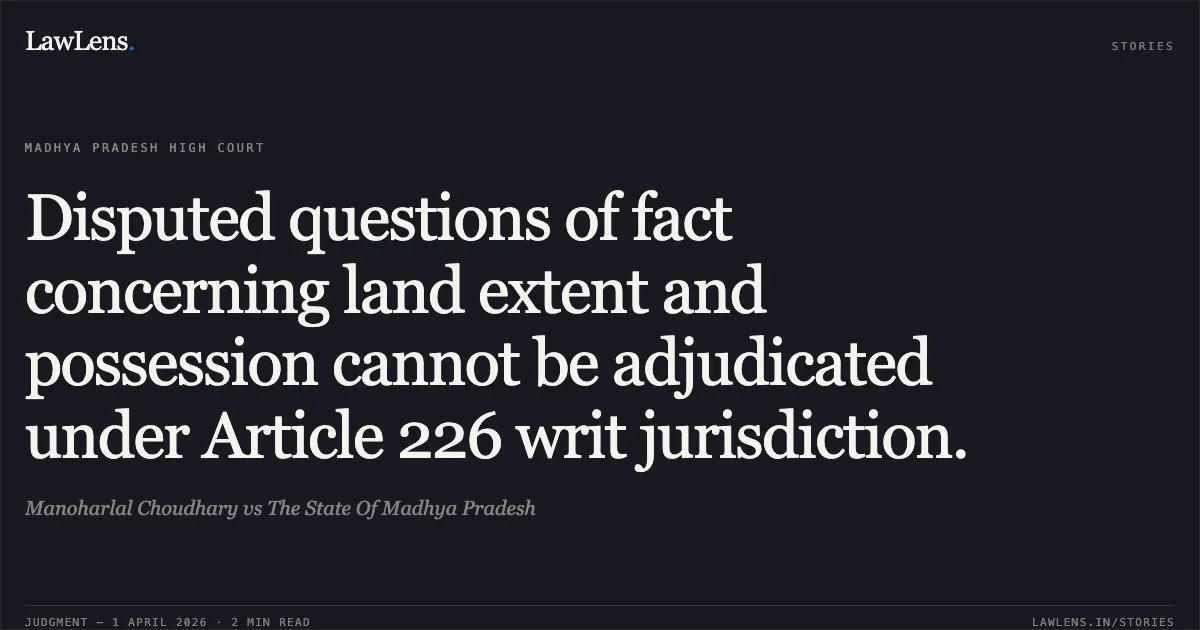
Source reference: p.6The court reasoned that since the core of the controversy involved determining the exact physical extent and possession of land, these were "disputed questions of fact"
Source reference: p.6Applying the settled principle of writ law, the court held that such factual determinations cannot be resolved in a summary proceeding under Article 226 and require evidence-based adjudication before a competent revenue or civil authority
Source reference: p.5, 6Holding
The High Court found no merit in the petition and dismissed it
The court held that writ jurisdiction is not the appropriate forum for resolving factual disputes over land measurements and possession
Source reference: p.6However, it granted the petitioner liberty to seek proper demarcation of the land in accordance with the prescribed statutory procedure to establish any subsisting legal rights before the competent authority
Source reference: p.6Original Court PDF
Manoharlal ChoudharyvsThe State Of Madhya Pradesh
Click to open original judgment
Original judgment, available to read, download and summarize on LawLens.in