Facts
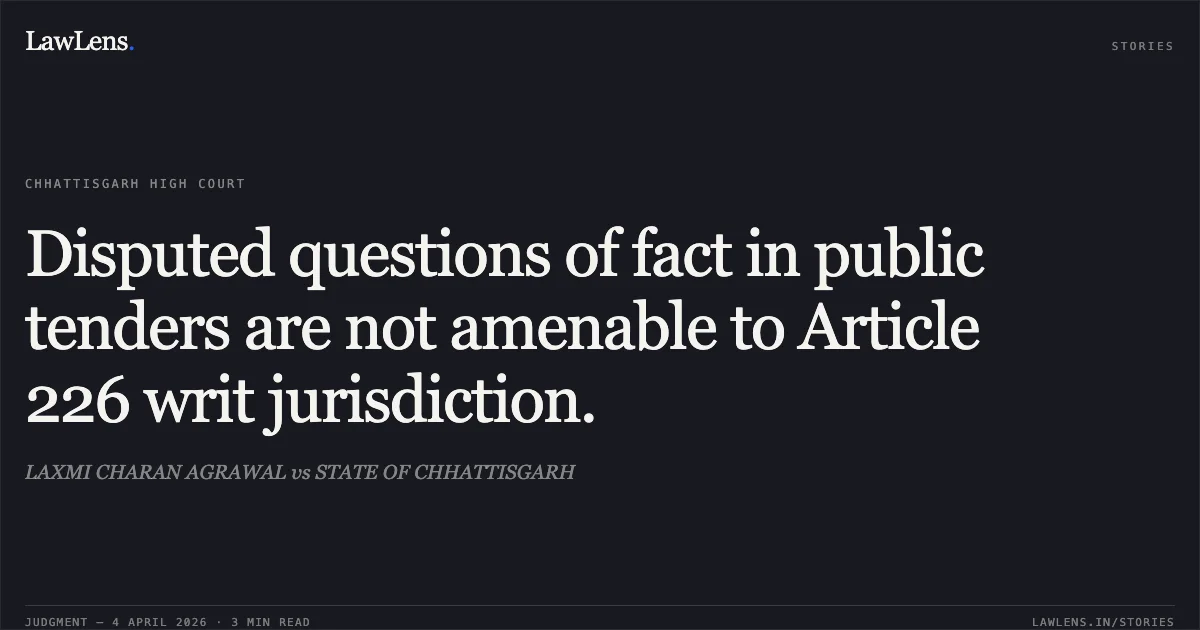
The petitioner filed a writ petition under Article 226 of the Constitution of India challenging the participation of Respondent No. 5 (M/s Ramsaran Singh) in public tender bids.
Source reference: para 4The petitioner alleged that Respondent No. 5 fraudulently used the experience, turnover, and net-worth credentials of a partnership firm for a newly formed Limited Liability Partnership (LLP) without complying with statutory merger requirements under the Limited Liability Partnership Act, 2008.
Source reference: para 5-6Further, it was alleged that Respondent No. 6 fabricated financial data and issued forged certificates to facilitate these bids.
Source reference: para 5The petitioner sought a writ of mandamus for a thorough investigation, a permanent injunction against Respondent No. 5 from future bidding, and strict action against Respondents No. 6 and 7.
Source reference: para 4The State contended that the petition involved disputed questions of fact and that the evaluation was conducted strictly as per tender terms.
Source reference: para 7Issues
1. Whether the High Court, in exercise of its extraordinary writ jurisdiction under Article 226, can adjudicate upon tender disputes involving seriously disputed questions of fact such as misrepresentation of credentials and the validity of corporate mergers.
Source reference: para 82. Whether the decision-making process of the respondent authorities in the procurement process was vitiated by patent illegality, arbitrariness, or mala fides.
Source reference: para 10Law Applied
The Court primarily applied the principles of judicial review in contractual matters under Article 226 of the Constitution.
Source reference: para 9It relied on the landmark precedent Tata Cellular v. Union of India (1994) 6 SCC 651, which established that judicial review is concerned with the decision-making process rather than the merits of the decision, and that the court does not sit as a court of appeal.
Source reference: para 9It further applied the doctrine from Michigan Rubber (India) Ltd. v. State of Karnataka (2012) 8 SCC 216, which held that if a decision relating to the award of a contract is bona fide and in the public interest, courts should not interfere unless there is assessment prejudice, mala fides, or perversity.
Source reference: para 9Reasoning
The Court observed that the petitioner’s allegations regarding the fraudulent use of financial data, illegal use of PAN across entities, and non-compliance with the Limited Liability Partnership Act involved "seriously disputed questions of fact".
Source reference: para 8These issues require a detailed examination of evidence and a trial of facts, which are not amenable to adjudication in a summary proceeding under writ jurisdiction.
Source reference: para 8Applying the rule from Tata Cellular, the Court noted that its role is limited to reviewing the manner in which the decision was made.
Source reference: para 9Since the record did not demonstrate any "patent illegality, arbitrariness, mala fides, or violation of statutory provisions" on the face of it, the Court found no reason to interfere with the tender process.
Source reference: para 10The Court emphasized that a procedural aberration or an error in assessment does not warrant interference unless the process is inherently flawed or against public interest.
Source reference: para 9Holding
The Court held that the petition was devoid of merit as it failed to establish any perversity or illegality in the procurement process that would justify the exercise of extraordinary jurisdiction.
The High Court dismissed the writ petition in limine (at the threshold), declining to grant the requested reliefs of investigation or injunction. No order as to costs was made.
Source reference: para 10Original Court PDF
LAXMI CHARAN AGRAWALvsSTATE OF CHHATTISGARH
Click to open original judgment
Original judgment, available to read, download and summarize on LawLens.in