Facts
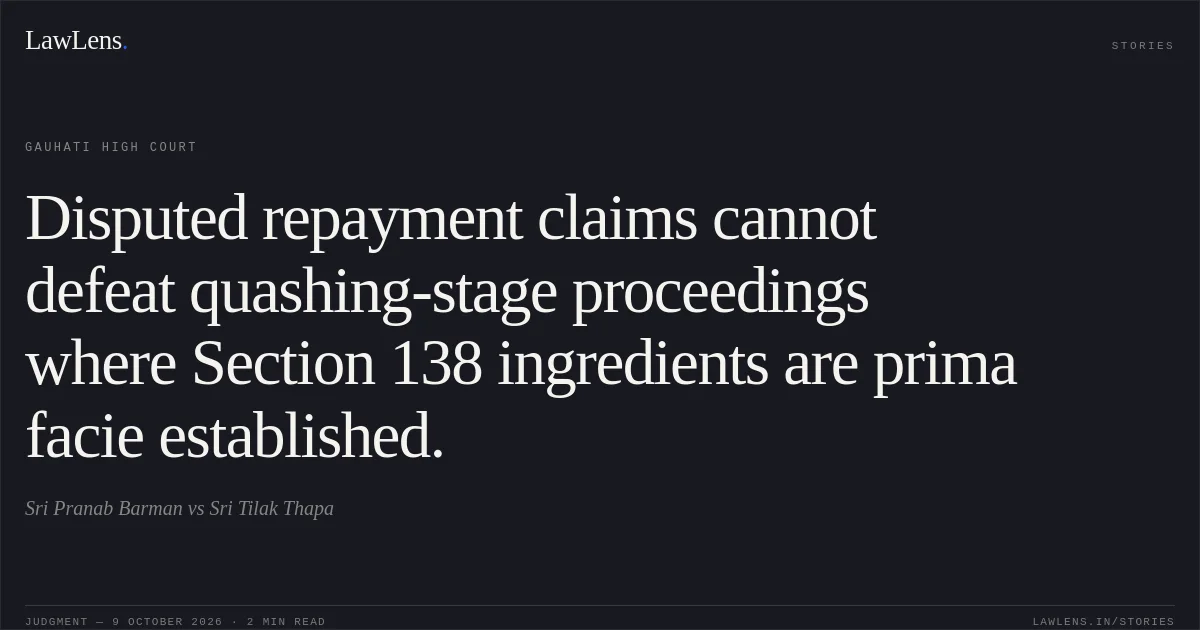
The respondent filed a complaint under Section 138 of the Negotiable Instruments Act, 1881, alleging that the petitioner had issued three cheques of ₹5,00,000 each towards repayment of money advanced for an IMFL shop arrangement.
Source reference: p. 2–6The cheques were dishonoured for insufficient funds; after service of a demand notice and non-payment within the statutory period, the respondent instituted C.R. (NI) Case No. 38/2025.
Source reference: p. 2–6The Magistrate took cognizance and issued notice to the petitioner.
Source reference: p. 2–6The petitioner sought quashing under Section 528 of the BNSS, contending, among other things, that part of the original advances had been made by the respondent’s wife, that he had already made payments, and that the claim exceeded his liability.
Source reference: p. 3–6, 8–10Issues
1. Whether the complaint and order taking cognizance under Section 138 of the NI Act should be quashed under Section 528 of the BNSS, given the petitioner’s claims about the extent of his liability and payments made.
Source reference: p. 2–6, 10–112. Whether the principle in Dashrathbhai Trikambhai Patel concerning part-payment after issuance of a cheque applied to the petitioner’s alleged payment of ₹50,000.
Source reference: p. 9–10Law Applied
Section 138 of the NI Act requires, prima facie, drawing of a cheque, its presentation, dishonour, written demand for payment, and failure to pay within 15 days of receipt of notice, as stated in K. Bhaskaran v. Sankaran Vaidhyan Balan.
Source reference: p. 7–8Under Dashrathbhai Trikambhai Patel v. Hitesh Mahendrabhai Patel, where part-payment is made after a cheque is drawn but before it is presented, the payment must be endorsed on the cheque under Sections 15 and 56 of the NI Act; otherwise, the cheque may not represent the legally enforceable debt at presentation.
Source reference: p. 8–10At the quashing stage, the High Court ordinarily does not assess disputed defence evidence or conduct a mini-trial; this principle was drawn from Rajeev Kourav v. Baisahab, CBI v. Aryan Singh, Naresh Aneja v. State of U.P., and Neeharika Infrastructure Pvt. Ltd. v. State of Maharashtra.
Source reference: p. 10–11Reasoning
The Court found that the petitioner’s issuance of the three cheques, their dishonour, and the demand notice followed by non-payment within the statutory period prima facie satisfied the ingredients of Section 138.
Source reference: p. 6–8The alleged ₹50,000 payment preceded issuance of the cheques and, in the Court’s view, was not shown to have been made towards the legally enforceable debt represented by them; accordingly, Dashrathbhai did not assist the petitioner.
Source reference: p. 9–10The petitioner’s further assertions about payments made after institution of the case and the actual balance due were matters of defence involving disputed facts and could not be determined in a quashing petition.
Source reference: p. 10Holding
The Court held that the petition disclosed no basis to quash the Section 138 proceedings or the order taking cognizance.
It dismissed the petition and vacated any interim order.
Source reference: p. 11Acts & Sections Cited
5 provisions across 3 statutes referred to in this judgment. Each provision opens on LawLens.
Bharatiya Nagarik Suraksha Sanhita, 20231
Negotiable Instruments Act, 18813
Code of Criminal Procedure, 19731
Original Court PDF
Sri Pranab BarmanvsSri Tilak Thapa
Click to open original judgment
Original judgment, available to read, download and summarize on LawLens.in