Facts
The applicant sought regular bail under Section 483 of the Bharatiya Nagarik Suraksha Sanhita, 2023 (corresponding to Section 439 of the Code of Criminal Procedure) in Crime No. 528/2025 registered at Police Station Kotwali Harda for offences under Sections 8/20 and 29 of the Narcotic Drugs and Psychotropic Substances Act, 1985 (“NDPS Act”).
Source reference: para. 1On 17 November 2025, police intercepted co-accused Pankesh Jhabar during a checkpoint operation and allegedly recovered 2.61 grams of MD powder, including the plastic packet, from his trouser pocket.
Source reference: para. 2On the basis of Pankesh’s memorandum statement, the applicant was implicated, and police subsequently searched a house allegedly identified by Pankesh, from which MD (methamphetamine) was recovered.
Source reference: para. 2The applicant denied involvement, contending that no contraband was recovered from his personal possession; that the house searched did not belong to or stand in his possession; that Sections 42 and other procedural safeguards under the NDPS Act were violated; and that the grounds of arrest were not communicated in writing.
Source reference: paras. 3, 7This was the applicant’s first bail application.
Source reference: para. 1Issues
Whether the applicant was entitled to regular bail under Section 483 of the BNSS/Section 439 of the CrPC in view of the recovery allegedly made pursuant to the co-accused’s memorandum statement and the prima facie material connecting him with offences under Sections 8/20 and 29 of the NDPS Act?
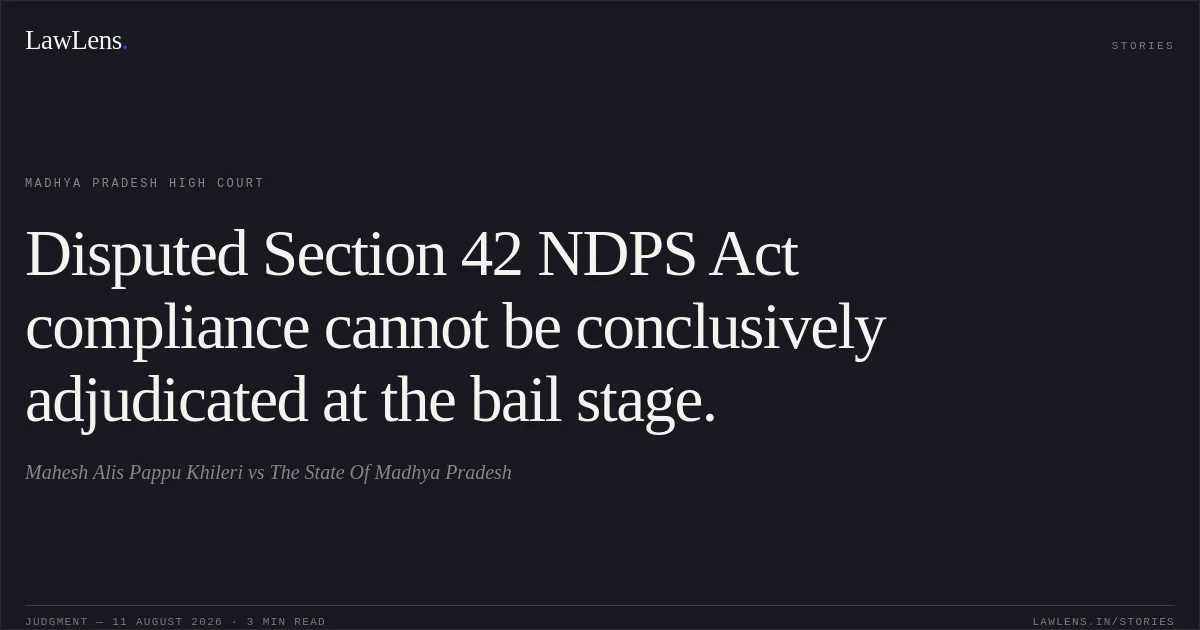
Source reference: paras. 1, 6, 8Whether the alleged non-compliance with Section 42 of the NDPS Act, including the failure to record grounds for immediate search without a warrant, could be conclusively determined at the bail stage?
Source reference: paras. 3, 6Whether the applicant’s contentions regarding absence of personal recovery, lack of proof of ownership or possession of the searched premises, false implication, and non-communication of grounds of arrest justified grant of bail?
Source reference: paras. 3, 7–8Law Applied
The Court applied Section 483 of the BNSS, corresponding to Section 439 of the CrPC, governing the High Court’s power to grant regular bail; Sections 8/20 and 29 of the NDPS Act, concerning prohibited narcotic activity, possession of cannabis-related contraband, and criminal conspiracy or abetment.
Source reference: para. 1It considered Section 42 of the NDPS Act, which prescribes procedural safeguards for searches of buildings or enclosed places based on prior information and requires recording and communicating the grounds where a warrant cannot be obtained and immediate action is necessary.
Source reference: para. 3The Court held that, at the bail stage, it should not conduct a meticulous appreciation of evidence or conclusively decide disputed questions of fact and law, particularly where alleged statutory non-compliance requires examination of evidence at trial.
Source reference: para. 6The precedent in Rohan Singh Thakur v. Union of India, M.Cr.C. No. 41873/2022, was treated as distinguishable on its facts.
Source reference: paras. 3, 7Reasoning
The case diary prima facie indicated that the applicant was implicated through the disclosure statement of co-accused Pankesh and that MD was recovered from premises allegedly pointed out pursuant to that information.
Source reference: para. 6Although the applicant argued that there was no recovery from his person and that the prosecution had not established his ownership or possession of the premises, the Court held that these matters required evidentiary appreciation and could not be conclusively resolved in an interlocutory bail proceeding.
Source reference: para. 7Similarly, the alleged breach of Section 42—particularly the delay between the disclosure statement and the search and the absence of recorded grounds necessitating immediate action—was treated as a mixed question of fact and law requiring consideration during trial.
Source reference: paras. 3, 6In view of the seriousness of the NDPS allegations, the alleged recovery, and the prima facie material indicating the applicant’s involvement, the Court found that the requisite satisfaction for bail had not been established.
Source reference: para. 8Holding
The Court answered the bail issues against the applicant.
It held that the disputed questions concerning Section 42 compliance, personal possession, ownership or possession of the searched premises, alleged false implication, and communication of the grounds of arrest could not justify bail at that stage.
Source reference: paras. 6–8Considering the nature and gravity of the allegations and the prima facie material in the case diary, the Court dismissed the applicant’s first regular bail application under Section 483 of the BNSS.
Source reference: para. 9Acts & Sections Cited
6 provisions across 3 statutes referred to in this judgment. Each provision opens on LawLens.
Bharatiya Nagarik Suraksha Sanhita, 20231
Code of Criminal Procedure, 19731
Narcotic Drugs and Psychotropic Substances Act, 19854
Original Court PDF
Mahesh Alis Pappu KhilerivsThe State Of Madhya Pradesh
Click to open original judgment
Original judgment, available to read, download and summarize on LawLens.in