01Facts
M/s. CRISPR Biopharma Inc. was originally constituted by a Deed of Partnership dated 3 March 2022. Following the death of one partner, the respondents’ reconstitution of the firm, induction of the petitioner as an incoming partner, and retirement of an existing partner were recorded in a fresh Deed of Partnership dated 1 July 2024, under which the petitioner and both respondents held equal shares in the profits and losses.
¶ 3Clause 25 of the 2024 Deed contained an arbitration agreement providing for appointment of arbitrators by the partners and appointment of an umpire by the nominated arbitrators.
¶ 4Disputes subsequently arose concerning access to books and accounts, filing of income-tax returns, change of the firm’s registered office, and a loan allegedly obtained without the petitioner’s knowledge.
¶ 5By notice dated 20 March 2026, served on the respondents on 23 and 24 March 2026, the petitioner invoked Clause 25, nominated Mrs. Karabi Roy as her arbitrator, and called upon the respondents to nominate their arbitrators.
¶ 6The respondents denied the allegations, alleged that the 1 July 2024 Deed was fabricated, and disputed the genuineness of the signatures appearing on it.
¶ 7They did not nominate arbitrators, resulting in the present application under Section 11(6) of the Arbitration and Conciliation Act, 1996.
¶ 8The respondents also instituted a civil suit challenging the genuineness, validity and enforceability of the 1 July 2024 Deed and sought consequential reliefs. No application under Section 8 of the Arbitration and Conciliation Act was pending in that suit; only an interim injunction application was pending.
¶ 12, 17–1802Issues
i.Whether the pendency of a civil suit challenging the genuineness and validity of the Deed of Partnership dated 1 July 2024 barred the High Court from exercising jurisdiction under Section 11(6) of the Arbitration and Conciliation Act, 1996?
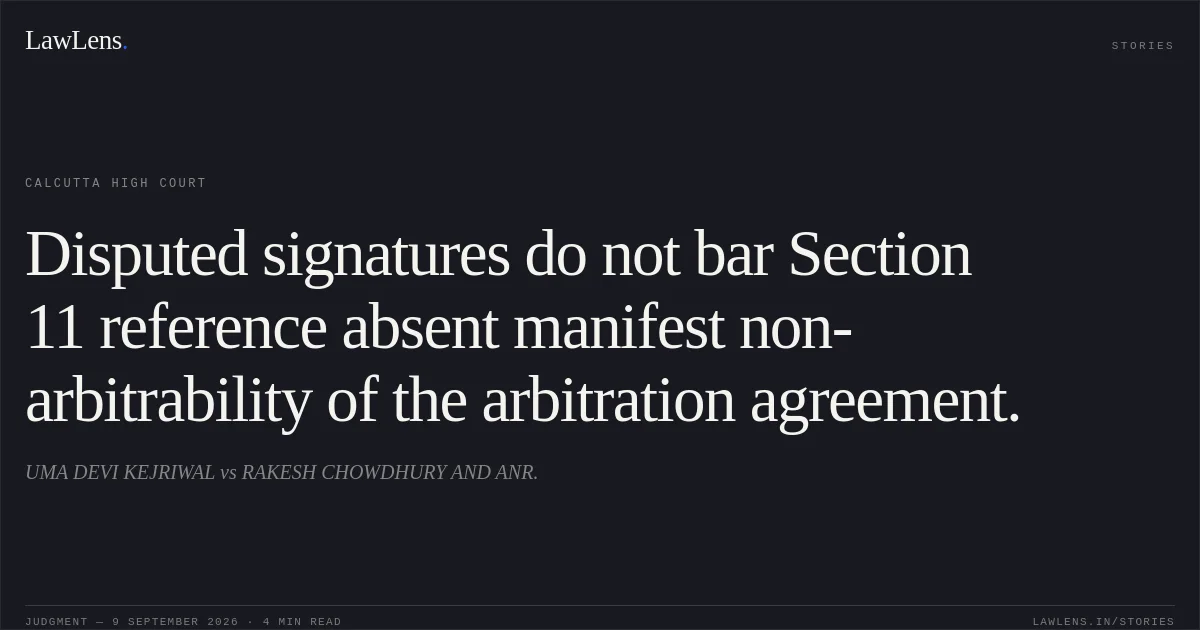
¶ 16–18ii.Whether the respondents’ allegation that certain signatures on the Deed were forged rendered the arbitration agreement in Clause 25 manifestly non-existent or non-arbitrable at the referral stage?
¶ 19–22iii.Whether the respondents’ failure to nominate arbitrators after receiving the petitioner’s notice resulted in failure of the agreed appointment procedure, warranting judicial intervention under Section 11(6)?
¶ 6, 8–11, 2303Law Applied
The Court applied Sections 11(6), 16 and 21 of the Arbitration and Conciliation Act, 1996: service of a notice invoking arbitration under Section 21 and failure of the agreed appointment procedure permit recourse to the Court under Section 11(6), while questions concerning the tribunal’s jurisdiction and the validity or scope of the arbitration agreement may ordinarily be determined by the Arbitral Tribunal under Section 16.
Section 8(3) permits commencement or continuation of arbitration notwithstanding the pendency of an application under Section 8 before a judicial authority.
Relying on The Agri Horticultural Society of India v. Enkon Private Limited and Vijay Kumar Sharma @ Manju v. Raghunandan Sharma @ Baburam, the Court held that pendency of civil proceedings or a Section 8 application does not, by itself, bar appointment under Section 11.
¶ 10 · ¶ 18Relying on SBI General Insurance Co. Ltd. v. Krish Spinning, the Court held that the Section 11 inquiry is confined to a prima facie examination and should not become a mini-trial on disputed facts; residual doubts should ordinarily be resolved in favour of reference.
¶ 11, 21The Court distinguished Rajia Begum v. Barnali Mukherjee, read with Rashid Raza v. Sadaf Akhtar, Avitel Post Studioz Ltd. v. HSBC PI Holdings (Mauritius) Ltd., and Managing Director, Bihar State Food and Civil Supply Corporation Ltd. v. Sanjay Kumar, which concern cases where the very existence of the arbitration agreement is denied or fraud is alleged to permeate the arbitration agreement itself.
¶ 14, 19–21Provisions in the judgment · 8 · Linked ones open on LawLens
Arbitration and Conciliation Act, 1996 Section 8Section 11Section 12Section 16Section 21Section 4
Commercial Courts Act, 2015 Section 2
Code of Civil Procedure, 1908 Section 151
04Reasoning
The Court rejected the respondents’ reliance on the pending civil suit. Since no Section 8 application had been filed, and even the pendency of such an application would not necessarily preclude appointment under Section 11, the mere existence of the suit and the possibility of inconsistent findings did not constitute a statutory bar.
¶ 18On the fraud objection, the Court found that the respondents admitted signing the Deed themselves and disputed only the genuineness of the signatures of the petitioner and the retiring partner. The petitioner, whose signature was questioned, herself relied upon and affirmed the Deed. Accordingly, the case was not one in which the parties sought to be bound had unequivocally denied ever entering into the arbitration agreement, as in Rajia Begum.
¶ 20The alleged forgery therefore raised a disputed question of fact requiring evidence, rather than a manifest case of non-arbitrability. The prima facie existence of Clause 25 was sufficient at the Section 11 stage, leaving the genuineness, execution and validity of the Deed open for determination by the Arbitral Tribunal under Section 16.
¶ 21–22The respondents’ failure to nominate arbitrators despite valid service of the petitioner’s notice established failure of the agreed appointment procedure.
¶ 6, 8, 2305Holding
The petition under Section 11(6) was allowed.
¶ 23The Court appointed Mr. Sourav Sengupta, Advocate, as the nominee arbitrator on behalf of the respondents, with Mrs. Karabi Roy continuing as the petitioner’s nominee arbitrator.
¶ 23The two nominee arbitrators were directed to jointly appoint a Presiding Arbitrator in accordance with law to constitute the Arbitral Tribunal.
¶ 23The arbitrators were directed to make disclosures under Section 12(1), remain subject to Section 12(5), and determine their remuneration in accordance with the Fourth Schedule or by agreement.
¶ 24–25The Court expressly left open all questions concerning arbitrability, maintainability, limitation, validity of claims and counterclaims, and the genuineness, execution or validity of the Deed for determination by the Arbitral Tribunal.
¶ 26Original Court PDF
UMA DEVI KEJRIWALvsRAKESH CHOWDHURY AND ANR.
Click to open original judgment
Original judgment, available to read, download and summarize on LawLens.in