01Facts
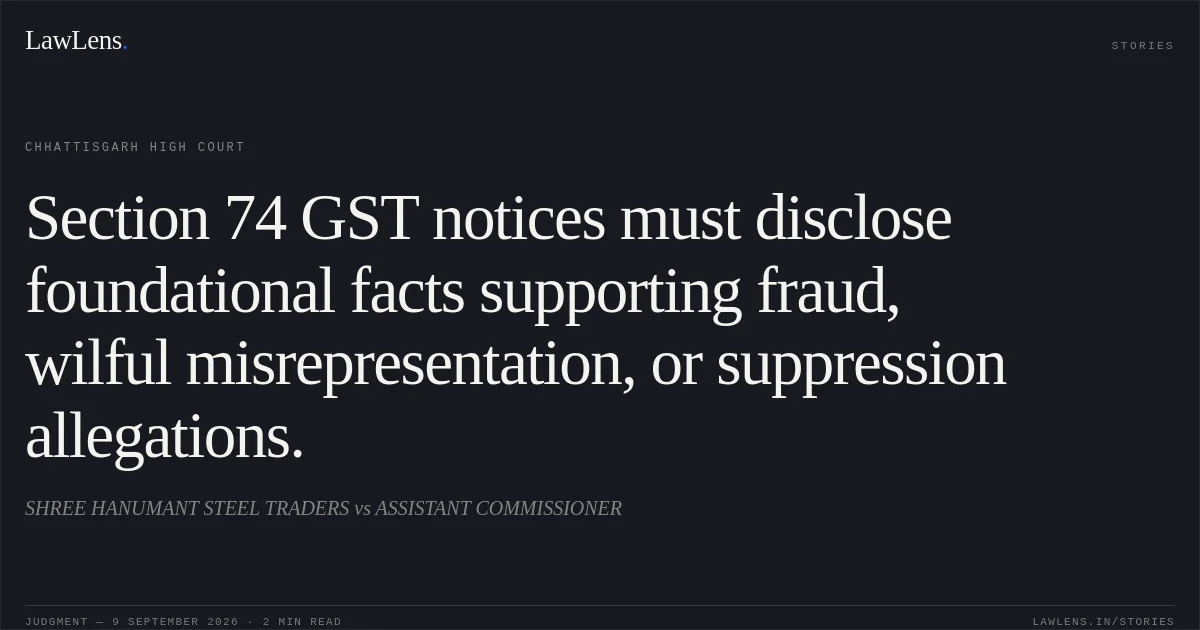
The petitioners, Shree Hanumant Steel Traders and its proprietor, challenged notices issued by the Assistant Commissioner under Section 74(9) of the Goods and Services Tax Act, 2017, dated 16 October 2025.
¶ 1The notices alleged that the petitioners had availed input tax credit on the basis of fake invoices without actual supply of goods.
¶ 3The petitioners contended that the notices merely invoked fraud, wilful misrepresentation and suppression without disclosing the foundational facts supporting those allegations, relying on the Supreme Court’s decision in Tata Steels Ltd. v. Union of India .
¶ 2The State opposed the petitions, asserting that the notices adequately disclosed the foundational facts and that the petitioners had an efficacious alternative remedy by way of appeal under Section 107 of the GST Act.
¶ 302Issues
i.Whether the notices issued under Section 74(9) of the GST Act, 2017 were legally sustainable when they failed to disclose sufficient foundational facts supporting the allegations of fraud, wilful misrepresentation or suppression?
¶ 1–5ii.Whether the availability of an alternative appellate remedy under Section 107 barred the exercise of writ jurisdiction in the circumstances of the case?
¶ 303Law Applied
The Court applied Section 74(9) of the GST Act, 2017, which governs determination of tax, interest and penalty in cases involving fraud, wilful misrepresentation or suppression of facts.
¶ 1It also considered Section 107, which provides an appellate remedy against GST orders.
¶ 3Relying on the Supreme Court’s decision in Tata Steels Ltd. v. Union of India , [2026] 189 taxmann.com 520 (SC), the Court held that where an extended limitation or penal consequence is invoked on the basis of fraud, wilful misrepresentation or suppression, the foundational facts leading to that inference must be evident from the notice itself.
¶ 5Mere mechanical recital of those expressions does not demonstrate due application of mind.
¶ 5Provisions in the judgment · 2 · Linked ones open on LawLens
Central Goods and Services Tax Act, 2017 Section 74Section 107
04Reasoning
The Court examined the impugned notices and found that the authority had failed to assign sufficient reasons while issuing them under Section 74(9).
¶ 5Although the State submitted that the notices alleged availment of input tax credit through fake invoices without actual supply, the Court held that such a general allegation did not adequately disclose the foundational facts necessary to support the statutory allegations of fraud, wilful misrepresentation or suppression.
¶ 3, 5Applying the principle in Tata Steels , the Court concluded that the statutory expressions could not be mechanically employed without demonstrating the factual basis and application of mind underlying the allegations.
¶ 5Consequently, the notices were held unsustainable notwithstanding the availability of an alternative remedy under Section 107.
¶ 3, 5–605Holding
The Court answered the principal issue in favour of the petitioners and quashed the notices dated 16 October 2025 issued under Section 74(9) of the GST Act, 2017, for failure to disclose sufficient foundational facts and reasons.
¶ 6The writ petitions were accordingly allowed.
¶ 6However, the respondent authority was granted liberty to issue fresh notices strictly in accordance with law, if so advised.
¶ 6–7Original Court PDF
SHREE HANUMANT STEEL TRADERSvsASSISTANT COMMISSIONER
Click to open original judgment
Original judgment, available to read, download and summarize on LawLens.in