Facts
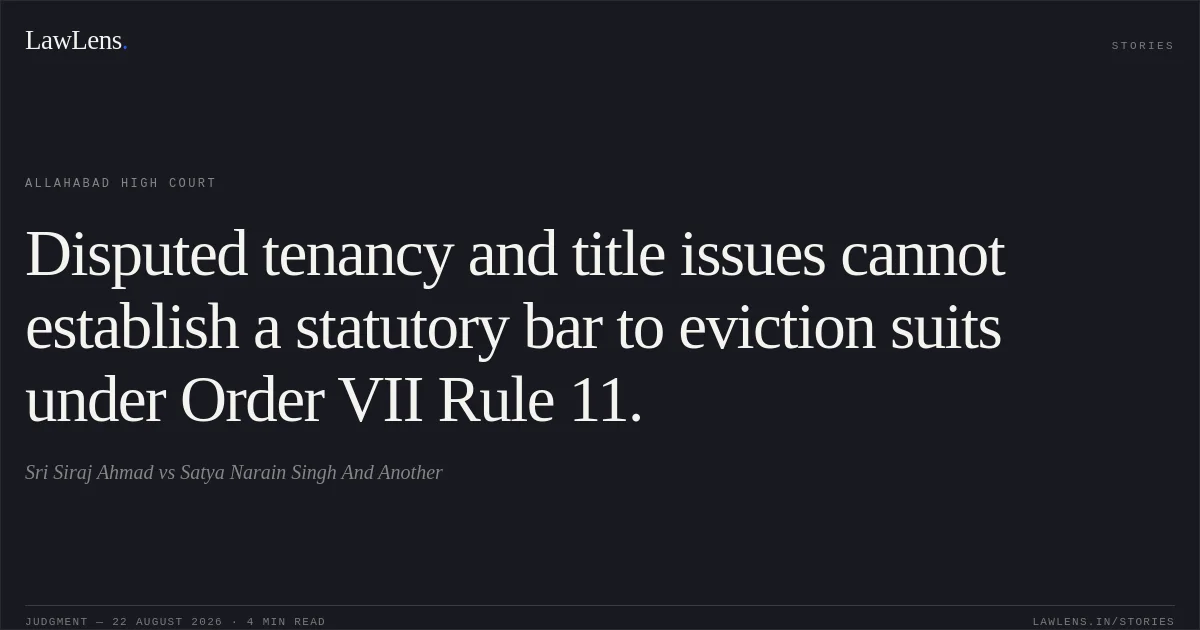
The plaintiffs instituted four suits before the Court of Small Causes seeking eviction of the respective defendants from shops, recovery of rent arrears and consequential reliefs, pleading a landlord–tenant relationship and default in rent payment.
Source reference: para. 3The plaintiffs’ notices referred to the U.P. Regulation of Urban Premises Tenancy Act, 2021 (“the 2021 Act”), including Sections 4, 8 and 9, and called upon the defendants to execute registered tenancy agreements.
Source reference: paras. 4, 11–12The defendants applied under Order VII Rule 11(a) and (d), read with Section 151 CPC, contending that the suits were barred by Section 38 of the 2021 Act and that the remedy lay before the Rent Authority rather than the Court of Small Causes.
Source reference: paras. 5, 8They also disputed the existence of the landlord–tenant relationship and raised issues concerning title, ownership and possession.
Source reference: paras. 10, 37–39The trial courts rejected the applications, leading to the present revisions under Section 25 of the Provincial Small Cause Courts Act, 1887.
Source reference: para. 7Issues
1. Whether the plaints disclosed a cause of action for the purposes of Order VII Rule 11(a) CPC?
Source reference: paras. 28–302. Whether, from the statements contained in the plaints, the suits were barred by Section 38 of the U.P. Regulation of Urban Premises Tenancy Act, 2021, thereby attracting Order VII Rule 11(d) CPC?
Source reference: paras. 10, 31–33, 51–563. Whether the absence of a written tenancy agreement, by itself, excluded the jurisdiction of the Rent Authority under the 2021 Act?
Source reference: paras. 10, 34–36, 454. Whether a disputed landlord–tenant relationship, particularly where questions of title or ownership were raised, could be conclusively adjudicated while deciding an application under Order VII Rule 11 CPC?
Source reference: paras. 10, 37–42, 46–48Law Applied
Order VII Rule 11(a) CPC permits rejection of a plaint only where it does not disclose a cause of action, while Rule 11(d) applies where the suit appears from the statements in the plaint itself to be barred by law.
Source reference: para. 28At this stage, the court must examine the plaint as a whole, accept its averments at face value, and ordinarily cannot rely upon the defence or adjudicate disputed questions of fact.
Source reference: paras. 29, 40, 48Section 38(1) of the U.P. Regulation of Urban Premises Tenancy Act, 2021 bars civil-court jurisdiction in matters relating to the Act, subject to the statutory scheme; however, Section 38(2) limits the Rent Authority’s jurisdiction to tenancy agreements submitted under the Act and expressly excludes questions of title or ownership.
Source reference: para. 32Relying on Akhilesh Kumar v. Sanjay Sahgal, 2026 (7) ADJ 2013, the Court held that the absence of a written tenancy agreement does not, by itself, oust the Rent Authority’s jurisdiction where the landlord–tenant relationship is admitted or otherwise established and the dispute falls within the Act.
Source reference: paras. 34–36, 45Conversely, a disputed foundational relationship involving title, ownership or source of possession cannot be conclusively determined under Order VII Rule 11 CPC.
Source reference: paras. 39–41, 46–48Reasoning
The plaints pleaded the essential facts constituting the plaintiffs’ claims—namely, the alleged landlord–tenant relationship, default in rent, service of notices, failure to comply with the notices, and entitlement to eviction and arrears. They therefore disclosed a cause of action under Order VII Rule 11(a) CPC, irrespective of whether those allegations would ultimately be proved at trial.
Source reference: paras. 30, 43, 50The Court rejected the defendants’ contention that the mere reference to Sections 4, 8 and 9 of the 2021 Act in the notices automatically excluded the jurisdiction of the Court of Small Causes; statutory jurisdiction had to be determined by the actual controversy and the jurisdiction conferred upon the Rent Authority.
Source reference: paras. 44, 49, 51At the same time, the plaintiffs’ argument that the absence of a written tenancy agreement necessarily excluded the 2021 Act was also rejected, particularly in view of Akhilesh Kumar and the mechanism under Sections 4(3) and 4(7).
Source reference: paras. 34–36The defendants’ denial of tenancy and their assertions concerning title and ownership raised disputed factual questions which could not be conclusively resolved at the Order VII Rule 11 stage.
Source reference: paras. 40–42Since the alleged bar under Section 38 did not appear clearly from the plaints themselves, rejection of the plaints under Rule 11(d) was unwarranted.
Source reference: paras. 52–56Holding
The High Court dismissed all four revisions and upheld the orders rejecting the defendants’ applications under Order VII Rule 11(a) and (d) read with Section 151 CPC.
It held that the plaints disclosed a cause of action and that the statutory bar under Section 38 of the 2021 Act was not apparent from the plaints so as to justify rejection at the threshold.
Source reference: para. 56The Court clarified that neither the absence of a written tenancy agreement nor the defendants’ denial of the landlord–tenant relationship, by itself, determined the forum or justified rejection of the plaints.
Source reference: paras. 45–49The suits were directed to proceed before the concerned court in accordance with law, while the disputed questions concerning tenancy, identity of the landlord, title, ownership and possession were expressly left open for adjudication on pleadings and evidence.
Source reference: paras. 59–60Acts & Sections Cited
7 provisions across 3 statutes referred to in this judgment. Linked provisions open on LawLens.
Provincial Small Cause Courts Act, 18871
Code of Civil Procedure, 19081
U. P. Regulation of Urban Premises Tenancy Act, 20215
Original Court PDF
Sri Siraj AhmadvsSatya Narain Singh And Another
Click to open original judgment
Original judgment, available to read, download and summarize on LawLens.in