Facts
The petitioners invoked Article 226 of the Constitution seeking directions to stop alleged illegal construction on land bearing Survey Nos. 691, 692, 693, 695 and 696, measuring 0.722 hectares, situated at Mouja Hajipur, Sironj, District Vidisha.
Source reference: para. 1–3They claimed title through Puran Gir and Shiv Gir, asserting that Shiv Gir had executed a registered Will in favour of Bhagwan Gir and Kishan Gir, whose legal heirs were the petitioners.
Source reference: para. 1–3Krishi Upaj Mandi Samiti, Sironj had earlier occupied part of the land as a tenant, allegedly at a rent of ₹6 per month.
Source reference: para. 1–3A suit for eviction, possession and mesne profits, Civil Suit No. 29-A/2007, was dismissed on 21 August 2008; the first appeal was dismissed, and Second Appeal No. 102/2011 remained pending.
Source reference: para. 1–3During the pendency of the second appeal, shops were allegedly constructed and auctioned by the Mandi Samiti, and the Municipal Council subsequently commenced construction of additional shops on the remaining land.
Source reference: para. 1–3The petitioners’ applications before the Municipal Council to mutate their names and stop the construction allegedly received no effective response.
Source reference: para. 1–3Issues
1. Whether the High Court, in exercise of writ jurisdiction under Article 226, could direct the authorities to stop construction when the petitioners’ title, possession and the precise portion of land affected were disputed and unclear.
Source reference: para. 5–62. Whether the petitioners should be relegated to the competent revenue authority/Collector for adjudication of their grievances after giving an opportunity of hearing to all concerned parties.
Source reference: para. 4, 6–7Law Applied
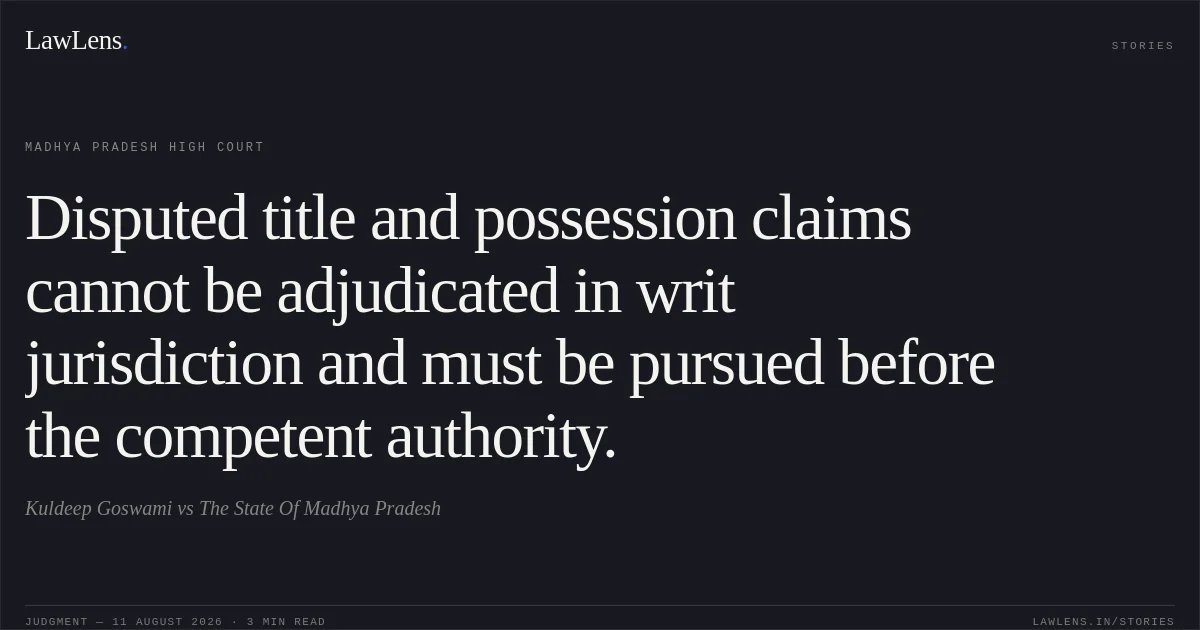
Article 226 of the Constitution confers discretionary writ jurisdiction, but such jurisdiction is ordinarily not exercised for adjudicating disputed questions of title and possession requiring factual determination.
Source reference: para. 4, 6–7A decree or proceeding for eviction does not, by itself, finally adjudicate title to the property; therefore, reliance on an eviction suit cannot establish ownership where title remains disputed.
Source reference: para. 4, 6–7Where the pleadings do not identify the precise property or portion involved and the rival rights require factual examination, the appropriate course is to approach the competent statutory authority, which must decide the matter in accordance with law after hearing all concerned parties and by passing a reasoned order.
Source reference: para. 4, 6–7Reasoning
The Court found that the petition did not establish which specific portion of the five survey numbers was undergoing construction.
Source reference: para. 5–6It also found that the petitioners’ alleged title and interest were not apparent, particularly because the civil proceedings relied upon were eviction proceedings and did not conclusively determine title.
Source reference: para. 5–6These disputed questions could not appropriately be resolved in the writ petition under Article 226.
Source reference: para. 5–6Without expressing any opinion on the merits of the rival claims, the Court considered it appropriate to direct the petitioners to place their claim, grievances and supporting documents before the competent authority/Collector, Vidisha.
Source reference: para. 5–6Holding
The writ petition was disposed of without adjudicating the merits.
The petitioners were granted liberty to file an appropriate application before the Collector, Vidisha, within one week.
Source reference: para. 7–9If filed, the Collector was directed to consider and decide the application after hearing all concerned parties, strictly in accordance with law, by a reasoned and speaking order, preferably within two weeks from receipt of the application.
Source reference: para. 7–9The Court clarified that it had expressed no opinion on the merits of the case.
Source reference: para. 7–9Original Court PDF
Kuldeep GoswamivsThe State Of Madhya Pradesh
Click to open original judgment
Original judgment, available to read, download and summarize on LawLens.in