Facts
Respondent No.1 instituted Civil Suit No. 620/2020 seeking damages, permanent injunction and mandatory injunction concerning alleged unauthorised construction, seepage and obstruction relating to property bearing No. 17/6, West Patel Nagar, New Delhi. The appellant was Defendant No.1 and was stated to occupy the first floor, while Respondent No.1 occupied the ground floor.
Source reference: pp. 2–3, paras. 2–3During the COVID-19 pandemic, summons were allegedly served electronically. The appellant did not appear and was proceeded ex parte, along with the other defendants, on 8 June 2022. The suit culminated in an ex parte judgment and decree dated 3 November 2023, awarding Respondent No.1 damages of ₹10,00,000 and granting injunctive reliefs.
Source reference: p. 3, para. 4The appellant claimed that he had never been served with the summons and became aware of the decree only in July 2025, when documents were sent to him on WhatsApp by Respondent No.2. He filed an application under Order IX Rule 13 CPC on 17 September 2025 seeking setting aside of the ex parte decree.
Source reference: p. 3, para. 5; p. 4, para. 6The Trial Court dismissed the application, holding that the appellant had knowledge of the decree by 19/22 July 2025, that the application was beyond the prescribed 30-day period, and that service had been established through the process server’s report concerning WhatsApp communication.
Source reference: p. 4, para. 7Issues
Whether the electronic communication of summons, allegedly sent to the appellant’s mobile number but answered by a third person, constituted due service upon the appellant under the circumstances of the case.
Source reference: p. 5, paras. 10–11Whether the appellant’s application under Order IX Rule 13 CPC was barred by limitation on the ground that he had knowledge of the ex parte decree in July 2025.
Source reference: p. 5, para. 10; p. 4, para. 7Whether the appellant had sufficient cause for non-appearance and was entitled to have the ex parte judgment and decree set aside.
Source reference: pp. 5–7, paras. 12–16Law Applied
The Court applied Order IX Rule 13 CPC, under which an ex parte decree may be set aside where the defendant establishes that summons were not duly served or that sufficient cause prevented appearance.
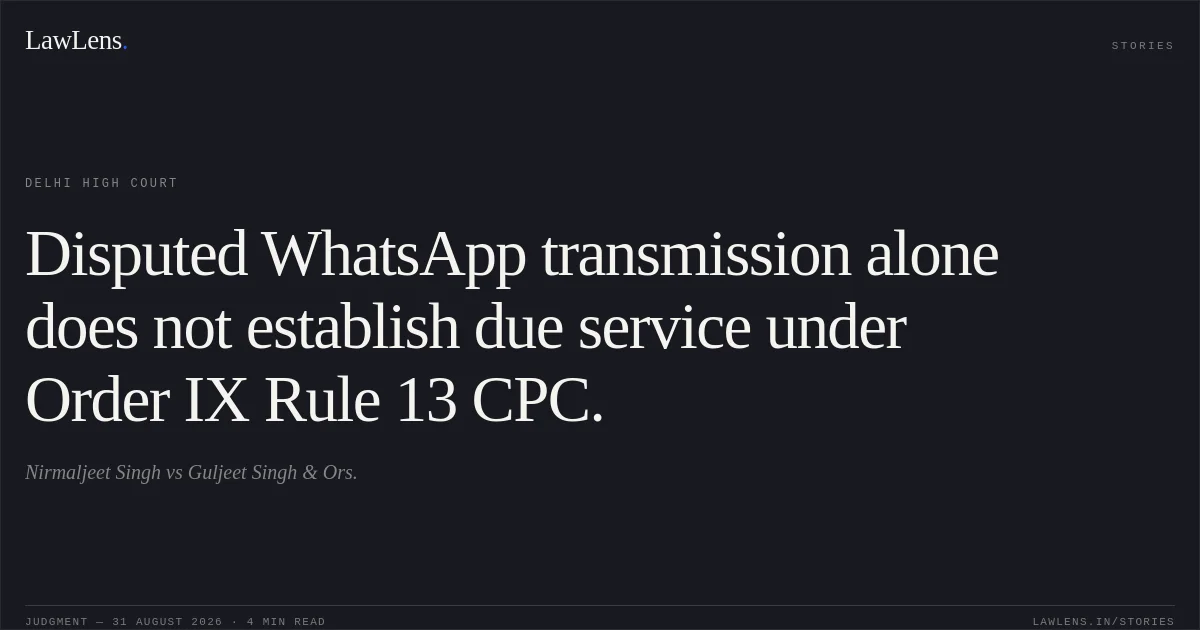
Source reference: p. 5, para. 12The Court held that transmission of summons to a mobile number is distinct from proof of their actual receipt and communication to the concerned defendant, particularly where service is disputed and the communication was answered by a third person.
Source reference: pp. 5–6, paras. 11–13It relied on G.P. Srivastava v. R.K. Raizada, (2000) 3 SCC 54, for the principle that “sufficient cause” should be construed in a manner advancing substantial justice, and on Parimal v. Veena @ Bharti, (2011) 3 SCC 545, for the rule that sufficient cause must be assessed on the facts of each case and discretion under Order IX Rule 13 CPC exercised judiciously.
Source reference: p. 6, para. 14The Court also recognised that Order IX Rule 13 CPC cannot be used to reopen a decree where due notice and adequate opportunity are established.
Source reference: p. 6, para. 15Reasoning
The Court found that the process server’s report merely recorded that summons were sent to mobile number 9210894210 and that the call was answered by Amarjeet Singh, who identified himself as the appellant’s relative and stated that he would inform him. This did not establish that the summons were actually received by, or brought to the notice of, the appellant.
Source reference: p. 5, para. 11Since the appellant consistently denied receipt and the alleged communication involved a third person, the Trial Court erred in treating transmission to the mobile number as conclusive proof of service or knowledge.
Source reference: p. 6, para. 13In these circumstances, the appellant’s claim that he learned of the decree only through the subsequent WhatsApp communication could not be rejected merely on an inference drawn from the electronic record.
Source reference: p. 6, para. 13Applying the substantial-justice approach under Order IX Rule 13 CPC, the Court held that the disputed and inadequately established mode of service warranted permitting the appellant to contest the suit, subject to costs.
Source reference: pp. 6–7, paras. 15–16Holding
The appeal was allowed. The order dated 26 May 2026 dismissing the appellant’s Order IX Rule 13 CPC application was set aside, and the application was allowed.
Consequently, the ex parte judgment and decree dated 3 November 2023 were set aside qua the appellant/Defendant No.1.
Source reference: p. 7, para. 17The appellant was directed to pay ₹20,000 as costs to Respondent No.1 within four weeks.
Source reference: p. 7, para. 18The consequential order directing release of ₹2,00,000 with accrued interest was also set aside qua the appellant; if unreleased, the amount was to remain deposited with the Trial Court, and if already released, it was made subject to appropriate orders in the suit.
Source reference: p. 7, para. 19Original Court PDF
Nirmaljeet SinghvsGuljeet Singh & Ors.
Click to open original judgment
Original judgment, available to read, download and summarize on LawLens.in