Facts
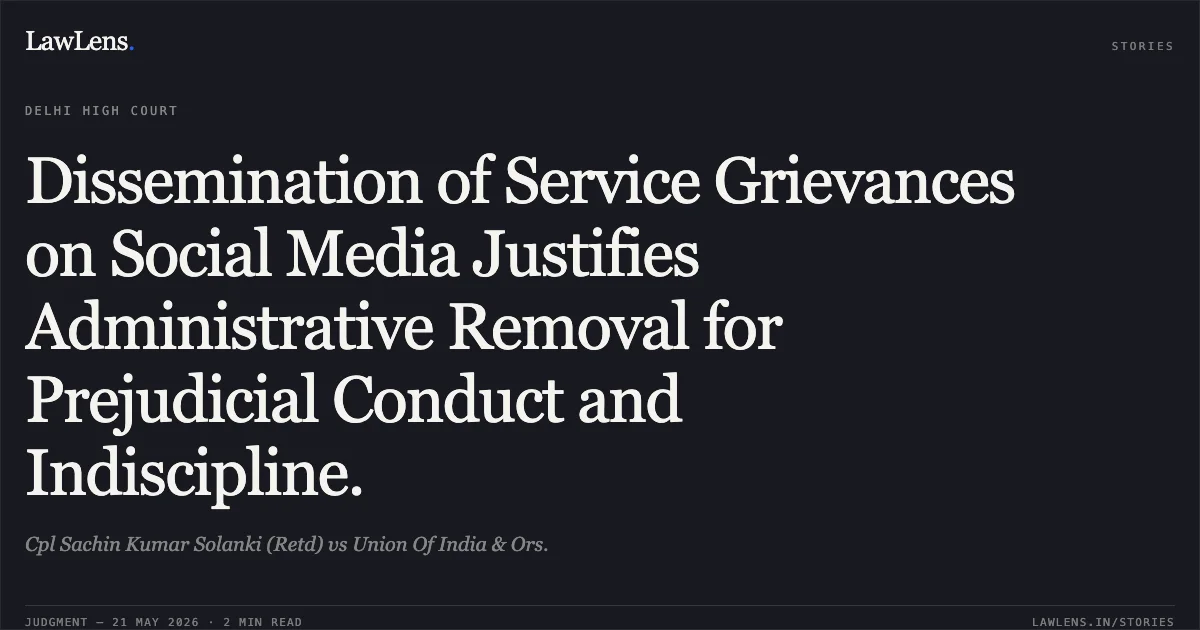
The Petitioner, enrolled as an Airman (Communication Technician) in the Indian Air Force (IAF) in 2011, was removed from service following an administrative inquiry.
Source reference: para. 4On 22.01.2017, the Petitioner uploaded a video to Facebook while in uniform, alleging systemic disparities between officers and airmen regarding rations, uniforms, allowances, and social treatment.
Source reference: para. 5A Court of Inquiry was assembled, leading to a Show Cause Notice on 29.08.2017.
Source reference: para. 6Despite the Petitioner’s reply citing mental stress and family circumstances, the Competent Authority issued a Speaking Order on 02.12.2017, ordering his removal under Section 20(3) of the Air Force Act, 1950.
Source reference: para. 7-9The Armed Forces Tribunal (AFT) dismissed his challenge on 17.10.2025.
Source reference: para. 8The Petitioner subsequently moved the Delhi High Court seeking reinstatement.
Source reference: para. 3Issues
1. Whether the administrative action taken under Section 20(3) of the Air Force Act, 1950, without a Court Martial, violated the principles of natural justice.
Source reference: para. 11, 222. Whether the punishment of removal from service was shockingly disproportionate to the admitted misconduct.
Source reference: para. 11, 243. Whether the scope of judicial review under Article 226 permits interference with military disciplinary orders in the absence of procedural patent illegality.
Source reference: para. 14-15Law Applied
Section 20(3) of the Air Force Act, 1950, and Rule 18 of the Air Force Rules, 1969, which empower the competent authority to dismiss or remove personnel from service.
Source reference: para. 9Paragraph 11, Chapter VIII of IAP 3903 and Air Force Order (AFO) 17/2015, which mandate extreme caution in social media usage and prohibit the public dissemination of service-related grievances.
Source reference: para. 18The established principle that judicial review in military matters is restricted to cases of mala fides, procedural impropriety, or "shocking" disproportionality, as the maintenance of discipline in the Armed Forces stands on a different footing than civil employment.
Source reference: para. 14-15Reasoning
The Court reasoned that the foundational facts—the recording and social media upload of the video while in uniform—were admitted by the Petitioner, negating the need for a full Court Martial trial.
Source reference: para. 17, 23The Court found that the Petitioner bypassed established internal grievance redressal mechanisms, choosing instead a public forum, which directly violated AFO 17/2015 and tarnished the IAF’s institutional image.
Source reference: para. 18, 24Regarding proportionality, the Court emphasized that military discipline requires strict adherence to hierarchy and morale; therefore, the Competent Authority’s decision that the Petitioner’s retention was "undesirable" was a specialized assessment that the Court should not substitute with its own view.
Source reference: para. 15, 25The Court dismissed the Petitioner's plea regarding his mental state, noting that a member of a combatant force is held to a higher standard of conduct regardless of personal stressors.
Source reference: para. 19Holding
The High Court answered the issues in the negative and dismissed the writ petition.
The Court held that there was no procedural infirmity or violation of natural justice as the Petitioner was served a Show Cause Notice and his reply was duly considered.
Source reference: para. 21-22The Court concluded that the punishment of removal was not "shockingly disproportionate" given the prejudicial nature of the act toward service discipline.
Source reference: para. 25-26The AFT’s order was upheld as a plausible view.
Source reference: para. 16, 27Acts & Sections Cited
1 provisions across 1 statute referred to in this judgment. Each provision opens on LawLens.
Air Force Act, 19501
Original Court PDF
Cpl Sachin Kumar Solanki (Retd)vsUnion Of India & Ors.
Click to open original judgment
Original judgment, available to read, download and summarize on LawLens.in