Facts
The parties married on April 28, 2007, and have a daughter.
Source reference: para 3The husband (Appellant) alleged persistent mental cruelty, including public screaming, false allegations of an illicit relationship between him and his mother, and desertion since August 6, 2012.
Source reference: para 3, 5He originally sought divorce under Section 13(1)(ia)(iii) of the Hindu Marriage Act. The Principal Judge, Family Court, Gaya, passed a decree for judicial separation under Section 10 on May 2, 2023, rather than divorce, citing the future responsibilities toward the minor daughter.
Source reference: para 2-3The husband appealed seeking divorce; the wife appealed to set aside the judicial separation.
Source reference: para 4-5Issues
1. Whether the husband is entitled to a decree of dissolution of marriage by divorce instead of judicial separation given the prolonged period of separation and non-resumption of cohabitation.
Source reference: para 8-92. Whether the wife is entitled to permanent alimony under Section 25 of the Hindu Marriage Act, and whether a child’s right to maintenance/inheritance can be bargained away during such settlement.
Source reference: para 12, 28-29Law Applied
Section 13(1)(ia) of the Hindu Marriage Act regarding cruelty.
Source reference: para 9Section 13(1A)(i), which allows divorce if there is no resumption of cohabitation for one year following a decree of judicial separation.
Source reference: para 7-8Section 25 of the Act, which grants wide discretion to award permanent alimony based on the "conduct of parties" and "other circumstances".
Source reference: para 12-14Rajnesh v. Neha (2021) regarding the criteria for maintenance.
Source reference: para 15Kalyan Dey Chowdhury v. Rita Dey Chowdhury (2017) on the court's continuing jurisdiction.
Source reference: para 17Rakhi Sadhukhan v. Raja Sadhukhan (2025/2024) regarding ensuring financial stability for the spouse.
Source reference: para 18, 24Principle that a child’s right to maintenance and inheritance is independent of the mother's alimony.
Source reference: para 28-31Reasoning
The High Court found that the Trial Judge correctly identified mental cruelty—specifically the wife's unfounded aspersions regarding the husband's relationship with his mother and her long-term desertion.
Source reference: para 9The High Court determined that judicial separation was insufficient as the parties had lived apart for 14 years with no prospect of reconciliation or cohabitation since the 2023 decree.
Source reference: para 5, 8Under Section 13(1A), the husband attained a statutory right to divorce.
Source reference: no citationThe Court noted that a decree of divorce on grounds of cruelty does not disqualify a spouse from receiving permanent alimony.
Source reference: para 21Given the husband's remarriage and the daughter's educational aspirations (NEET coaching), the Court upheld the parties' prior informal agreement for a lump-sum settlement of Rs. 20 lakhs.
Source reference: para 22, 25The Court clarified as a matter of law that the wife cannot waive the daughter's independent rights to maintenance or ancestral property.
Source reference: para 29-30Holding
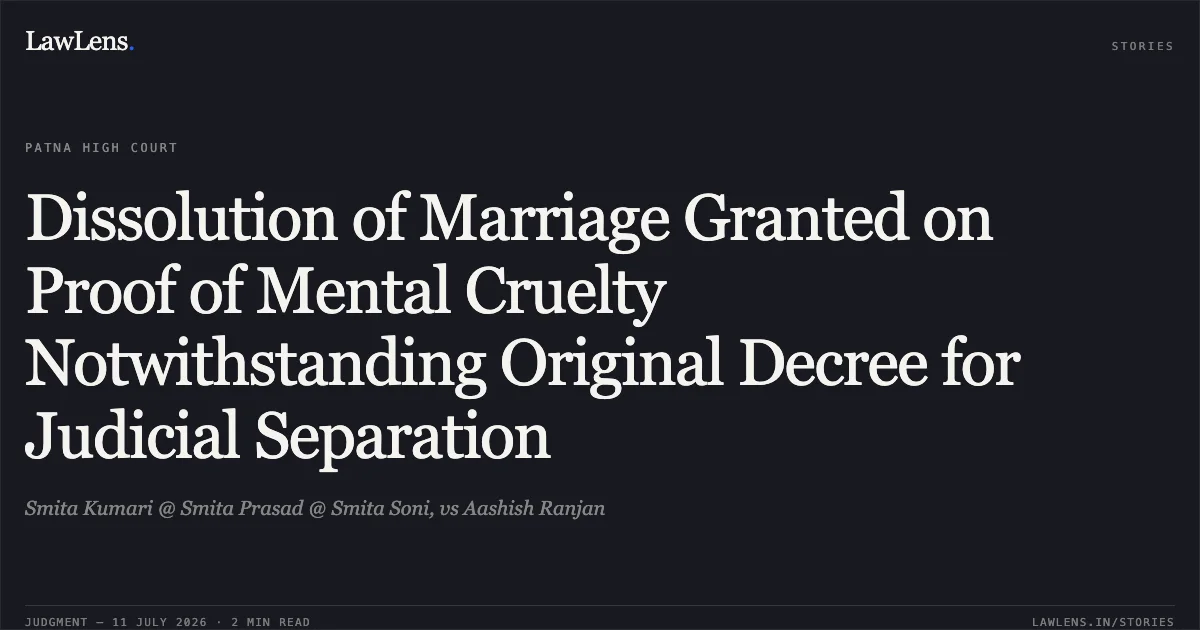
The High Court allowed the husband’s appeal (M.A. 383/2023), set aside the judicial separation, and granted a decree of divorce.
The wife’s appeal (M.A. 375/2023) was dismissed.
Source reference: para 11The Court ordered the husband to pay Rs. 20 lakhs as permanent alimony in two installments of Rs. 10 lakhs each.
Source reference: para 32It specifically held that the daughter remains entitled to claim separate maintenance for studies and retains her legal rights to inheritance regardless of this settlement.
Source reference: para 33-34Acts & Sections Cited
4 provisions across 1 statute referred to in this judgment. Each provision opens on LawLens.
Hindu Marriage Act, 19554
Original Court PDF
Smita Kumari @ Smita Prasad @ Smita Soni,vsAashish Ranjan
Click to open original judgment
Original judgment, available to read, download and summarize on LawLens.in