Facts
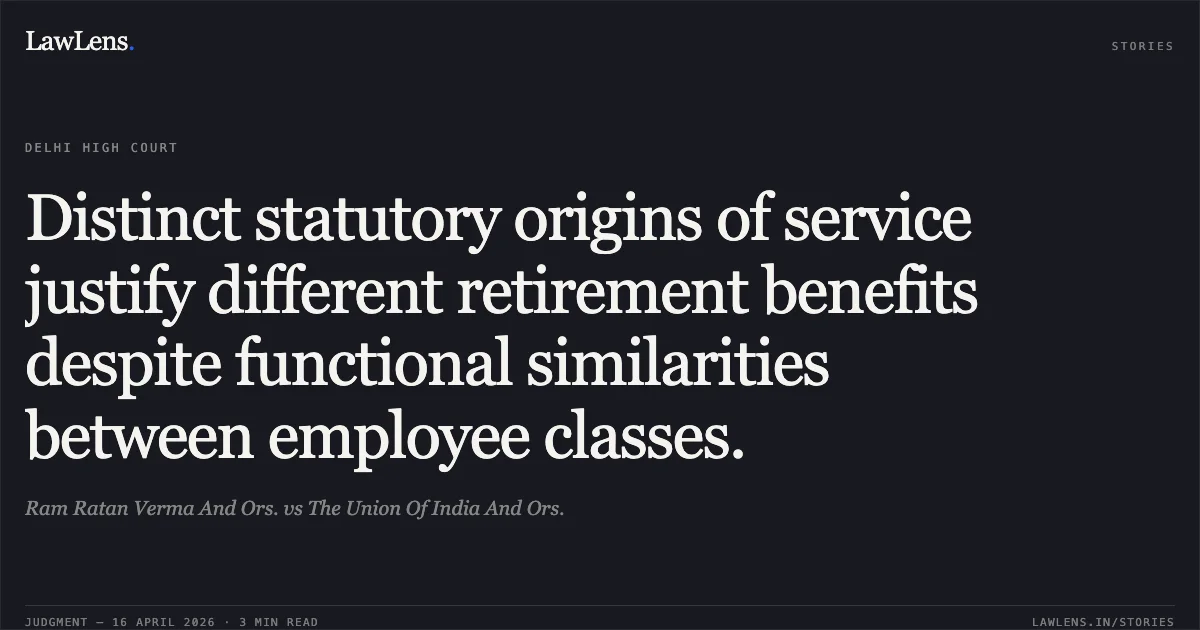
The Petitioners, retired direct recruits of the Food Corporation of India (FCI), sought a mandamus directing the Respondents to grant them pensionary benefits at par with employees transferred to FCI from the erstwhile Food Department ("food transferees")
Source reference: para 1While food transferees were permitted to retain or elect pension benefits based on their antecedent Government service under Section 12A of the FCI Act, direct recruits were governed by the FCI Contributory Provident Fund (CPF) Regulations, 1967
Source reference: para 3, 8-9The Petitioners claimed that since they worked under the same pay pattern and service structure as the transferees, the exclusion from the pension regime was discriminatory
Source reference: para 3They further relied on an Office Memorandum (OM) dated May 1, 1987, which provided a "deeming clause" for CPF beneficiaries to switch to a pension scheme
Source reference: para 4The Government had previously rejected their claim via an order dated June 30, 2015
Source reference: para 6Issues
1. Whether the Petitioners, as direct recruits of FCI, can claim pensionary benefits at par with food transferees as a matter of legal right.
Source reference: para 6(i)2. Whether the Office Memorandum dated May 1, 1987, applies, either directly or by necessary implication, to FCI direct recruits.
Source reference: para 6(ii)3. Whether the denial of pensionary benefits to the Petitioners violates Article 14 of the Constitution of India.
Source reference: para 6(iii)4. Whether the rejection order dated June 30, 2015, has a disabling effect on the present claim.
Source reference: para 6(iv)Law Applied
The Court applied Sections 12 and 12A of the Food Corporation Act, 1964, which distinguish between the Corporation’s power to frame general service rules and the specific statutory arrangement for employees transferred from the Central Government
Source reference: para 8-9It interpreted the Office Memorandum dated May 1, 1987, noting its limited application to civilian Central Government employees under the 1962 CPF Rules
Source reference: para 12-13The Court relied on Article 14 of the Constitution, emphasizing that the guarantee of equality cannot create substantive rights not conferred by statute
Source reference: para 19Key precedents included Food Corporation of India v. Ashis Kumar Ganguly, which restricts parity claims to benefits traceable to a common regulatory source
Source reference: para 23Pradeep Kumar Biswas v. Indian Institute of Chemical Biology, clarifying that "State" status under Article 12 does not automatically grant employees the status or benefits of Government servants
Source reference: para 28, 42Reasoning
The Court held that perceived unfairness does not equate to a legal entitlement for a writ of mandamus
Source reference: para 7It reasoned that food transferees and direct recruits constitute distinct legal classes; the former's pension rights were anchored in their prior status as Government servants and preserved by the statutory mechanism of Section 12A, whereas the Petitioners entered service under the FCI’s independent CPF-based framework
Source reference: para 8-10, 20Regarding the 1987 OM, the Court found it was not self-executing for PSU employees; Paragraphs 6.1 and 7.2 explicitly required administrative authorities of other CPF systems to issue separate orders, which was never done for FCI direct recruits
Source reference: para 12-14Under the Article 14 analysis, the Court determined that equality cannot be used to transplant the advantages of one service regime (Government service) onto another (Corporation service) when they have different legal origins
Source reference: para 19-21The Court distinguished Ashis Kumar Ganguly because the present claim did not involve a benefit under a common regulatory source, but rather an attempt to extend a pension scheme outside the Petitioners' applicable framework
Source reference: para 25Holding
The Court dismissed the writ petition, holding that the Petitioners failed to establish an enforceable legal right to pensionary benefits
It concluded that the direct recruits and food transferees do not stand on the same legal footing regarding terminal benefits
Source reference: para 30The 1987 OM did not automatically apply to the Petitioners, and the distinction maintained between the two classes of employees was legally relevant and not arbitrary under Article 14
Source reference: para 47The Court declined to create a pension regime through judicial direction where the governing law and policy had not provided for one
Source reference: para 47Acts & Sections Cited
1 provisions across 1 statute referred to in this judgment. Each provision opens on LawLens.
Food Corporations Act, 19641
Original Court PDF
Ram Ratan Verma And Ors.vsThe Union Of India And Ors.
Click to open original judgment
Original judgment, available to read, download and summarize on LawLens.in