Facts
The petitioners filed a public-interest writ petition under Article 226 challenging the District Collector’s order dated 29 June 2026, which allotted 2.42 hectares of land recorded as pasture land for construction of a Sub-District Hospital.
Source reference: paras. 1–2, p. 2They alleged that the land had previously been earmarked for the hospital elsewhere and that the alternative site formed part of a pasture land and contained a natural water body (Nadi).
Source reference: paras. 1–2, p. 2The State stated that the originally reserved land had been found unsuitable by the CMHO; a survey and committee recommendation led to selection of Aarazi No. 1335.
Source reference: paras. 3–5, pp. 2–3It further submitted that an equivalent area of pasture land was reserved elsewhere and that the allotted land was not recorded as a Nadi or as containing a water body.
Source reference: paras. 3–5, pp. 2–3Issues
Whether the District Collector’s allotment of pasture land for the Sub-District Hospital was unlawful or arbitrary, including for want of authority or adequate consideration of the site’s suitability.
Source reference: paras. 7–9, pp. 4–5Whether the petitioners established that the allotted land contained a natural water body, rendering the allotment liable to be set aside.
Source reference: para. 10, p. 5Whether the allotment warranted interference under Article 226.
Source reference: paras. 12–14, pp. 5–6Law Applied
The Court referred to the Rajasthan Land Revenue Act, 1956, the Rajasthan Tenancy Act and the rules framed under them as conferring authority on the competent revenue authorities to deal with the reservation and allotment of Government land.
Source reference: para. 8, p. 4It applied the principle that, under Article 226, judicial review examines the decision-making process rather than substituting the Court’s view for that of the competent authority; interference is justified where a decision is arbitrary, perverse, contrary to law or vitiated by mala fides.
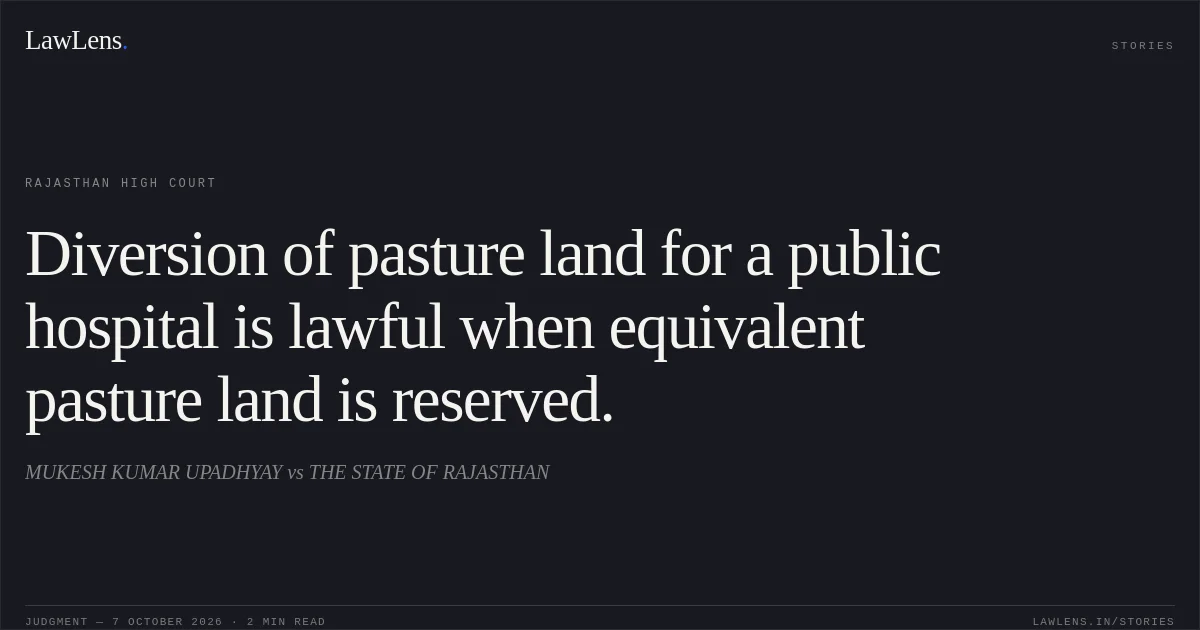
Source reference: para. 12, p. 5The Court also treated the reservation of pasture land of equivalent area as relevant to whether the diversion of the pasture land was legally sustainable.
Source reference: para. 9, p. 4Reasoning
The Court found that the originally selected site had been considered unsuitable, and that the alternative site was identified following a survey and recommendations concerning its suitability.
Source reference: paras. 7–8, p. 4Because an equivalent area of pasture land was reserved under the Collector’s order, the Court held that the pasture-land diversion did not, by itself, make the allotment illegal.
Source reference: para. 9, pp. 4–5The record did not support the allegation that the site was recorded as a Nadi or contained a water body.
Source reference: para. 10, p. 5In light of the steps taken by the authorities, the absence of demonstrated statutory violation or arbitrariness, and the public purpose of providing healthcare, the Court found no basis for judicial interference.
Source reference: paras. 11–13, pp. 5–6Holding
The Court held that the petitioners had not established illegality or infirmity in the Collector’s order dated 29 June 2026.
It dismissed the writ petition and disposed of any pending applications.
Source reference: paras. 14–16, p. 6Original Court PDF
MUKESH KUMAR UPADHYAYvsTHE STATE OF RAJASTHAN
Click to open original judgment
Original judgment, available to read, download and summarize on LawLens.in