Facts
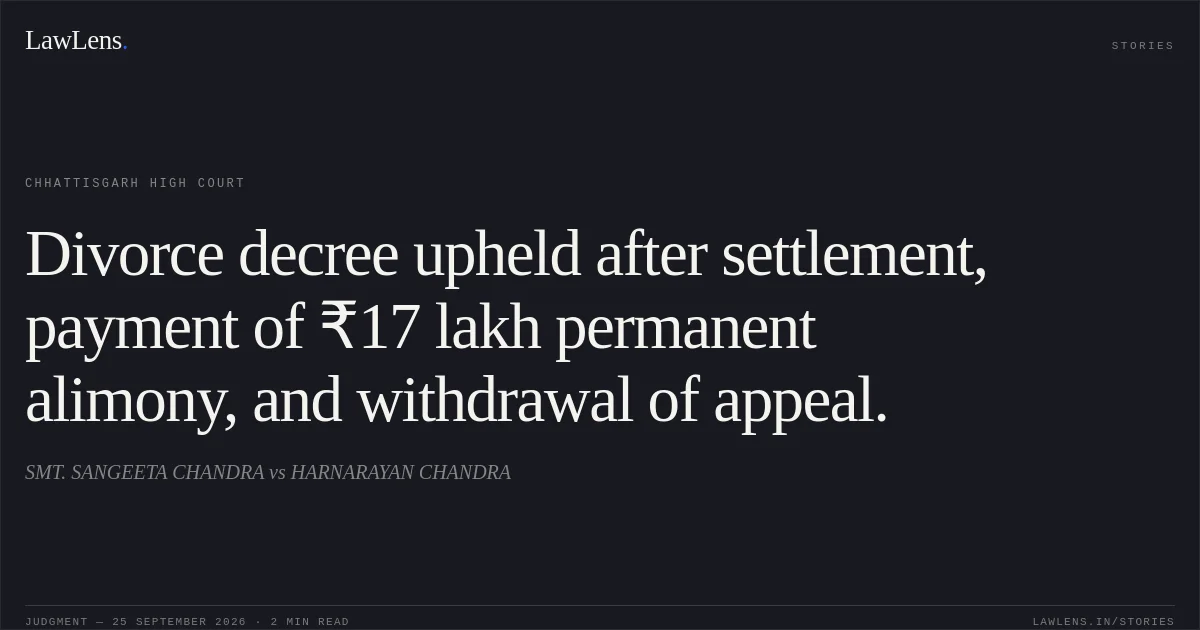
The respondent-husband had instituted proceedings under Section 13(1) of the Hindu Marriage Act, 1955, seeking dissolution of his marriage with the appellant-wife solemnised on 26 June 1997.
Source reference: p.1, para.1The Family Court, Sakti/Janjgir-Champa, allowed the petition and dissolved the marriage by judgment and decree dated 19 June 2025. The wife challenged that decision by filing FA(MAT) No. 294 of 2025 before the High Court.
Source reference: p.1, para.1During mediation before the High Court Mediation Centre, the parties arrived at a settlement dated 18 September 2026. Under the settlement, the husband agreed to pay the wife ₹17,00,000 as permanent alimony through two cheques of ₹9,00,000 and ₹8,00,000.
Source reference: pp.1–2, paras.2–4The settlement also contemplated withdrawal of pending proceedings, including the maintenance case and criminal revision, and mutual non-interference in each other’s future lives.
Source reference: pp.3–5, para.4On receipt of the agreed amount, the wife stated that she did not wish to contest the appeal and sought permission to withdraw it.
Source reference: p.5, para.5Issues
Whether, in view of the settlement reached between the parties and payment of ₹17,00,000 towards permanent alimony, the appellant-wife should be permitted to withdraw the matrimonial appeal?
Source reference: p.5, paras.5–6Whether the appeal challenging the decree of divorce should be disposed of in accordance with the parties’ settlement?
Source reference: pp.1–5, paras.1–6Law Applied
The proceedings arose from the decree of dissolution of marriage under Section 13(1) of the Hindu Marriage Act, 1955, which permits dissolution of marriage on the statutory grounds specified therein.
Source reference: p.1, para.1The Court applied the procedural principle that an appellant may withdraw an appeal when the parties have voluntarily settled their disputes and the appellant no longer wishes to pursue the challenge.
Source reference: pp.1–5, paras.2–6It also recognised the binding effect of a voluntarily executed settlement placed on record, particularly where the parties were represented by counsel, the settlement was reached through mediation, and consideration agreed as permanent alimony had been handed over.
Source reference: pp.1–5, paras.2–6No separate judicial precedent was cited.
Source reference: no citationReasoning
The High Court examined the settlement deed dated 18 September 2026 and noted that it was voluntarily executed by both parties without coercion, pressure, or undue influence.
Source reference: pp.3–5, para.4The agreed settlement provided for payment of ₹17,00,000 to the wife through two identified cheques as full settlement of the parties’ claims.
Source reference: pp.3–4, para.4Since the wife confirmed receipt of the cheques and expressly stated that she did not wish to contest the appeal, the Court found no reason to continue adjudicating the challenge to the divorce decree.
Source reference: p.5, paras.5–6The parties’ settlement therefore furnished sufficient basis for permitting withdrawal of the appeal and disposing of the matter in accordance with their agreement.
Source reference: p.5, paras.5–6Holding
The Court accepted the parties’ settlement and permitted the appellant-wife to withdraw the appeal.
FA(MAT) No. 294 of 2025 was dismissed as withdrawn, and the Court directed that the decree be drawn accordingly.
Source reference: p.5, para.6The decree of divorce dated 19 June 2025 consequently remained undisturbed.
Source reference: no citationActs & Sections Cited
1 provisions across 1 statute referred to in this judgment. Each provision opens on LawLens.
Hindu Marriage Act, 19551
Original Court PDF
SMT. SANGEETA CHANDRAvsHARNARAYAN CHANDRA
Click to open original judgment
Original judgment, available to read, download and summarize on LawLens.in