Facts
The petitioner, a married daughter of a government employee who died in harness on 23.04.2013, applied for compassionate appointment claiming to be a dependent divorcee
Source reference: para 3-5Her application was rejected by the Food & Supplies Department on 08.02.2022 because her divorce petition was filed on the same day as her father's death, failing to meet the statutory requirement of being filed before the death
Source reference: para 5-7The West Bengal Administrative Tribunal (Tribunal) upheld this rejection on 19.11.2024, further remarking that the claim was "ill-intended"
Source reference: para 4, 23The petitioner moved the High Court challenging the Tribunal's order and alternatively claiming eligibility as a "married daughter"
Source reference: para 8Issues
1. Whether a divorcee daughter is eligible for compassionate appointment under Notification No. 26-Emp if the divorce petition was filed on the same date as the employee’s death rather than prior to it
Source reference: para 7, 132. Whether the petitioner could alternatively claim benefit as a "married daughter" without having established prior dependency
Source reference: para 173. Whether the Tribunal exceeded its jurisdiction by casting aspersions on the motive behind a valid judicial decree of divorce
Source reference: para 23-25Law Applied
The Court primarily applied Notification No. 251-Emp dated 03.12.2013, as amended by Notification No. 26-Emp dated 01.03.2016, which requires a divorce petition to be filed before the death/incapacitation of the employee to qualify for dependency status
Source reference: para 5-6It relied on State of West Bengal vs. Debabrata Tiwari (2023) 5 SCC 712, emphasizing that compassionate appointment is an exception to general employment rules and must be granted strictly per the scheme's stipulations to achieve its "beneficial objective"
Source reference: para 12Furthermore, it applied Director of Treasuries in Karnataka vs. V. Somyashree (2021) 12 SCC 20, which held that if a daughter is married and subsisting in that marriage at the time of death, she is not a "dependent" under such rules
Source reference: para 9, 18Reasoning
The Court reasoned that paragraph 3(dd)(a) of the 2016 Notification contains "clear and unambiguous" language requiring the divorce petition to precede the death
Source reference: para 13Since the petition was filed on the same date as the death, the authorities correctly found the condition unfulfilled; the Court refused to embark on a factual inquiry into the exact "time" of filing versus the "time" of death as it constitutes a disputed issue of fact not amenable to judicial review
Source reference: para 14Regarding the alternate claim as a "married daughter," the Court found the petitioner had never established dependency on the employee during his lifetime, a prerequisite for such a class of claimants
Source reference: para 17Finally, the Court scrutinized the Tribunal’s remarks, determining that neither the State nor the Tribunal has the jurisdiction to label a decree from a competent court as "ill-intended" or "collusive"
Source reference: para 25-26Holding
The Court held that the petitioner was ineligible for compassionate appointment as she failed to meet the strict criteria of the scheme regarding the timing of her divorce petition
The writ petition was disposed of by upholding the rejection of her claim; however, the Court set aside the Tribunal’s jurisdictional overreach regarding the alleged "mala fide" nature of the divorce decree
Source reference: para 21, 26-27Original Court PDF
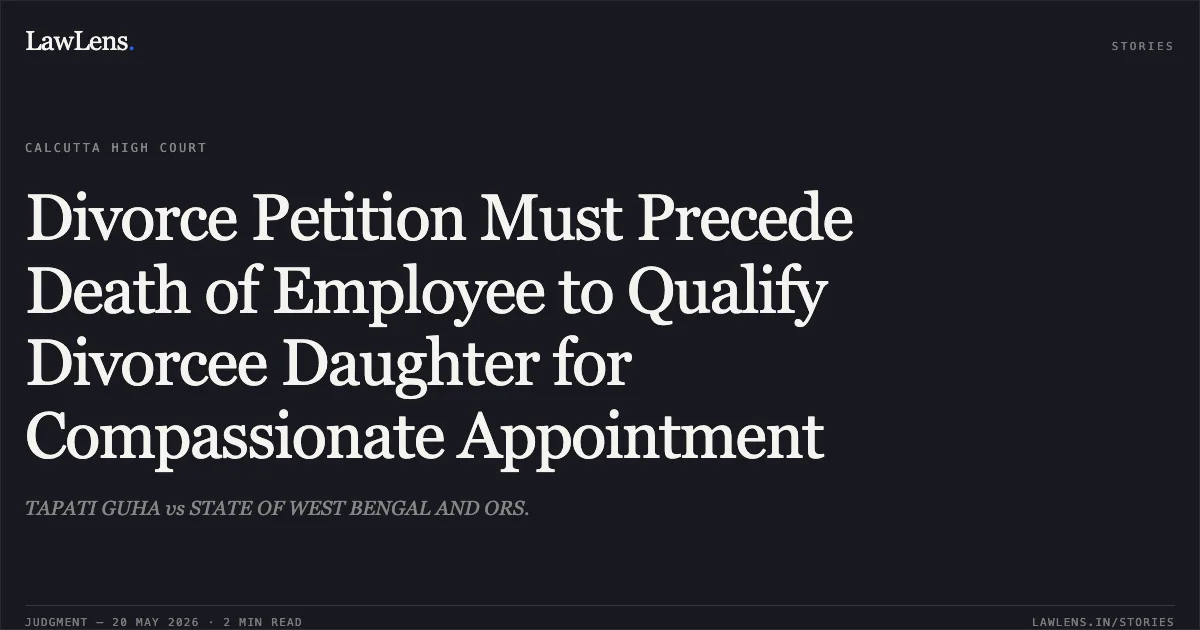
TAPATI GUHAvsSTATE OF WEST BENGAL AND ORS.
Click to open original judgment
Original judgment, available to read, download and summarize on LawLens.in