Facts
The Appellant (step-father of victims 'K' and 'M') was convicted by the Trial Court under Section 376(2)(f)(i) of the IPC and Section 6 of the POCSO Act for the sexual assault of his minor step-daughters
Source reference: p. 1-2The incident occurred between April 25–28, 2014, while the victims' biological mother was at the hospital tending to a sick child
Source reference: p. 3The matter was reported after the landlord (PW-2) and his wife (PW-11) were alerted by victim 'K's' cries
Source reference: p. 3While the Trial Court acquitted the biological mother, it sentenced the Appellant to 15 years RI and a fine
Source reference: p. 2The Appellant challenged the conviction, alleging false implication based on "inborn hatred" from the step-daughters due to the replacement of their biological father and citing lack of scientific corroboration in the MLC
Source reference: p. 4Issues
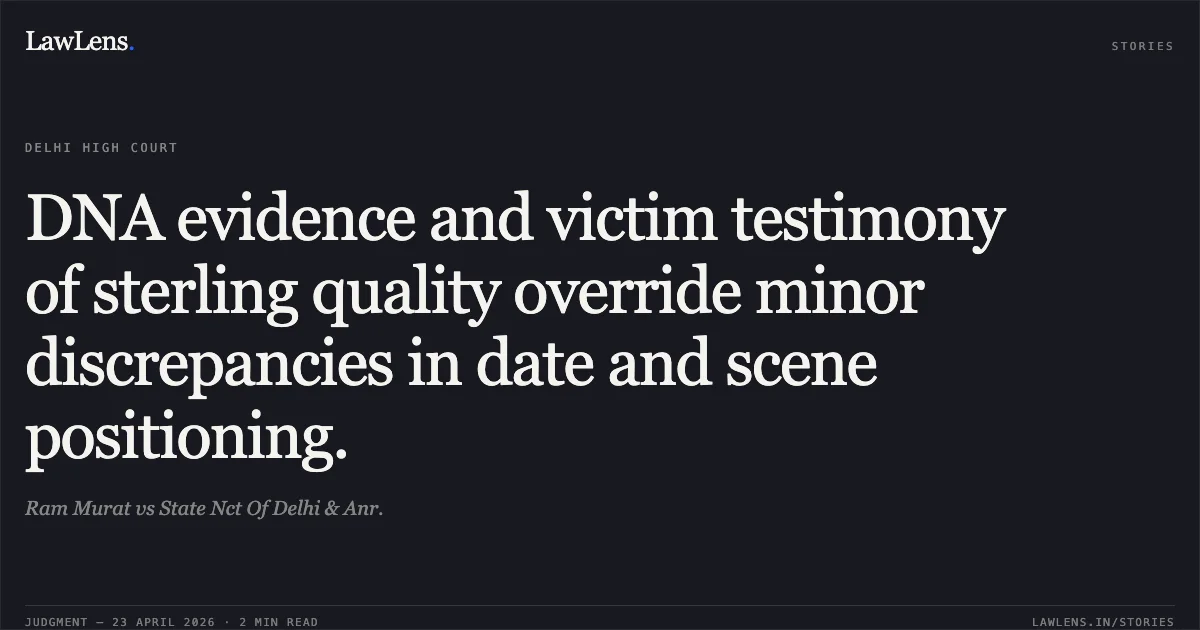
1. Whether minor discrepancies in witness testimonies regarding the date of the incident and the exact physical position of the accused in the room vitiate the prosecution's case
Source reference: p. 7-8 / para. 14-172. Whether the absence of physical injuries in the MLC and the refusal of a gynecological exam by one victim negate the charge of sexual assault when DNA evidence is present
Source reference: p. 10-11 / para. 19-233. Whether the sole testimony of a prosecutrix is sufficient for conviction in the absence of independent ocular witnesses to the act
Source reference: p. 11 / para. 24Law Applied
The Court primarily applied Section 376(2)(f)(i) of the IPC and Section 6 of the POCSO Act
Source reference: p. 2It relied on the principles from Balu Sudam Khalde v. State of Maharashtra (2023), which established that minor variations or trivial discrepancies do not permit the rejection of evidence as a whole unless they touch the core of the case
Source reference: p. 5-7the Court applied the doctrine from Ganesan v. State (2020) and State of Punjab v. Gurmit Singh (1996), asserting that the testimony of a prosecutrix, if of "sterling quality," requires no corroboration and stands on a higher pedestal than an injured witness
Source reference: p. 11-13Reasoning
The Court dismissed the Appellant's arguments regarding the date discrepancy (April 28 vs. 29), noting that the timeline aligned with the late-night medical examination conducted at 2:30 AM
Source reference: p. 7-8It found the landlord’s testimony regarding the "thumping signal" and finding the Appellant in his undergarments to be strong circumstantial corroboration
Source reference: p. 8, 16Crucially, the Court linked the MLC to the FSL report (Ex. PW-9/A), which confirmed that seminal stains found on victim 'K's' underwear and cotton swabs matched the DNA profile of the Appellant
Source reference: p. 10-11The Court reasoned that the biological mother’s admissions under Section 313 Cr.P.C.—specifically that the Appellant forcibly took the victim from the hospital despite her apprehensions—further cemented the Appellant's "evil intent" and presence at the scene
Source reference: p. 17-18Holding
The High Court answered all issues in the negative and affirmed the conviction.
It held that the testimony of victim 'K' was credible and supported by both ocular circumstances and scientific technical evidence
Source reference: p. 15-16The Court dismissed the appeal, upheld the judgment of conviction and order on sentence, and directed the Appellant to surrender forthwith to serve the remainder of his 15-year term
Source reference: p. 18Acts & Sections Cited
9 provisions across 3 statutes referred to in this judgment. Each provision opens on LawLens.
Code of Criminal Procedure, 19733
Indian Penal Code, 18601
Protection of Children from Sexual Offences Act, 20125
Original Court PDF
Ram MuratvsState Nct Of Delhi & Anr.
Click to open original judgment
Original judgment, available to read, download and summarize on LawLens.in