Facts
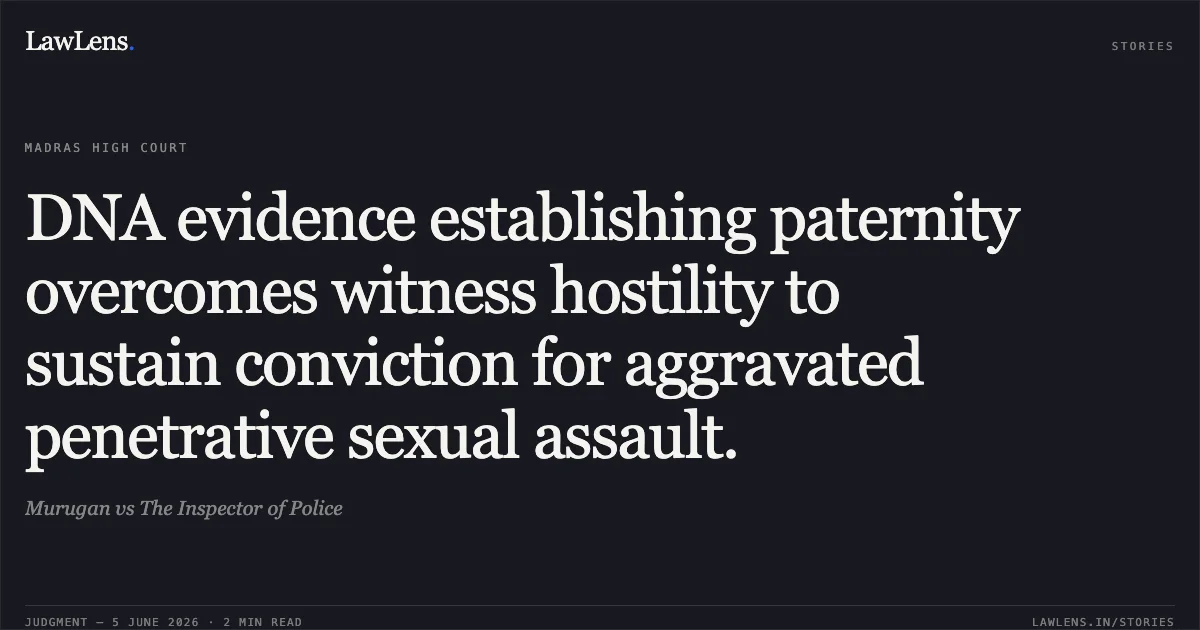
The Appellant was convicted by the Fast Track Mahila Court, Theni, for committing penetrative sexual assault on a 13-year-old victim on multiple occasions in 2020, resulting in her pregnancy
Source reference: p.1-3During the trial, the victim and her parents (PW1–PW3) turned hostile and denied the occurrence
Source reference: p.7-8However, a DNA test conducted after the filing of the final report confirmed the Appellant as the biological father of the child born to the victim
Source reference: p.8-9The Appellant challenged the conviction on grounds of procedural lapses in DNA sample collection, non-furnishing of documents under Section 207 Cr.P.C., and the hostility of material witnesses
Source reference: p.6Issues
1. Whether a conviction can be sustained solely based on DNA evidence and a Section 164 Cr.P.C. statement when the victim and witnesses have turned hostile
Source reference: p.7-82. Whether the procedural delay and manner of collecting DNA samples after the filing of the police report vitiate the evidence
Source reference: p.9-103. Whether the charge under Section 5(l) of the POCSO Act is sustainable in the absence of specific evidence regarding "repeated" assault
Source reference: p.13Law Applied
The Court applied Section 5 (Aggravated penetrative sexual assault) and Section 6 (Punishment) of the POCSO Act, 2012, alongside Section 506 IPC regarding criminal intimidation
Source reference: p.1-2The court utilized the principle that a statement recorded under Section 164 Cr.P.C. can be used for corroboration if the witness admits the signature
Source reference: p.8It also relied on the evidentiary value of expert DNA reports and the procedural requirements of Section 207 Cr.P.C. regarding the furnishing of documents to the accused
Source reference: p.10Reasoning
The Court held that while the victim turned hostile, her admission of the signature on the Section 164 Cr.P.C. statement allowed it to be used for corroboration
Source reference: para 17The DNA report (Exhibits P9, P10, etc.) provided "clinching evidence" of paternity, establishing the foundational fact of sexual penetration
Source reference: para 18, 26The Court rejected the defense of procedural lapses in the DNA test, noting that the samples were collected via judicial order, the chain of custody was intact (sent to FSL within six days), and the Deputy Director of the FSL (PW13) was cross-examined by the defense, proving no prejudice was caused
Source reference: para 19-22Distinguishing the precedent Karandeep Sharma v. State of Uttarakhand, the Court found no evidence of sample tampering or haste in this trial
Source reference: para 23-25Finally, the Court noted that since PW3 was hostile, "repeated" assault under Section 5(l) could not be proven; however, the act was covered under Section 5(j)(ii) as it resulted in pregnancy
Source reference: para 28Holding
The Court upheld that DNA evidence can establish the foundational facts necessary for a POCSO conviction even when the victim contradicts the prosecution's case
The High Court partly allowed the appeal. It set aside the conviction under Section 506 IPC due to witness hostility. It altered the conviction from Section 5(l) to Section 5(j)(ii) of the POCSO Act. The sentence of life imprisonment was modified to rigorous imprisonment for a term of 20 years.
Source reference: para 28, 29, 30Acts & Sections Cited
8 provisions across 3 statutes referred to in this judgment. Each provision opens on LawLens.
Code of Criminal Procedure, 19735
Indian Penal Code, 18601
Original Court PDF
MuruganvsThe Inspector of Police
Click to open original judgment
Original judgment, available to read, download and summarize on LawLens.in