Facts
The appellant was employed as domestic help by the respondent, during which they engaged in sexual relations on the pretext of marriage.
Source reference: para. 3The parties married on March 2, 2016, and a child was born on April 1, 2016.
Source reference: para. 3Following matrimonial disputes, the appellant filed a complaint under Section 12 of the Protection of Women from Domestic Violence Act, 2005, seeking interim maintenance and other reliefs.
Source reference: para. 3In response, the respondent sought a DNA test to establish paternity. The Trial Court ordered the test; the resulting DNA report dated May 8, 2017, established that the respondent was not the biological father.
Source reference: para. 4Consequently, the Trial Court and the First Appellate Court rejected the child’s claim for maintenance.
Source reference: para. 4The High Court of Delhi remanded the appellant’s maintenance claim for fresh consideration but upheld the denial of maintenance to the child, leading to this appeal.
Source reference: para. 5Issues
1. Whether the child is entitled to maintenance from the respondent despite a DNA report establishing non-paternity, in light of the presumption of legitimacy under Section 112 of the Indian Evidence Act.
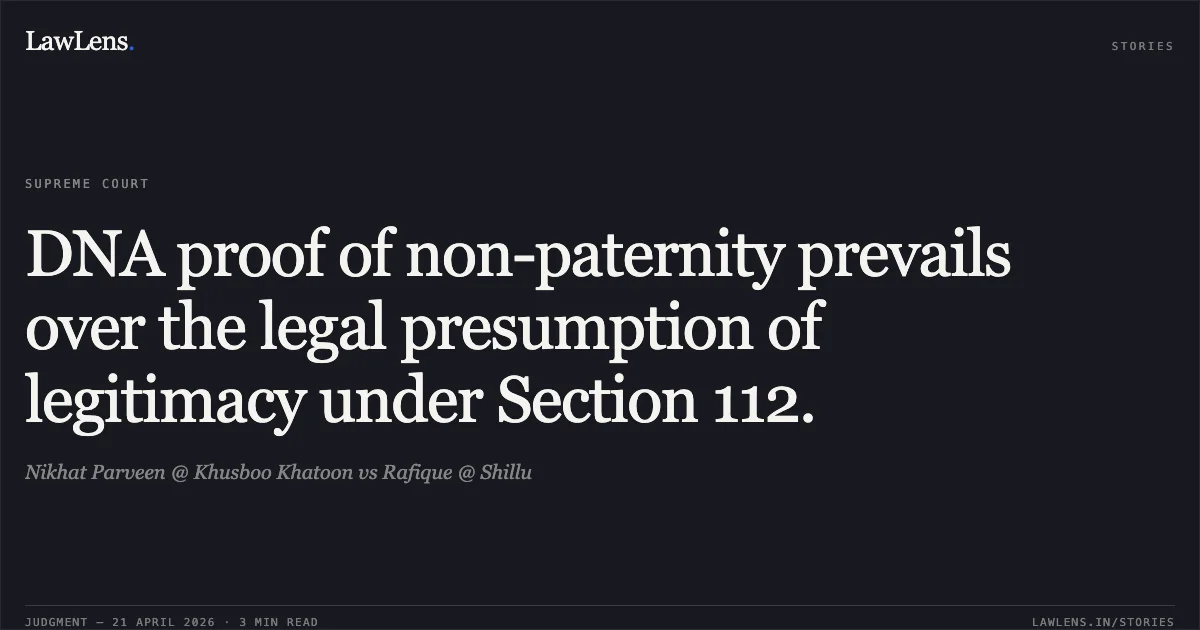
Source reference: para. 2, 52. Whether a scientifically accurate DNA test report overrides the "conclusive proof" of legitimacy envisaged under Section 112 of the Indian Evidence Act (now Section 116 of the Bharatiya Sakshya Adhiniyam, 2023).
Source reference: para. 6, 9Law Applied
The Court primarily applied Section 112 of the Indian Evidence Act, 1872 (and its equivalent Section 116 of the Bharatiya Sakshya Adhiniyam, 2023), which stipulates that birth during a valid marriage is "conclusive proof" of legitimacy unless "non-access" is proven.
Source reference: para. 6It relied on Nandlal Wasudeo Badwaik v. Lata Nandlal Badwaik, which established that when scientific proof (DNA) conflicts with a legal presumption, the former must prevail in the interest of justice.
Source reference: para. 7.3, 9The Court further considered Goutam Kundu v. State of W.B. regarding the restricted ordering of blood tests.
Source reference: para. 7.2Aparna Ajinkya Firodia v. Ajinkya Arun Firodia regarding the child's right to privacy.
Source reference: para. 7.5Ivan Rathinam v. Milan Joseph regarding the "balancing of interests" between social stigma and the quest for biological truth.
Source reference: para. 7.6, 8Reasoning
The Court observed that while Section 112 of the IEA seeks to prevent the stigma of illegitimacy, the presumption it creates is rebuttable by proof of non-access.
Source reference: para. 7.3, 7.5The Court distinguished this case from Aparna Ajinkya Firodia, noting that here, the DNA test had already been conducted with the appellant's consent and the results had attained finality without dispute.
Source reference: para. 9Following the precedent in Badwaik, the Court reasoned that where the truth is scientifically known and available on record, there is no room for legal presumptions to override such facts.
Source reference: para. 7.3, 9The Court held that since the respondent was proven not to be the biological father through an undisputed scientific process, the legal fiction of "conclusive proof" under Section 112 must yield to the actual proof of non-paternity.
Source reference: para. 9, 10Holding
The Supreme Court dismissed the appeal, holding that the High Court did not err in denying maintenance to the daughter as the DNA report conclusively proved the respondent was not the biological father.
However, invoking its concern for the child's welfare, the Court directed the Secretary, Women and Child Development, Government of NCT of Delhi, to depute an officer to monitor the child's residence, education, nutrition, and health, and to take remedial measures where necessary.
Source reference: para. 11All pending applications were disposed of.
Source reference: no citationActs & Sections Cited
3 provisions across 3 statutes referred to in this judgment. Each provision opens on LawLens.
Protection of Women from Domestic Violence Act, 20051
Bharatiya Sakshya Adhiniyam, 20231
Hindu Marriage Act, 19551
Original Court PDF
Nikhat Parveen @ Khusboo KhatoonvsRafique @ Shillu
Click to open original judgment
Original judgment, available to read, download and summarize on LawLens.in