01Facts
The petitioner-plaintiff, born on 18.8.1997, filed O.S. No. 1695 of 2026 before the Fourth Assistant Judge, City Civil Court, Chennai, seeking a declaration that the respondent-defendant is his biological father
¶ 4He alleged that in 1990, when his mother was about 18 and living with her parents, she developed an intimate relationship with the respondent, who lived in the opposite house, and that the plaintiff was born from that relationship
¶ 9 · p. 4The mother married one Mr. Sreekumar on 20.10.1996
¶ 10 · p. 5 · ¶ 12 · p. 6The plaintiff was born on 18.8.1997, during the subsistence of that marriage
¶ 10 · p. 5The plaintiff filed I.A. No. 3 of 2026 under Order XXVI Rule 10 CPC seeking a direction that the defendant undergo DNA profiling with him
¶ 5The trial court dismissed the application on 28.9.2026, holding that a DNA test could not be ordered routinely given the presumption under Section 116 of the Bharatiya Sakshya Adhiniyam (BSA), 2023
¶ 6, 9–10The plaintiff filed this revision under Article 227 of the Constitution
p. 2 · ¶ 102Issues
i.1. Whether a court may direct a DNA test in a paternity suit where the plaintiff was born during a valid subsisting marriage of his mother, so that the presumption under Section 116 BSA is engaged
¶ 7 · pp. 3–4 · ¶ 12 · pp. 5–6ii.2. Whether the trial court's refusal to order the DNA test is perverse or otherwise warrants interference under Article 227 of the Constitution
¶ 11 · p. 503Law Applied
The court applied Section 116 of the BSA, 2023, which raises a presumption as to the legitimacy of a child born during the continuance of a valid marriage, as described in the judgment
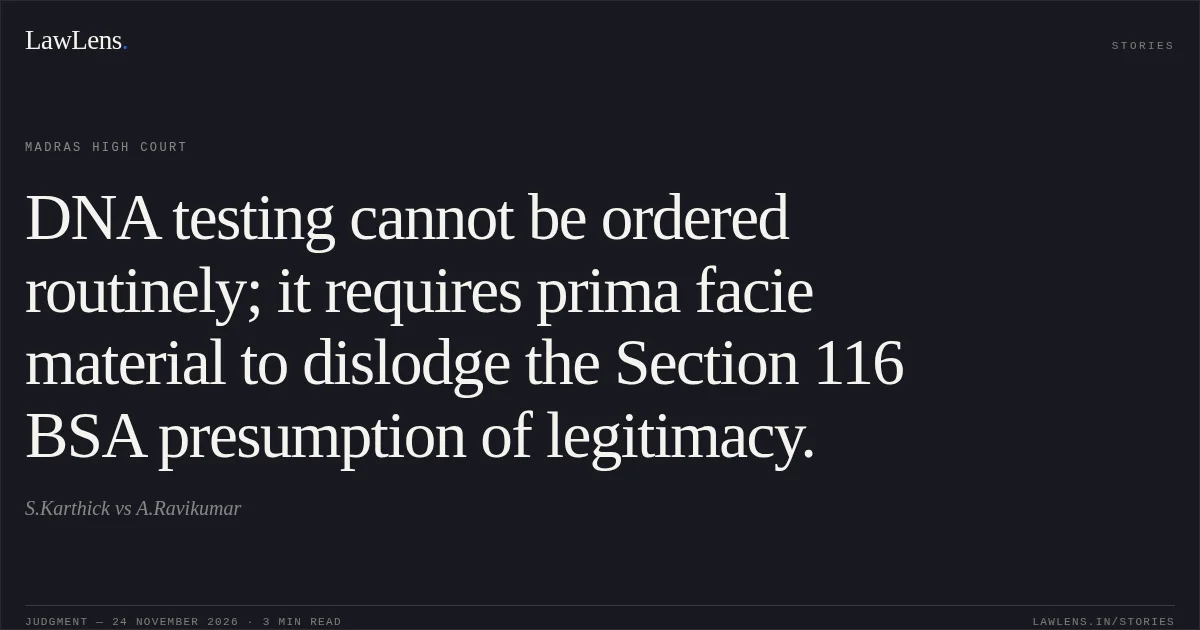
¶ 10 · p. 5 · ¶ 12 · p. 6It relied on the settled principle that a DNA test cannot be ordered in a routine fashion and may be ordered only where there is sufficient prima facie material to dislodge the Section 116 presumption
¶ 12 · pp. 5–6The court also noted Order XXVI Rule 10 CPC as the procedural basis of the application
p. 2 · ¶ 5The petitioner relied on Chaturbhuj Pradhan v. Amar Pradhan (2026 SCC OnLine SC 994) for the proposition that the sole question is biological paternity and that DNA testing is the best means of resolving it; the judgment does not record the holding of that decision or expressly distinguish it
¶ 7–8 · pp. 3–4The scope of interference under Article 227 is confined to perversity or patent illegality in the lower court's reasoning
¶ 11 · p. 5Provisions in the judgment · 1 · Linked ones open on LawLens
Bharatiya Sakshya Adhiniyam, 2023 Section 116
04Reasoning
The trial court weighed the plaintiff's allegation of a 1990 relationship, which predated the mother's marriage, against the fact that the plaintiff was born in August 1997, within a year of the marriage in October 1996, during its subsistence
¶ 9–10 · pp. 4–5Because the presumption under Section 116 BSA was available on these dates, the court held that it could not be displaced by ordering a DNA test in the absence of prima facie material dislodging it
¶ 12 · p. 6The High Court found that the trial court's reasoning was "perfectly in order" and free from perversity, so no interference under Article 227 was warranted
¶ 11 · p. 5The judgment does not analyse whether the petitioner placed any specific material before the trial court to rebut the presumption, beyond the alleged pre-marriage relationship
¶ 9–12 · pp. 4–6Nor does it examine Chaturbhuj Pradhan in terms, so the reasoning rests on the general routine-testing principle rather than on a reconciliation with the petitioner's authority
¶ 8, 1205Holding
The court answered Issue 1 in the negative on the present record: a DNA test cannot be ordered routinely where the child was born during a valid subsisting marriage and the Section 116 presumption remains intact, and no sufficient prima facie material to dislodge it was shown
¶ 12 · p. 6On Issue 2, the trial court's order was not perverse and did not warrant interference under Article 227
¶ 11 · p. 5The civil revision petition is dismissed, and the connected CMP No. 31193 of 2026 is dismissed
¶ 13 · p. 6The suit itself remains pending before the City Civil Court, and the trial court's findings on paternity are left open for adjudication on evidence
Original Court PDF
S.KarthickvsA.Ravikumar
Click to open original judgment
Original judgment, available to read, download and summarize on LawLens.in