01Facts
The deceased was married to A3 on 28-08-2008. She lived in a joint family with A1 (father-in-law), A2 (mother-in-law) and A4 (sister-in-law).
¶ 4(i)The prosecution alleged that the accused demanded Rs. 7 lakh for A3's juice shop, Rs. 4 lakh and Rs. 6 lakh for house leases, Rs. 3.5 lakh for A4's marriage, Rs. 5.8 lakh (Kisan Vikas Patra maturity) and Rs. 55,000 on 01-08-2012, and beat the deceased when she refused to seek money from her parents.
¶ 4(ii)The deceased died by hanging on 03-08-2012.
¶ 4(ii)The maternal uncle (PW1) lodged a complaint; an FIR was registered under Section 174(3) CrPC, later altered to Sections 498A, 304B and 406 r/w 34 IPC, and a charge-sheet was filed.
¶ 4(iii)The trial court framed charges under 498A, 304B and 406 IPC, later altered (20-12-2016) to 498A, 306 and 406 IPC without objection from the prosecution or de facto complainant.
¶ 4(v), 17The trial court acquitted A2–A4 of all charges and A1 of Section 406 IPC, but convicted A1 under Sections 498A and 306 IPC: three years' RI and seven years' RI respectively, concurrent.
¶ 4(vii)The RDO's inquest report and the PW3 (mother) statements before the RDO differed materially from her deposition on the alleged demands.
¶ 10, 1202Issues
i.1. Whether the prosecution established a dowry demand and cruelty within the meaning of Section 498A IPC, so as to sustain A1's conviction under Sections 498A and 306 IPC.
¶ 9–16, 21–22ii.2. Whether the specific transactions alleged (shop funding, lease payments, loan for A4's marriage, KVP maturity amount, Rs. 55,000) were made pursuant to dowry demands.
¶ 10–16iii.3. Whether the evidence of PW2, the letter Ex.P16, and the hearsay witnesses establish cruelty driving the deceased to suicide.
¶ 18–20iv.4. Whether the acquittal of A2–A4 and of A1 under Section 406 IPC is perverse and liable to be set aside in the de facto complainant's appeal.
¶ 6, 21, 23(i)03Law Applied
Section 498A IPC (cruelty by husband or relatives, including harassment for unlawful dowry demands) and Section 306 IPC (abetment of suicide), which requires cruelty of such a nature as to drive the woman to suicide.
¶ 21–22Section 406 IPC (criminal breach of trust) and Section 304B IPC, the latter having been dropped by alteration of charge.
¶ 4(v), 17The alleged transactions are treated as dowry only if made pursuant to a demand, and voluntary family transfers and loans are treated as outside dowry.
¶ 13–15Principles of appreciation of witness testimony, including the weight of earlier statements (Section 161 CrPC statement and the RDO's inquest statement) against later improvements, and the treatment of hearsay evidence.
¶ 10–11, 20Section 323 IPC, applied to the isolated slapping incident, though no charge was framed for it.
¶ 22Section 374(2) CrPC (appeal against conviction) and Section 372 CrPC (victim's appeal against acquittal) as the appellate jurisdictions invoked.
No binding precedent is cited in the judgment.
Provisions in the judgment · 10 · Linked ones open on LawLens
Code of Criminal Procedure, 1973 Section 374Section 372Section 174Section 207Section 313Section 161
Indian Penal Code, 1860 Section 406Section 34Section 306Section 323
04Reasoning
The court found that the marriage was preceded by a romantic relationship and that the charge did not allege a dowry demand at marriage.
¶ 9On the shop funding (Rs. 7 lakh), the court held that PW3 had first described the transaction as voluntary before the RDO and that her deposition introduced the demand for the first time. The investigating officer confirmed that her Section 161 statement did not contain these facts. The court therefore treated the demand as an improvement.
¶ 10–11On the Rs. 4 lakh and Rs. 6 lakh lease payments, the court found that PW3's earliest statement attributed the lease to her own initiative, and that she had recovered the lease amount from the landlord, so no dowry was shown.
¶ 12–13The Rs. 3.5 lakh loan was backed by a bond (Ex.P2) and an acknowledgement, which made it a loan rather than dowry.
¶ 14The Kisan Vikas Patra maturity amount was held to be a voluntary transfer by PW3 for her daughter's benefit. The court found PW1's contrary account an afterthought, based on jail visit records (Ex.D3) showing that he had not met PW3 after 09-09-2011.
¶ 15The Rs. 55,000 transaction was found improbable because PW3's earliest version linked it to the maturity amount, while later depositions described it as independent.
¶ 16On cruelty, PW2's testimony was held to show, at most, a quarrel and one slapping incident by A1 on 03-08-2012, and the prosecution had not proved the alleged breaking of the phone.
¶ 18The letter Ex.P16 contained no reference to dowry and named only A1 and A2. PW1 was treated as corroborative only, and his evidence was assessed in light of PW3's.
¶ 20Since the evidence showed family quarrels rather than cruelty of the kind in Section 498A, and no abetment of suicide, the court held the acquittal of A2–A4 justified.
¶ 21As to A1, the court found the single slapping incident insufficient for Sections 498A or 306 IPC and noted that it might attract Section 323 IPC, for which no charge existed. It treated his detention during investigation and trial as adequate punishment for that offence.
¶ 2205Holding
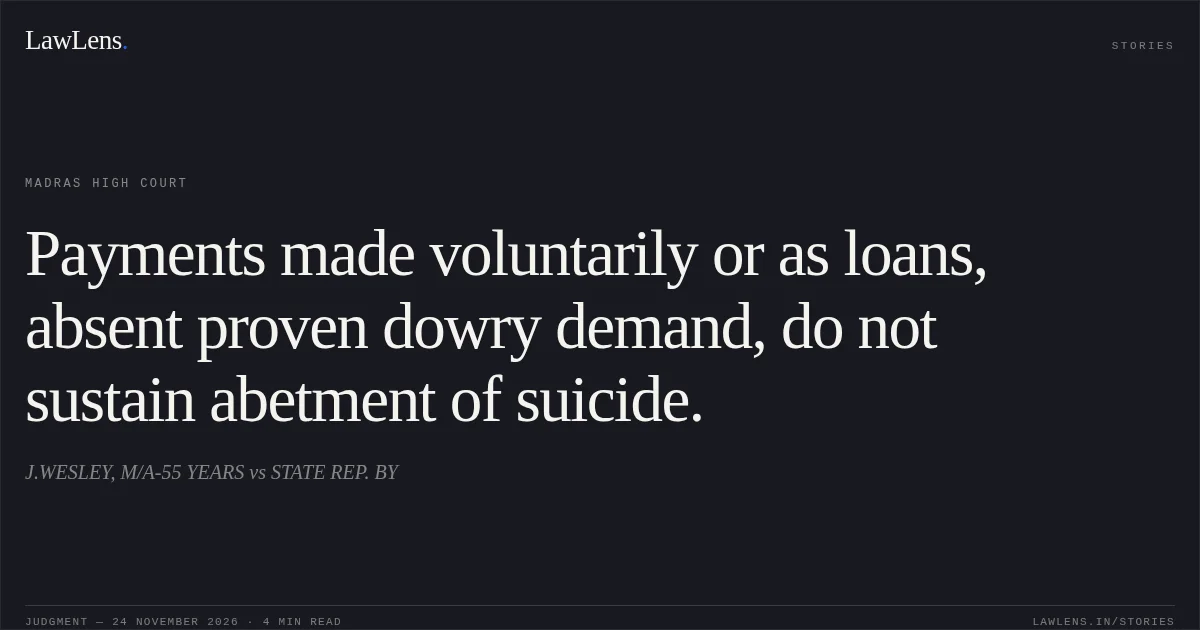
The prosecution failed to establish any dowry demand or cruelty of a nature that drove the deceased to suicide, and the evidence did not support Sections 498A, 306 or 406 IPC.
¶ 21–22The appeal of the de facto complainant (Crl.A. No. 49 of 2018) is dismissed. The acquittal of A2–A4 of all charges and of A1 under Section 406 IPC is confirmed.
¶ 23(i)The appeal of A1 (Crl.A. No. 543 of 2017) is allowed. His conviction and sentence under Sections 498A and 306 IPC are set aside. He is acquitted of all charges, any fine paid is to be refunded, and bail bonds stand discharged.
¶ 23(ii)Original Court PDF
J.WESLEY, M/A-55 YEARSvsSTATE REP. BY
Click to open original judgment
Original judgment, available to read, download and summarize on LawLens.in