01Facts
The respondent (decree-holder) sued for specific performance of a suit sale agreement against the petitioner (judgment-debtor) and obtained a decree.
¶ 2The decree was executed in R.E.P. No. 1 of 2024 before the III Additional District Judge, Salem.
¶ 2 · pp. 2–3The petitioner failed to appear and was set ex parte on 01.10.2024.
¶ 2 · p. 3The petitioner filed applications on 08.01.2025 to set aside the ex parte order and to condone a 69-day delay.
¶ 2 · p. 3The Executing Court dismissed both applications, holding that under Order XXI Rule 106(3) CPC the limitation is 30 days and the court could not condone the delay thereafter.
¶ 2 · p. 3The petitioner contended that the 30-day limit applies only to a final order passed after ex parte proceedings, relying on Sundarammal and another v. Kanagaraj and another, 2025 SCC OnLine Mad 2980.
¶ 3 · pp. 3–4The respondent argued that the limitation runs from the date of the ex parte order where notice was served.
¶ 4 · p. 4The petitioner's affidavit stated that he was suffering from severe leg pain and was under hospital treatment, which prevented his appearance.
¶ 8 · p. 6The execution petition was posted for submission of a draft sale deed, and no final order had been passed against the petitioner.
¶ 7 · pp. 5–602Issues
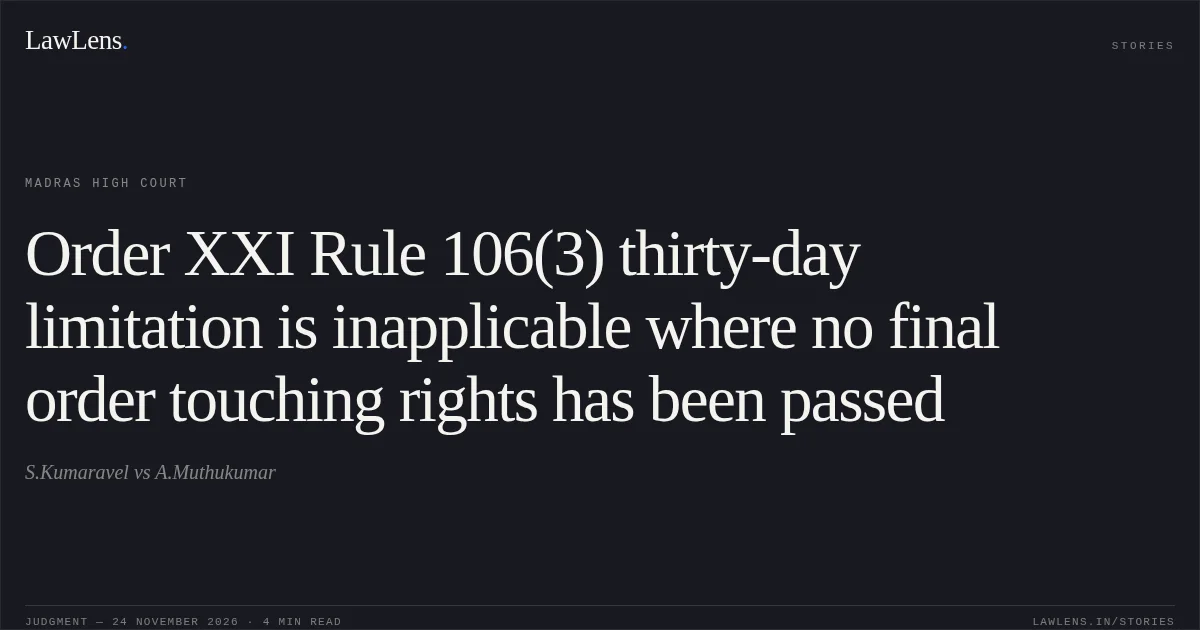
i.1. Whether the 30-day limitation under Order XXI Rule 106(3) CPC bars an application to set aside an ex parte order in execution where no final order touching the judgment-debtor's rights has been passed.
¶ 6 · pp. 4–5 · ¶ 7 · pp. 5–6ii.2. Whether the petitioner, having shown sufficient cause through his affidavit, is entitled to an opportunity to contest the execution petition on merits.
¶ 8 · p. 6 · ¶ 9 · p. 603Law Applied
Order XXI Rule 105(3) CPC permits the executing court to hear an application ex parte and pass such order as it thinks fit where the opposite party fails to appear.
¶ 5 · p. 4Under Order XXI Rule 106(1) and (3), a party against whom such an order touching his rights is passed may apply to set it aside within 30 days of the order (if notice was served) or of knowledge (if not).
¶ 5 · p. 4Following Sundarammal and another v. Kanagaraj and another, 2025 SCC OnLine Mad 2980, the limitation under Rule 106(3) applies only to an order passed in consequence of ex parte proceedings, not to the mere order setting a party ex parte; if the party appears before a final order is passed, he may seek to set aside the ex parte order at any time before that final order.
¶ 6 · pp. 4–5 (quoting paras. 52 of Sundarammal)The time-line for disposal of execution proceedings laid down by the Supreme Court in Periyammal (Dead) Through LRs and others v. V. Rajamani and another, 2025 INSC 329 is applicable.
¶ 10 · p. 7Provisions in the judgment · 1 · Linked ones open on LawLens
Code of Civil Procedure, 1908 Section 115
04Reasoning
The Executing Court erred in treating Rule 106(3) as a bar. Since the petitioner was set ex parte on 01.10.2024 and the execution petition was merely posted for submission of a draft sale deed, no final order touching his rights had been passed.
¶ 7 · pp. 5–6The 30-day period therefore had not begun to run, and the petitioner could seek to set aside the ex parte order by showing sufficient cause.
¶ 7 · p. 6On the merits of sufficient cause, the Court accepted the uncontroverted assertion of severe leg pain and hospital treatment in the affidavit as a reason for non-appearance, and held that the petitioner should be given an opportunity to contest the execution on merits.
¶ 8 · p. 6Because the Court found Rule 106(3) inapplicable, the separate question of condonation of the 69-day delay was effectively rendered academic.
¶ 7 · p. 6 · ¶ 9 · p. 6The Court balanced the relief against costs to the decree-holder, fixed at Rs. 5,000 in each revision.
¶ 8 · p. 605Holding
Question 1 is answered in the negative: the 30-day limitation under Order XXI Rule 106(3) CPC does not apply where no final order has been passed against the judgment-debtor after he was set ex parte, and the ex parte order may be challenged by showing sufficient cause.
¶ 6–7 · pp. 4–6Question 2 is answered in the affirmative on the basis of the uncontroverted medical ground in the affidavit.
¶ 8 · p. 6Both CRPs are allowed, subject to the petitioner paying Rs. 5,000 in each revision to the respondent (or depositing it in R.E.P. No. 1 of 2024 if refused) within two weeks of receiving the order; non-compliance results in automatic dismissal of the revisions. On compliance, the impugned common order dated 11.09.2025 stands set aside and the Executing Court must proceed with the execution in accordance with law.
¶ 8–9 · pp. 6–7The Executing Court is further directed to dispose of R.E.P. No. 1 of 2024 expeditiously, bearing in mind the Periyammal time-line. No costs are awarded beyond the conditional amount, and CMP No. 5212 of 2026 is closed.
¶ 10 · p. 7Original Court PDF
S.KumaravelvsA.Muthukumar
Click to open original judgment
Original judgment, available to read, download and summarize on LawLens.in