01Facts
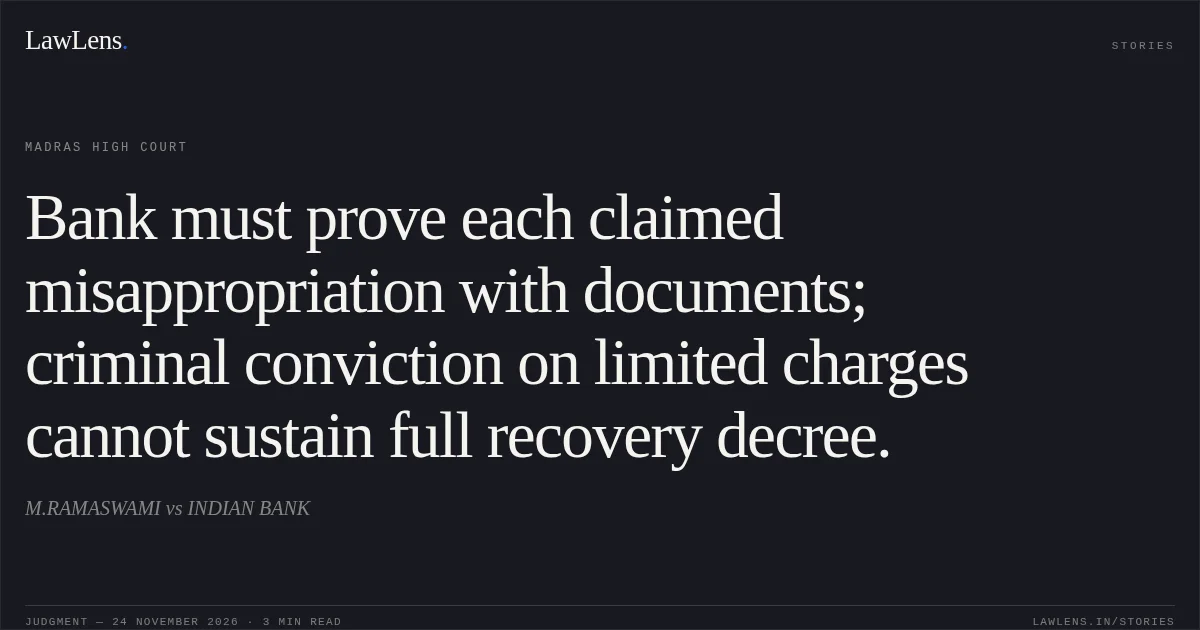
The plaintiff bank sued its former Manager (first defendant) and a second defendant for recovery of Rs.17,97,702 allegedly misappropriated across 33 transactions (1992–1996), plus interest of Rs.9,80,799 and further interest at 10.5% p.a.
p. 2The first defendant was suspended on 11.12.1996, and charges were framed on 30.07.1998. The suit was filed on 03.12.1999.
p. 2 · p. 7The defendants denied liability, alleged victimisation for trade union activity, and contended that only three charge-sheets had been filed in the CBI cases (C.C. Nos. 66, 67 and 68 of 2001) and that no documents supported the 33 heads of claim.
p. 3The trial court framed nine issues, including whether the first defendant misappropriated funds and whether the sum of Rs.27,75,500 was recoverable.
pp. 3–4The plaintiff examined a power of attorney holder (PW-1) and marked Exs. P1–P10. The first defendant testified as DW-1.
p. 4The Single Judge decreed Rs.27,75,500 with 10.5% interest from the date of suit against both defendants.
p. 5The appellants contended that the suit was time-barred, that misappropriation was not proved, and that the departmental charges covered only Rs.5,32,010.
p. 5The respondent relied on the departmental and criminal findings, stating that originals were with the CBI and only certified copies were available.
p. 5The first defendant had been convicted in the criminal case under Sections 477A and 420 IPC and Section 13(2) r/w 13(1)(d) of the Prevention of Corruption Act, 1988, for three specific charges.
p. 602Issues
i.1. Whether the suit is barred by limitation.
pp. 5–6 · ¶ 6(i)ii.2. Whether all 33 heads of alleged misappropriation were proved so as to justify recovery.
p. 6 · ¶ 6(ii)iii.3. To what other relief the plaintiff is entitled.
p. 6 · ¶ 6(iii)03Law Applied
The Court relied on the Original Side Appeal framework under Order XXXVI Rule 1 of the Original Side Rules read with Clause 15 of the Letters Patent.
p. 1The plaintiff's burden to prove each claimed item by admissible evidence was treated as controlling; a criminal court judgment alone was held insufficient to fasten liability for the entire claim, and the plaintiff could have filed certified copies or summoned records from the criminal court.
pp. 7–8 · ¶ 8The limitation principle applied was that time runs from the date the misappropriation was first known to the plaintiff, which, on the facts, was 11.12.1996.
p. 6 · ¶ 7The criminal provisions (IPC ss. 477A, 420; PC Act s. 13(2) r/w s. 13(1)(d)) were referred to only as the basis of conviction on three charges.
p. 6 · ¶ 7No specific statutory provision governing limitation or evidence was cited.
Provisions in the judgment · 2 · Linked ones open on LawLens
Indian Penal Code, 1860 Section 420
Prevention of Corruption Act, 1988 Section 13
04Reasoning
The Court held the suit within limitation, as it was filed on 03.12.1999, within three years of the bank's knowledge on 11.12.1996.
pp. 6–7 · ¶ 7–8On the merits, it found that the departmental charges (Ex. P1) covered only Rs.5,32,010 across three heads, and the criminal proceedings addressed three charges totalling about Rs.5,44,750.
pp. 6–7 · ¶ 7The Court rejected the respondent's explanation that original documents were seized by the CBI, holding that this did not excuse non-production, since certified copies or summoned records could have been filed.
p. 8 · ¶ 8Consequently, the Single Judge's decree for the entire claim was unsustainable because no evidence supported the 33 heads.
pp. 8–9 · ¶ 8–9The respondent conceded that Ex. P1 was the only available document for recovery, and the Court therefore confined relief to the amount proved under Ex. P1.
p. 9 · ¶ 10–11The second defendant's liability was set aside for want of any material against him.
p. 9 · ¶ 1205Holding
(i) The suit is not time-barred. (ii) The plaintiff did not prove the 33 heads of misappropriation.
p. 8 · ¶ 8 · p. 8 · ¶ 9The decree for Rs.27,75,500 is set aside. The suit is partly decreed for Rs.5,32,010 with interest at 5% from 30.07.1998 until realisation. The bank must credit Rs.2,18,532 already deposited (the appellants' submission refers to Rs.2,18,536; this discrepancy is noted), and the first defendant must deposit the balance, including interest, within one month. The decree against the second defendant is set aside. The appeal is partly allowed without costs.
p. 8 · ¶ 10 · p. 9 · ¶ 11–12Original Court PDF
M.RAMASWAMIvsINDIAN BANK
Click to open original judgment
Original judgment, available to read, download and summarize on LawLens.in