01Facts
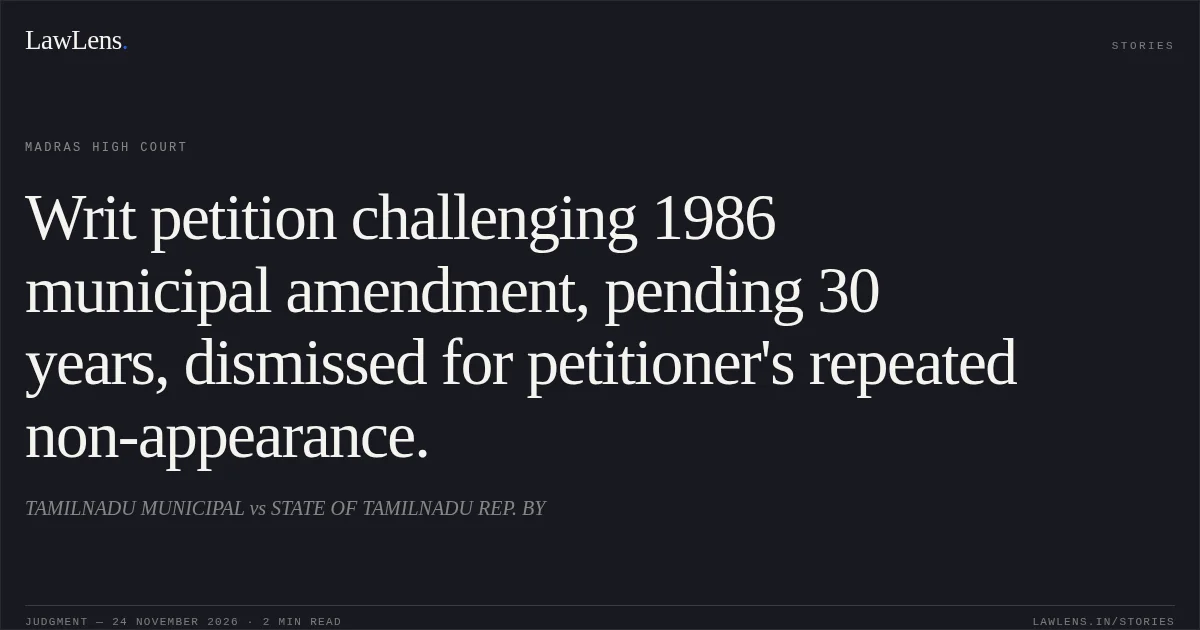
The petitioner, a teachers' association, filed a writ petition under Article 226 of the Constitution seeking a declaration that the Tamil Nadu Municipal Laws (Second Amendment) Act, 1986 (Act No. 65 of 1986) is ultra vires the Constitution, illegal, void and unenforceable.
pp. 6–7, captionThe challenge was first filed as W.P. No. 12704 of 1988. It was transferred to the Tamil Nadu State Administrative Tribunal on its establishment and numbered T.A. No. 81 of 1992. On the Tribunal's abolition, it was re-transferred to the High Court and renumbered W.P. No. 19940 of 2007.
p. 7, para 4The petition had been pending for more than 30 years.
p. 7, para 2On several earlier listings, the petitioner did not appear. The matter was therefore listed "for dismissal".
p. 7, para 3On the date of the order, no one appeared for the petitioner. The State was represented by Mr. K. Rajesh, Government Advocate.
p. 702Issues
i.1. Whether a writ petition pending for over three decades, in which the petitioner has repeatedly failed to appear despite multiple listings, may be dismissed for non-prosecution without adjudicating the constitutional validity of the impugned amendment Act.
pp. 7, paras 2–3 · p. 8, para 503Law Applied
The writ jurisdiction is invoked under Article 226 of the Constitution of India, which empowers the High Court to issue writs for enforcement of rights and for relief against unlawful state action.
pp. 6–7, captionThe order identifies no specific statutory provision, procedural rule, or precedent as the basis for dismissal.
The order proceeds on the court's inherent power to dismiss a petition for non-prosecution where the petitioner is absent on repeated listings.
p. 7, para 3 · p. 8, para 5The order takes into account the procedural history of transfers between the High Court and the Tribunal under the statutory scheme for the Tribunal's abolition.
p. 7, para 4 · no citation for the statutory provision04Reasoning
The court first traced the procedural history. The writ, initially filed in 1988, passed through the Tribunal and was returned to the High Court upon the Tribunal's abolition, so the matter had remained undecided for decades.
p. 7, para 4The court then noted that the matter had been listed on several occasions, and that the petitioner was unrepresented on each occasion.
p. 7, para 3 · p. 8, para 5Because the petitioner was absent even on the final listing, the court treated the petition as one not being pursued. It dismissed the writ on that ground rather than examining the constitutional challenge to Act No. 65 of 1986.
p. 8, para 5The order records no findings on the merits of the vires challenge.
p. 8, para 505Holding
The Court dismissed W.P. No. 19940 of 2007 for non-prosecution, given the petitioner's continued non-appearance over repeated listings and the long pendency of the matter.
p. 8, para 5The order records no findings on the constitutional validity of the Tamil Nadu Municipal Laws (Second Amendment) Act, 1986, and no costs were awarded. The dismissal is therefore best read as a dismissal for default, not an adjudication on the merits. Copies were directed to the State Commissioner and Secretary to Government, Education Department, and to the Director of School Education.
pp. 8–9, "To" list · p. 8, para 5Original Court PDF
TAMILNADU MUNICIPALvsSTATE OF TAMILNADU REP. BY
Click to open original judgment
Original judgment, available to read, download and summarize on LawLens.in