01Facts
The petitioners (plaintiffs) sued their sisters, the respondents (defendants), for partition and separate possession
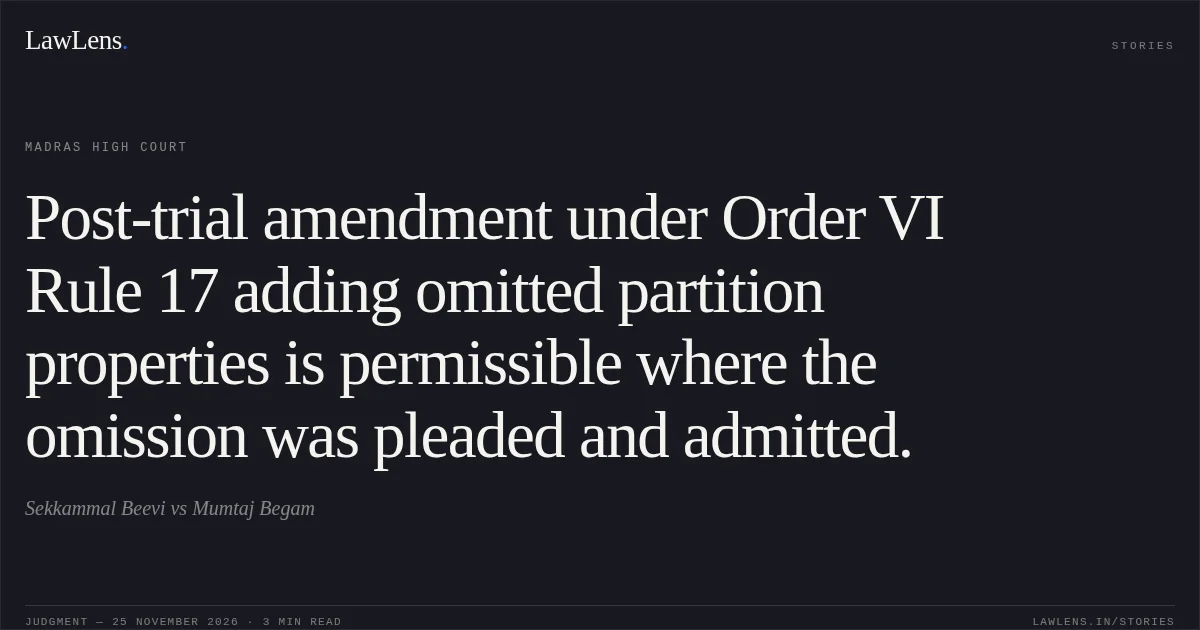
¶ 2The defendants filed a written statement, and trial commenced. D.W.1 was examined. When the matter was posted for the defendants' further evidence, the defendants filed I.A. No. 3 of 2025 under Order VI Rule 17 CPC to amend the pleadings and add properties omitted from the plaint
¶ 2The omitted properties belonged to their father, Mathar Mydeen, and comprised: (a) property under a settlement deed dated 05.09.1958 executed by Beer Mydeen in favour of the father; (b) property purchased under a sale deed dated 18.11.1987 from Shankara Muthaliyar; and (c) properties under Patta Nos. 233 and 552–553
¶ 6The defendants had raised the non-inclusion of these properties in their written statement
¶ 7, 12The petitioners filed no reply to the written statement
¶ 12In cross-examination, the petitioners admitted that certain properties had been omitted
¶ 8, 12The petitioners contended the properties had already been partitioned among the heirs and are in their possession, but pleaded no such fact in the plaint
¶ 9The trial court allowed the amendment by order dated 15.07.2026
¶ 202Issues
i.1. Whether the trial court erred in allowing an amendment under Order VI Rule 17 CPC after commencement of trial without the applicants establishing due diligence under the proviso
¶ 3, 7ii.2. Whether the omitted properties are necessary for the effective and complete adjudication of the partition suit, such that their inclusion should be permitted
¶ 13–14iii.3. Whether the petitioners' plea that the properties were already partitioned and are in enjoyment of the heirs can defeat the amendment at this stage
¶ 9, 1103Law Applied
Order VI Rule 17 CPC, whose proviso bars amendments after commencement of trial unless the party shows due diligence; the petitioners invoked this proviso
¶ 3, 7Pandit Malhari Mahale v. Monika Pandit Mahale (2020) 11 SCC 549, which in turn quotes Vidyabai v. Padmalatha, holding that the court must first decide whether the amendment is necessary to resolve the real dispute, and that the proviso is a jurisdictional embargo on the court's power to allow late amendments
¶ 4, 10In a suit for partition all properties available for division must be brought within the proceedings so that shares can be effectively determined and multiplicity of suits avoided
¶ 13Whether properties are available for partition or were previously partitioned is a question of evidence for trial
¶ 9, 1304Reasoning
The Court accepted that the petitioners had raised the due diligence objection, and noted the defendants had raised the omission in their written statement and that the petitioners offered no satisfactory explanation for the delay
¶ 7, 12The Court did not make an express finding on due diligence under the proviso. Instead, it reasoned from the pleadings and the record: the omission was specifically pleaded in the written statement, the petitioners did not answer it, and the petitioners themselves admitted the omission in cross-examination
¶ 12, 14On that basis, the Court held that inclusion of the omitted properties was necessary for proper adjudication of shares in a partition suit, and it treated the petitioners' partition defence as a disputed question of fact to be tried on evidence
¶ 9, 11, 13The Court treated the necessity-for-adjudication test as the controlling consideration
¶ 14The reasoning rests on the trial court's findings and the record rather than an explicit application of the Vidyabai jurisdictional test, which is a point of vulnerability for the decision
¶ 10, 1405Holding
The trial court's allowance of the amendment, given the specific plea in the written statement and the subsequent admission in cross-examination, was not perverse or illegal and did not warrant interference
¶ 14–15The Civil Revision Petition under Article 227 is dismissed without costs, and the connected C.M.P. is closed
¶ 16The omitted properties stand added to the suit schedule, and the petitioners' contention of prior partition remains open for determination on evidence at trial
¶ 9, 11, 16Original Court PDF
Sekkammal BeevivsMumtaj Begam
Click to open original judgment
Original judgment, available to read, download and summarize on LawLens.in