01Facts
The first respondent (plaintiff) sued respondents 2 to 4 in O.S. No. 41 of 2011 (later O.S. No. 75 of 2014, District Munsif Court, Madurai) for a permanent injunction restraining eviction except by due process of law.
¶ 2The petitioner, a third party, had purchased the suit property along with the building before the suit was instituted.
¶ 2The plaintiff's claim that a building existed on the property at institution was rejected in C.R.P.(MD) No. 777 of 2012.
¶ 2The plaintiff earlier filed I.A. No. 445 of 2014 under Order I Rule 10(2) CPC to implead the petitioner as 5th defendant. The trial court dismissed it on 08/01/2015, holding that the petitioner was not a pendente lite purchaser and that the plaint contained no specific allegations against him.
¶ 3, 10This Court upheld that order in C.R.P.(MD) No. 815 of 2015 (dated 07/10/2020).
¶ 3, 10While dismissing that application, the trial court observed that impleadment was premature and that the plaintiff could seek it later if necessary.
¶ 12The plaintiff later sought amendment of the plaint, but no specific relief was sought against the petitioner. The only allegations were that he violated the injunction, evicted the plaintiff without due process, and was not a bona fide purchaser.
¶ 11The plaintiff then filed I.A. No. 7 of 2021, which the trial court allowed on 22/09/2025, treating the petitioner as a necessary party because he bought from the erstwhile owners and the plaintiff was a tenant.
¶ 2, 8, 12The petitioner challenged that order under Article 227.
¶ 1, 302Issues
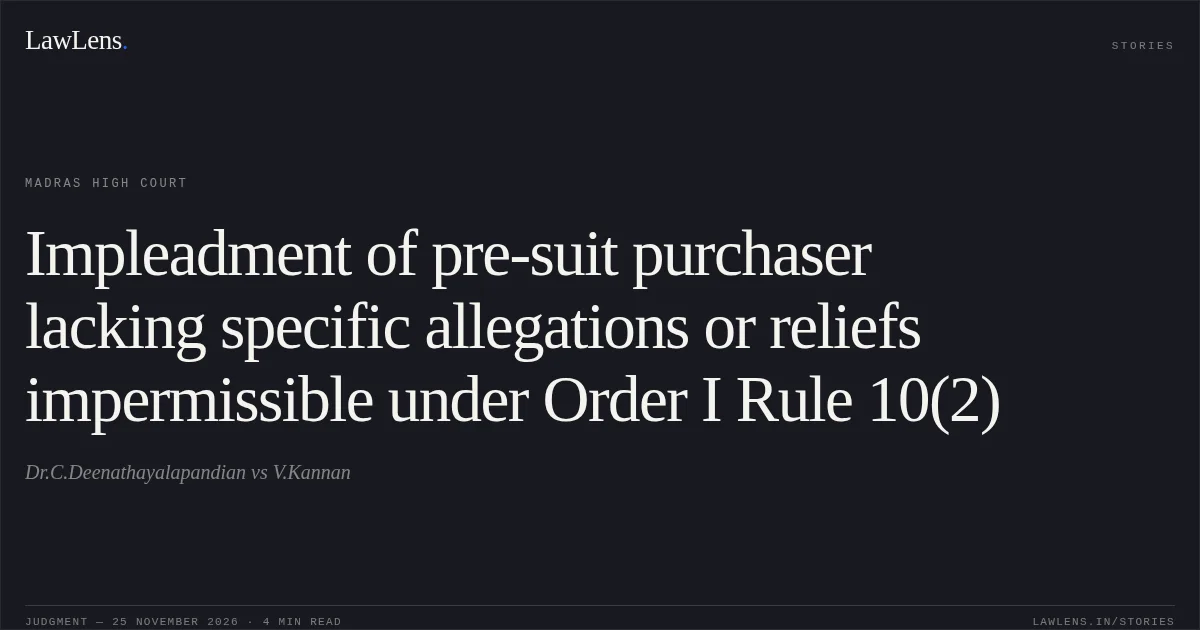
i.1. Whether the petitioner, who purchased the suit property before the suit was instituted and against whom no specific allegation or relief is pleaded, is a necessary or proper party under Order I Rule 10(2) CPC, such that the impleadment order is sustainable.
¶ 13–15ii.2. Whether the dismissal of the earlier impleadment application (I.A. No. 445 of 2014), as affirmed by this Court, and the trial court's liberty-reserving observation, bar or affect the subsequent application for the same relief.
¶ 10–1203Law Applied
Order I Rule 10(2) CPC permits the addition of a necessary or proper party.
¶ 4Under Kasturi v. Iyyamperumal (2005) 6 SCC 733, as quoted by the petitioner, a necessary party is one in whose absence no effective decree can be passed, or against whom there must be a right to some relief in respect of the controversy. A proper party is one whose presence is necessary to adjudicate all questions effectually, though no relief is claimed against them. Collateral disputes between parties and third parties cannot be imported into the suit, and a person must be directly and legally affected by the answers to the controversy.
¶ 4 (quoting Kasturi · ¶ 6, 7, 13, 16, 17)The petitioner relied on S. Ramachandra Rao v. S. Nagabhushana Rao (2024) 17 SCC 361, holding that res judicata applies at subsequent stages of the same proceedings and that binding interlocutory orders cannot be disregarded.
¶ 5 (quoting paras 29–33)Tuticorin Nazareth Diocese v. Palraj (2013) 1 TNCJ 474 (Mad) holds that a party cannot be added as a defendant merely to bind it without evidence of a claim against it.
¶ 6 (quoting paras 3(i), 7)Provisions in the judgment · 1 · Linked ones open on LawLens
Code of Civil Procedure, 1908 Section 151
04Reasoning
The plaint contained no specific allegation against the petitioner. The plaintiff's grievances concerned the other defendants, who allegedly demolished the building.
¶ 13Had the petitioner evicted the plaintiff, demolished the building, or assisted in eviction, those facts would have to be pleaded.
¶ 14The petitioner had purchased before the suit, and no relief was sought against him, even after amendment.
¶ 11, 13, 14The plaintiff also failed to show how the petitioner's presence was necessary for effective adjudication.
¶ 14The trial court's reasoning, based on the purchase from the erstwhile owners, notice to the tenant, and avoidance of multiplicity, did not address these defects.
¶ 8, 15On the second issue, the court noted the earlier dismissal and the liberty reserved in it. The trial court's observation that impleadment could be sought later did not dispense with the statutory test under Order I Rule 10(2). The court therefore examined the new application on the merits of the necessary-party test and found it wanting.
¶ 10, 12, 14, 15The judgment does not expressly decide the res judicata question raised by the petitioner.
05Holding
The petitioner is neither a necessary nor a proper party, as no specific allegation or relief is directed against him, he purchased before institution of the suit, and the plaintiff has not shown that his presence is needed for effective adjudication.
¶ 13–15The trial court's order dated 22/09/2025 in I.A. No. 7 of 2021 in O.S. No. 75 of 2014 was unsustainable. The Civil Revision Petition is allowed, the impugned order is set aside, and CMP(MD) No. 1569 of 2026 is closed. No costs.
¶ 15, 16Original Court PDF
Dr.C.DeenathayalapandianvsV.Kannan
Click to open original judgment
Original judgment, available to read, download and summarize on LawLens.in