01Facts
The plaintiff (Jagarunnissa) sued for a permanent injunction, claiming ownership of the suit property under a sale deed dated 07.11.1975 (Ex. A1), possession, and patta in her name, and alleging that defendants 1–3 (instigated by defendants 5–6) interfered with her possession and attempted to fence the land.
¶ 3 · p. 3Defendants 1, 2 and 4 contended that the survey property (Sy. No. 70/7, 5.84 acres) belonged to them and their father, that 2.12 acres were leased to Boorasamy Padayachi in 1951, and that 0.12 acres were sold to his son Raguraman by sale deed dated 18.01.2001; they asserted the plaintiff was never in possession.
¶ 4 · pp. 3–4The trial court framed three issues on possession, entitlement to injunction, and other reliefs.
¶ 6 · p. 5Plaintiff examined PW-1 and PW-2 and marked Exs. A1–A15; defendants examined DW-1 and DW-2 and marked Exs. B1–B2.
¶ 6 · p. 5The trial court partly decreed the suit (injunction granted except as to 10 cents).
¶ 6 · p. 5On the plaintiff's appeal (A.S. No. 55 of 2004), the First Appellate Court decreed the suit in its entirety.
¶ 7–8 · pp. 5–6Defendants 1, 2 and 4 filed this second appeal.
¶ 8 · p. 602Issues
i.1. Whether the non-consideration of Ex. A15 (TNEB notice), relied upon by the trial court, vitiates the judgment of the First Appellate Court.
¶ 8 · p. 6 · ¶ 14 · pp. 12–1303Law Applied
The Court's jurisdiction was confined to the substantial question of law framed at admission, under Section 100 CPC, which is referred to only in the prayer.
p. 2 · ¶ 8 · p. 6In a suit for permanent injunction, the Court must determine who is in possession of the property, and the plaintiff's title and possession must be established by sufficient documents.
¶ 14 · pp. 12–13A party asserting a prior lease or title, and constructive possession through a tenant, bears the burden of proving it with evidence.
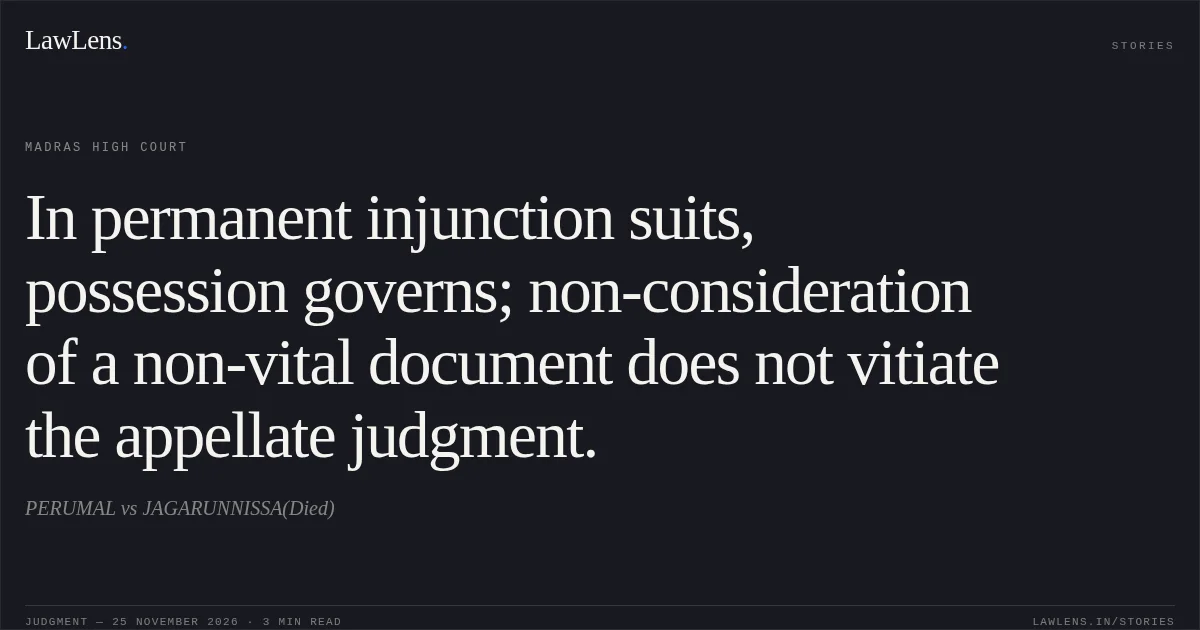
¶ 12.1 · pp. 10–11A document that is not vital to the decision does not vitiate the appellate judgment if it is not considered.
¶ 14 · p. 13The judgment cites no precedents.
Provisions in the judgment · 1 · Linked ones open on LawLens
Code of Civil Procedure, 1908 Section 100
04Reasoning
The Court held that the plaintiff proved title and possession through Ex. A1 (sale deed), Ex. A5 (UDR patta), kist receipts (Ex. A2 series), the 1955 parental deed (Ex. A10), and the evidence of PW-2, an adjacent owner.
¶ 12.1 · p. 10Defendants failed to prove their claimed ownership and 1951 lease: no proper evidence was produced, Raguraman was neither a party nor a witness, and the claimed leasing was inconsistent with Ex. B2, a 1953 sale by Perumal Padayachi to Janakiammal, under which nothing was retained within the same boundaries.
¶ 12.1–13 · pp. 10–12Because the property had already been sold, the defendants could not claim it, and the lease theory was regarded as an afterthought.
¶ 13 · pp. 11–12The Court also noted a discrepancy between Ex. A5 (SF 70/7B3) and Ex. B1 (SF 70/7B1, 70/7B2).
¶ 13 · pp. 11–12The Court did not separately analyse the trial court's exclusion of 10 cents, but it held that the defendants had no right in the property, so the constructive possession argument failed.
¶ 13 · p. 12On the substantial question, the Court reasoned that in an injunction suit the controlling question is possession, which the plaintiff had proved independently; Ex. A15, a notice to the Junior Engineer, was therefore not vital, and its non-consideration did not vitiate the First Appellate Court's judgment.
¶ 14 · pp. 12–1305Holding
The substantial question of law is answered against the appellants: non-consideration of Ex. A15 does not vitiate the First Appellate Court's judgment, as Ex. A15 was not vital to determining possession.
¶ 14 · pp. 12–13The Second Appeal is dismissed as lacking merit, with the connected miscellaneous petition closed and no costs.
p. 13The First Appellate Court's decree granting a permanent injunction over the entire suit property is thereby sustained.
¶ 13–14 · pp. 12–13Original Court PDF
PERUMALvsJAGARUNNISSA(Died)
Click to open original judgment
Original judgment, available to read, download and summarize on LawLens.in